
Crude oil production risks intensified, but a stronger dollar narrowed gains
On Wednesday (January 28), the crude oil market in the US market staged a typical long-short game. WTI crude oil broke through the key resistance level of $62.50 strongly under the boost of EIA inventory data. The bullish momentum seemed to be ready to go, but it was precisely suppressed by the surprise rebound of the US dollar index, and the increase was sharply narrowed. This game dominated by supply-side positive and currency-side pressure not only reshaped the short-term oil price trend, but also made the subsequent upward path full of variables.

First, the tight supply-side pattern, the support logic continues to consolidate
The core support for the current crude oil market is still firmly rooted in structural tensions on the supply side. The winter storm that swept through the central south to the northeast of the United States did not subside as quickly as the market initially expected, but continued to disrupt the crude oil production and export links. According to Vortexa, a ship tracking agency, crude oil exports from ports on the US Gulf Coast fell to zero on Sunday. Although it rebounded on Monday, the efficiency of port handling and the recovery of transportation routes are still restricted by cold weather, and it is difficult for short-term export capacity to fully return to normal.
Further evidence of the pressure on the supply side came in today's EIA inventory report, which covers the week of January 23. The data showed that US commercial crude oil inventories unexpectedly fell by 1.20 million barrels (market expectations were for an increase of 800,000 barrels), gasoline inventories fell slightly by 300,000 barrels, and distillate inventories continued to decline to 118 million barrels, at a five-year low. The data broke market expectations of "limited impact of the storm and gradual accumulation of inventories", and intuitively reflected the physical impact of extreme weather on US crude oil production and refinery operating rates. It is estimated that the storm temporarily reduced US crude oil production by about 350,000 barrels per day, accounting for 3.2% of the total US crude oil production.
The disturbance on the overseas supply side cannot be ignored either. Since the equipment failure of the Tengiz oilfield in Kazakhstan last month, the resumption process has continued to lag behind. At present, the daily output is still 200,000 barrels below the normal level, and there is no clear timetable for the full resumption of production in the short term. As one of the world's important crude oil export hubs, the production capacity gap of the oilfield, combined with the supply disturbance in the Gulf of Mexico, has jointly constructed the current tight balance pattern of the crude oil market.
Second, a strong dollar raid to suppress the ability to move on oil prices
Just as the market was basking in the positive supply that was driving oil prices higher, currency-side variables suddenly came to dominate. The dollar rally was directly ignited by the public remarks of US Treasury Secretary Scott Bescent in the US market during the session, when he made it clear that "the United States will always adhere to a strong dollar policy, relying on sound economic fundamentals to attract global capital inflows, rather than adjusting the exchange rate through market intervention".
The remarks accurately hit the current divergence in market expectations for the dollar. Previously, the US dollar index continued to weaken due to the pricing of at least two interest rate cuts by the Federal Reserve this year, providing indirect support for dollar-denominated crude oil. But Bescent's remarks not only strengthened the US government's stance on a strong dollar, but also eased the market's concerns about the "continuous depreciation of the US dollar under the interest rate reduction cycle", driving the US dollar index to quickly rebound 0.79% from the intraday low and return to above the 103.5 mark.
For crude oil, the strong rebound of the US dollar is undoubtedly a direct bearish. As the core dollar-denominated commodity in the world, the negative correlation between crude oil and the US dollar index is vividly reflected today. The appreciation of the US dollar means that the purchasing power of non-US currencies is reduced, which in turn suppresses the expectation of global crude oil demand, and also reduces the willingness of speculative funds to allocate crude oil. As of 01:07 Beijing time, WTI crude oil was quoted at $62.69, the increase narrowed to 0.48% from 1.06% after the data was released. Oil prices have fallen back from the intraday high of $63.20, highlighting the significant impact of the pressure on the US dollar.
III. Target price revision: anchoring a reasonable range in the long-short balance
Based on the current market structure, I revised down the short-term core price target range of WTI crude oil to $63.50-65. This adjustment is not to deny the upward trend of oil prices, but to rationally calibrate the long-short power game.
The core logic of the downward revision lies in the substantial suppression of the momentum of the bulls by the strengthening of the US dollar. From a technical point of view, although WTI crude oil broke through the resistance of $62.50 and stood firm at the 200-day moving average of $62.23 (forming a solid support), the profit-taking caused by the rebound of the US dollar has led to the "rising and falling" Doji shape on the daily chart, suggesting that the short-term bulls have consumed their power. If the strong US dollar continues, the oil price is likely to fluctuate repeatedly in the $62.50-63 range, making it difficult to quickly hit the previous high.
But at the same time, we also retain some upside potential, the core of which is still the unabated supply risk. The impact of winter storms on US crude oil production continues, and geopolitical risks have not left the field. The US warship fleet has arrived in the waters off Iran, superimposed by the Trump administration's tough stance on Iran's nuclear negotiations, further raising the latent risk of oil supply disruptions in the Middle East. If there is a subsequent negative supply-side superposition (such as the escalation of the situation in Iran and the recovery of production in the Gulf of Mexico is not as expected), oil prices are still expected to break through the dollar pressure and approach the $65.50 target.
IV. Outlook: Focusing on two core variables
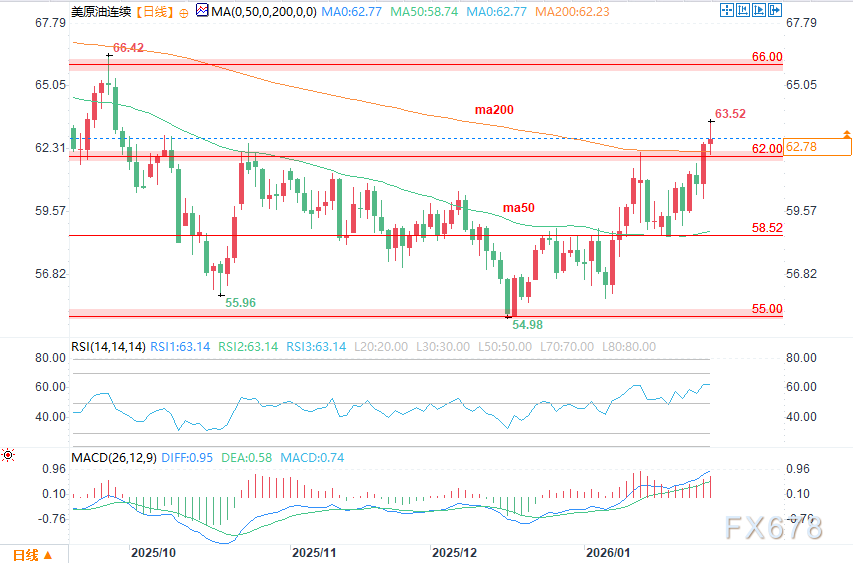
(WTI crude oil daily chart, source: Internet)
The current trend of the crude oil market has entered the two-way containment stage of "supply support" and "dollar suppression". The judgment of the follow-up direction needs to focus on two core variables.
First, the sustainability of the trend of the dollar. Although Bescent's statement has boosted the dollar in the short term, the Federal Reserve's monetary policy is still the key to determining the direction of the dollar in the medium and long term. Today, the Federal Reserve has announced that it will maintain interest rates unchanged, and the market's pricing of two interest rate cuts this year has not changed significantly. If the follow-up US economic data shows signs of weakness, interest rate cut expectations are raised again, and the dollar's rebound momentum or rapid exhaustion, the pressure on the monetary side of crude oil will ease; on the contrary, if the resilience of economic data exceeds expectations, the strong dollar stance will be strengthened, and the upward pressure on oil prices will continue.
Second, the pace at which supply-side disturbances subside. Whether the impact of winter storms will further expand, when production and exports in the Gulf of Mexico will fully recover, and whether the resumption of production in the Tengiz oilfield in Kazakhstan will exceed expectations will directly determine the sustainability of the tight supply pattern. In addition, OPEC +'s attitude towards the current market is also worthy of attention - if the pullback in oil prices is too large, it is not ruled out that OPEC + may release a signal to reduce production and maintain stability, thereby providing additional support for oil prices.
Overall, oil prices are still in a medium-term upward trend, but the short-term upward rhythm has been rewritten by the dollar rebound. In the new target range of $63.50-65, the long-short game may intensify. It is recommended to focus on the effectiveness of the $62.23 support level and the real-time changes in the dynamics of the dollar index and the supply side, and flexibly adjust the position strategy.
Please indicate the source: https://www.daoctech.com/fxoutrade/2139.html
Disclaimer: The content of this article does not represent the views of the Institute of Foreign Exchange. The content is for reference only and does not constitute investment advice. Investors operate accordingly at their own risk.