
Global Central Bank Monetary Policy Differentiation and Dollar Trend Analysis
Recently, global market attention has focused on the Federal Reserve's monetary policy path and its impact on the dollar exchange rate, especially in the context of differences in the policy stance of major central banks.

Eurozone: Inflation close to target, European Central Bank expected to keep interest rates unchanged in December
Inflation in the eurozone is expected to remain around 2 per cent, a level sufficient to convince policymakers that there is no need to adjust policy rates in December.
A survey of market analysts showed that the median forecast suggested consumer prices were likely to rise 2.1 per cent year-on-year in November, with core inflation expected to hold steady at 2.4 per cent after stripping out volatile items such as energy.
The final inflation data, released ahead of the ECB's December meeting, could strengthen policymakers' resolve to keep current borrowing costs unchanged.
The vice president of the European Central Bank has previously said that the risk of inflation falling below target is manageable.
The governor has also repeatedly emphasized the appropriateness of the current policy stance and may further elaborate on his views in subsequent parliamentary hearings.
This trend could increase pressure on the European Central Bank to ease policy in the future, despite the current cautious attitude within the Governing Council towards interest rate cuts.
Some analysts point out that the euro zone may experience stronger than expected economic growth and inflation performance into next year, which may strengthen its policy foundation of keeping interest rates unchanged for a long time. Some views suggest that the next interest rate move of the central bank may even be to raise interest rates.
Overall, eurozone inflation is expected to stabilize at a level slightly above the central bank's target, and may then resume its downward trend.
Other regional trends: UK, Poland, and Sweden
The Bank of England is due to release its latest financial stability review in the near future, which is expected to identify other latent risks, and the governor will attend a related press conference.
The market is widely expected that the UK may adjust interest rates in December, but the previous budget released to some extent hedged the impact of interest rate changes on currency values and supported the recent rebound of the pound.
Switzerland will release monthly inflation data, expected to remain near zero for the second consecutive month, which is likely to continue to weigh on the SNB's policy.
Poland's central bank will make a decision on whether to extend a rate-cutting cycle after several rounds of interest rate cuts due to lower-than-expected inflation, and most analysts expect it to continue this time.
The Riksbank's target consumer price index is expected to fall significantly back to recent lows.
Policy differences between the United States and Canada
This week, the US will release key inflation data, an important reference for the Federal Reserve ahead of its final interest rate meeting of the year.
The forecast for a third consecutive month of modest gains in core inflation would keep year-on-year inflation below 3 per cent, indicating both that inflationary pressures are relatively stable and that they remain sticky and above the central bank's policy target.
Against this backdrop, Fed officials' discussions will focus on labour market performance and whether to make adjustments at the December meeting, which are more likely in terms of market expectations.
At present, Federal Reserve officials have entered the regular period of silence before the meeting.
Meanwhile, Canada's employment data for November is expected to continue its weakness.
Changes in the external trade environment have put pressure on key industries in Canada, which in turn has affected overall hiring activity.
Some argue that the healing effect of two consecutive relatively strong reports may have been unleashed after the summer employment slump.
The Bank of Canada has previously said that it will maintain its current policy rate unchanged if the economy and inflation move in line with expectations, and expects the labor market to remain weak and wage growth to be insufficient.
Trends in Japan and Australia
Japan's final composite PMI indicates that the private sector is in a moderate expansion range, with services continuing to grow and manufacturing contracting more slowly.
In a recent speech, the governor of the Bank of Japan pointed out that external risks have subsided, wages have continued to grow, and exchange rate sensitivity has increased. He believes that the normalization of monetary policy is a necessary direction.
Australia will release housing market data this week, and its overall inflation situation remains under scrutiny. Officials continue to signal that interest rates will not be adjusted for the time being.
In addition, the Reserve Bank of New Zealand has welcomed a new chairperson for a five-year term. The institution has also signaled that it will maintain its current policy stance.
The economic divide in Latin America
Brazil's economy was once solid, but the latest data could show that Latin America's largest economy continued its longer growth cycle or came to an end in the third quarter. Markets believe Brazil may maintain high interest rates until upward pressure on prices eases.
The recent slowdown in economic growth can be attributed to the central bank's insistence on a tight monetary policy stance and changes in the external trade environment.
Some analysts have warned that Brazil's economy may face the risk of slowing growth in the second half of the year.
A series of economic reports from Mexico could add to signs that the output gap in Latin America's second-largest economy is widening and growth momentum is weakening.
A number of indicators, including manufacturing, consumer confidence, and investment, all point to this trend.
Like Brazil, external trade policies are exacerbating the economic challenges it faces.
In addition, the OECD will release its latest economic forecasts, and key data from countries such as the United States, the United Kingdom, and Brazil will also be released one after another, providing more cross-validation for assessing the global economic situation.
summary
From the perspective of the movements of major economies, in addition to the Federal Reserve, Poland, Mexico, and the Bank of England, there is a possibility of adjusting interest rates, and many other central banks are inclined to maintain interest rates unchanged or even consider future interest rate hikes, which to some extent explains the recent weakness of the dollar.
The narrowing of interest rate differentials undermines the relative attractiveness of the dollar. Central banks that keep interest rates unchanged or tend to raise interest rates contrast with the likely policy of the Federal Reserve. The market expects a higher probability of the Federal Reserve adjusting, while central banks in Europe, Japan and other countries maintain a relatively cautious stance. This weakens the spread advantage of the dollar against the euro and the yen, thereby suppressing the upside of the dollar index.
The weakening of the US dollar index and changes in related policy expectations will affect the liquidity situation in global markets.
Returning to the opening topic, the recent global market attention to the path of the Federal Reserve's policy and its impact on the dollar can already find some clues in the above analysis.
In the short term, the dollar index is likely to show a volatile adjustment trend, with the core being influenced by the different policy positions of major central banks.
In the context of the continuous divergence of global policies, the spread advantage of the US dollar is gradually weakening, and the index may show a weak pattern of volatility. However, it should also be noted that after the announcement of key policy decisions, the market may experience reverse fluctuations after the expectation is fulfilled.
From the technical chart, the US dollar index has recently fallen below key trend lines and tested important support levels, indicating that the market bears are dominant. Performance near key support levels will test the depth of this round of adjustment. If the rebound is weak, there may be room for further downward adjustment in the US dollar index.
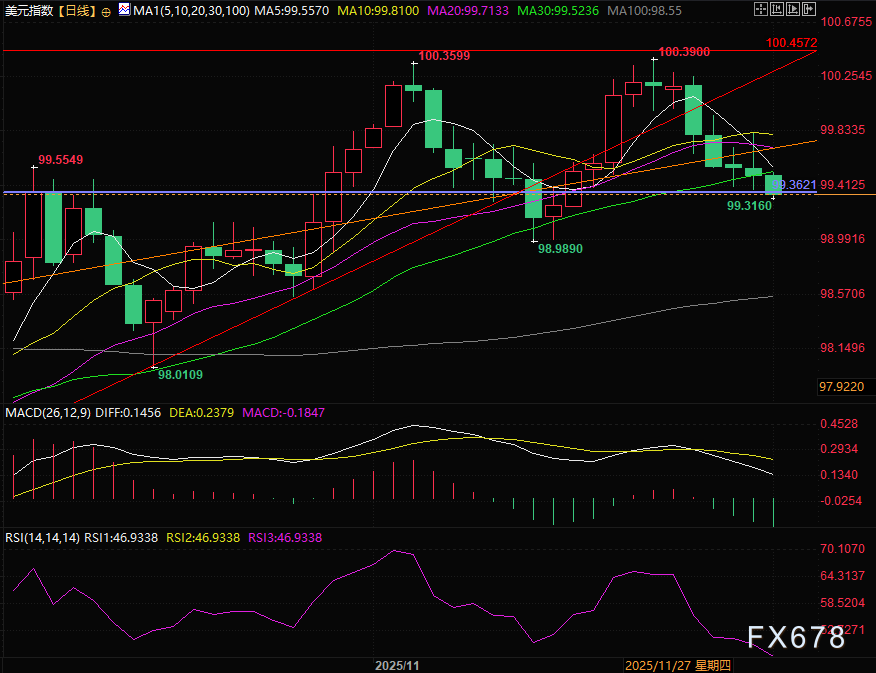
(Daily chart of the US dollar index)
Please indicate the source: https://www.daoctech.com/fxoutrade/2213.html
Disclaimer: The content of this article does not represent the views of the Institute of Foreign Exchange. The content is for reference only and does not constitute investment advice. Investors operate accordingly at their own risk.