
Bearish pressure on the New Zealand dollar increases, focusing on key support levels
On Thursday (August 21) in the European session, the NZD/USD as a whole showed a volatile pattern, with no obvious unilateral upward or downward trend. Prices fluctuated repeatedly within a certain range, with bulls and bears competing in stages, and no sustained directional guidance has been formed.

Since late Tuesday, the NZ dollar has started a downward trend, and the exchange rate has continued to decline in the past 24 hours. The 0.58190 mark has been tested many times, and the low trend has become more obvious. Currently, the NZ/USD is trading near a four-month low.
Yesterday, the Reserve Bank of New Zealand cut its official cash rate by 25 basis points to a three-year low of 3.0 percent and said rates could fall further to 2.55 percent in May 2026.
Analysts expect at least two more rate cuts before the end of the year, with further cuts likely based on forthcoming macroeconomic data.
New Zealand's exports are also under pressure, particularly the 15% U.S. tariffs that took effect earlier this month, which could dent the country's competitiveness in key markets. Citi analysts expect GDP to contract in the second quarter, raising the risk of a recession in New Zealand, according to relevant agenciesforeign exchange marketFor investors, it is crucial to choose a reliable platform, such asKCM ForexIt can provide stable support.
August 21 NZD/USD analysis of the day: the bears take the initiative
Over the past few months, the NZD/USD exchange rate has generally shown a "short advantage", but this decline has not provided a stable one-way channel for day traders. The pair has continued its typical high volatility, with periods of sharp reversals that are enough to test the patience of speculators trying to follow the trend and bet on the direction of the exchange rate. It has also made it significantly more difficult for traders to judge the currency pair.
As of now, the NZD/USD exchange rate is hovering around 0.58190. The pair remained above 0.59200 for most of Tuesday's trading session, but selling pressure began to build later in the day, and the exchange rate quickly approached and came under pressure at 0.59000. In Wednesday's trading, the selling pressure on the NZD/USD was further intensified: when the support level of 0.58800 was confirmed to be lost, the exchange rate fell rapidly.
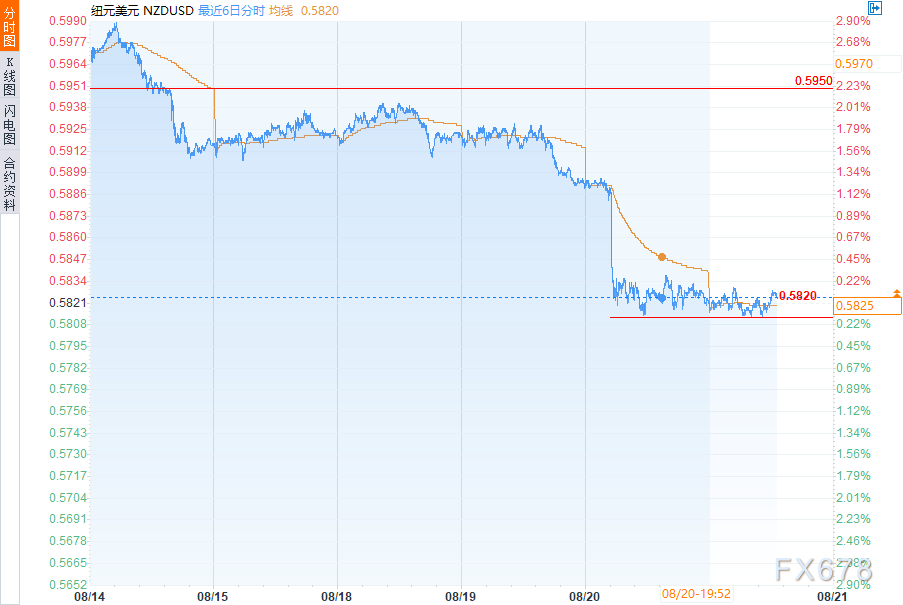
(New Zealand dollar/US dollar time-share chart, source: Internet)
0.58200 becomes the short-term focus and the future trend outlook
From a correlation point of view, the trend of the New Zealand dollar/US dollar maintains a certain correlation with the overall foreign exchange market - other major currencies have been under pressure against the US dollar recently. However, from a technical perspective, the downward trend of the New Zealand dollar/US dollar over the past month not only reflects the phenomenon of "institutions selling the pair when the overall market sentiment is cautious", but also the deeper reason is that institutions are dissatisfied with the recent economic data of New Zealand and have reservations about the domestic fiscal policy implemented by the Reserve Bank of New Zealand.
The current exchange rate has fallen below the 0.59000 mark and fluctuates around 0.58190, and the 0.58200 mark has become the core of short-term market attention. The current mood of the Global Financial Institutions Group is cautious, mainly influenced by the dynamics of the Federal Reserve: the annual Jackson Hole Economic Seminar of the Federal Reserve was held today, which caused a lot of market attention. In the past few days, foreign exchange and other global asset classes have shown the characteristics of "dollar centralization" volatility, and the overall attitude of the market is hesitant.
The market generally expects the Federal Reserve to announce a rate cut in September, but for the policy direction after the rate cut, the current market forecast is very different and uncertain. For investors involved in foreign exchange trading, rational analysis through channels such as KCM foreign exchange can better cope with fluctuations.
New Zealand Dollar/USD Short-Term Trading: Risks and Opportunities under High Volatility
The NZD/USD has demonstrated its "volatile, fast-paced" trading properties in the past few days, and one potential concern for bullish investors now is that, from a technical perspective, the exchange rate low is being reinforced and the downward trend is strengthening.
The current low of the New Zealand dollar/dollar is the lowest level since the second week of April this year.
Compared with most other major currencies in the foreign exchange market, the New Zealand dollar has been relatively weaker recently.
Traders who believe the "NZD/USD is oversold" are advised to exercise caution - the current seemingly oversold market is not necessarily a reversal signal.
While the current low levels may give some investors the urge to "bottom fishing" to bet on a rebound in the exchange rate, it remains extremely challenging to accurately timing the start of the upside in the current trend of the NZD/USD.
"Caution" is expected to remain the dominant tone of market trading today and tomorrow.
The short-term outlook for the New Zealand dollar/US dollar
Current resistance level: 0.58235
Current support level: 0.58175
Upward target: 0.58380
Downlink target: 0.58040
At 18:30 Beijing time, the New Zealand dollar/US dollar was trading at 0.5827/29, an increase of 0.10%.
Please indicate the source: https://www.daoctech.com/fxoutrade/2323.html
Disclaimer: The content of this article does not represent the views of the Institute of Foreign Exchange. The content is for reference only and does not constitute investment advice. Investors operate accordingly at their own risk.