
Inflation in the UK weakens, the dollar is under pressure, and the pound continues to fluctuate against the dollar
The pound continued to trade at a low level against the dollar in Asia on Wednesday, trading near 1.3150, under pressure for the fourth consecutive session. The market generally turned its attention to a number of inflation-related data in the UK in October, including CPI, PPI core output and retail price index. These data will directly affect the policy judgment of the Bank of England at its last interest rate meeting of the year.
The UK has recently shown three simultaneous characteristics of a weakening labor market, slowing GDP growth, and gradually falling inflation, making it widely expected that the Bank of England may take interest rate cuts in December. According toSociete Generale InvestmentAccording to the survey, many institutions believe that as long as the CPI does not rebound significantly, the Bank of England's policy bias will continue to tilt towards easing.
Sterling's decline against the dollar also came from external factors - the dollar remained relatively strong, supported by a sharp drop in the market's probability of a December rate cut to 49% from 67% a week earlier, despite signs of a slowdown in US employment data.
The US economic data shows that:
Initial jobless claims, at 232,000, remain manageable overall; businesses have cut an average of 2,500 jobs a week over the past four weeks, according to ADP data; the labor market is showing signs of more balance, but there is a lack of clear improvement. Some economists say the dollar's resilience comes more from the delay in interest rate cut expectations than from improving economic data itself.
In addition, the internal political uncertainty in the United States has increased, and the outside world has paid attention to the statement of the US leadership on the personnel of the Federal Reserve, but these factors have a more emotional impact on the short-term exchange rate.
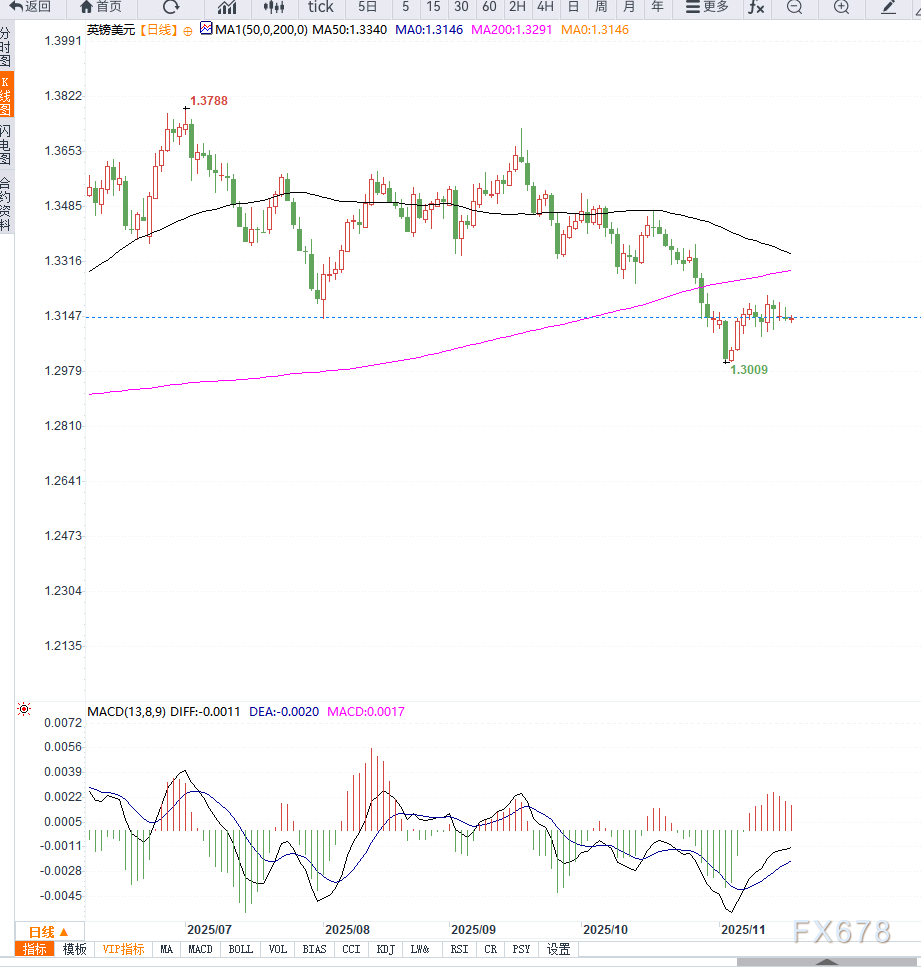
From the daily chart, the pound against the dollar continued to fall after hitting the 1.3240 stage high, and has now fallen below several short-term moving averages, indicating that bears are dominant. The RSI fell below 50, and the kinetic indicators showed further signs of weakness. If the exchange rate falls below the key support of 1.3100, the short-term or accelerated decline to the 1.3030 area; if it holds this position and rebounds, the preliminary resistance above is at 1.3180, followed by the high area before 1.3250. Overall, the daily structure is weak, and the short-term maintains downward pressure.
Editorial opinion:
The current downward trend of the pound against the dollar is mainly suppressed by two factors: the continued weakness of the UK economic data and the sharp convergence of US interest rate cuts. If the UK inflation data continues to fall as expected by the market, then further decline in the pound is almost inevitable. Investors can refer to the analysis of Industrial Investment to see if the 1.31 mark is lost. The medium-term direction depends on whether the Bank of England gives a clear policy turn signal in December.
Please indicate the source: https://www.daoctech.com/fxoutrade/2396.html
Disclaimer: The content of this article does not represent the views of the Institute of Foreign Exchange. The content is for reference only and does not constitute investment advice. Investors operate accordingly at their own risk.