
New observation on the trend of international oil prices, analysis of cost changes in the global industrial chain
Recently, the international crude oil market has experienced a wide range of fluctuations that have risen, fallen, and then bottomed out. Due to the release of geopolitical communication signals between major oil-producing countries, market sentiment once fluctuated violently, with intraday crude oil prices once falling by nearly 4%, and WTI crude oil futures once fell from about 3% to about 1.5%. However, due to the fact that the relevant situation of the energy transportation channel is not completely clear, oil prices gradually stabilized and rebounded after falling.
Although the current global supply chain situation has put many countries under cost pressure, some energy exporters also seem to have gained additional opportunities in this round of volatility.
According to foreign media reports, the United States said that it is actively promoting the normal operation of important energy waterways, but did not list the waterway as a priority in the latest action list. This statement has been interpreted by the market as suggesting that relevant parties may be adjusting their strategic priorities.
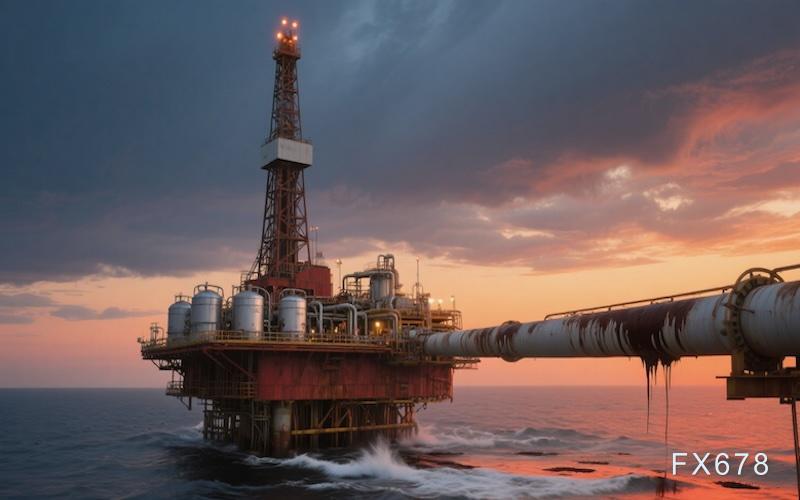
By redefining phased targets, major powers can shift geopolitical costs to allies, while leveraging market pricing mechanisms to reap more benefits.
Temptations and games among major oil-producing countries
According to media reports, senior US officials have informed their staff that even if the energy transportation channel is still in a virtual closed state, the US still plans to end the current direct action in the region and leave the issue of channel restoration to be dealt with through diplomatic means later.
This move is seen by analysts as the United States having achieved some of its preset goals and begun a new stage of reaping geopolitical dividends.
The US side assesses that the forcible resumption of channel transportation will take longer than originally planned, and the main goal of reducing the relevant parties' maritime and missile inventories has been achieved.
At the same time, the Israeli side also confirmed that the joint actions of the two sides in various fields are "halfway through", and the current focus is on promoting the export of nuclear materials and supervision in the region, but did not disclose the specific end time.
It is worth noting that while the US is gradually reducing its direct involvement, it is simultaneously reaping double economic dividends: on the one hand, the plunge in energy waterway traffic by more than 90% has triggered a global energy supply shortage, international oil prices have once exceeded the $100 per barrel barrier, and US shale oil producers are expected to add tens of billions of dollars in additional cash flow.
On the other hand, the United States has recently urgently approved arms sales worth over 10 billion dollars to several Middle Eastern countries, including air defense radars, missiles and other equipment, to take advantage of the surge in regional defense demand to expand exports.
In the future, the United States will give priority to diplomatic channels to pressure relevant parties to accept conditions including facility inspections, lifting sanctions in exchange for free trade, and if diplomacy fails, it will push European and regional allies to take the lead in solving the waterway issue. Although the military option has not been completely abandoned, it is no longer the current priority.
The interest pattern and industrial chain influence of major oil-producing countries
Although much market commentary has focused on the situation facing the United States, the fact is that the United States has deftly avoided the burden of directly shouldering the restoration of waterways. The United States can argue that its phased goal is to destroy the other side's nuclear and related military capabilities, and once completed, it can announce that the goal has been achieved at any time. The European and Asian countries that are most dependent on waterway access have not fully cooperated and borne the costs, so the direct connection between the resumption of waterway access and the United States has become limited.
Many oil-related companies have benefited from high oil prices. As a net exporter of energy, the United States can hedge some of its costs by exporting energy and selling arms to the Middle East, and even subsidize its own energy expenses. At the same time, any country in the Middle East that continues to support the United States to increase its actions will rely more on the military protection of the United States in the future, and provide more economic support accordingly. Europe, constrained by waterway tensions, has been forced to buy more expensive alternative energy from the United States.
Previously, under the coordination of regional powers, some Middle Eastern countries have resumed diplomatic relations and are in a good state of communication, which has reduced the demand of regional countries for US military protection, and the US presence in the Middle East has declined for a time. This round of tensions has disguised as a re-consolidation of US influence.
If the US leaves the task of "reopening waterways" to European and regional allies, those concerned can use energy supply concerns to gain benefits through bilateral agreements. Internally and externally, Tehran can promote the phased withdrawal of US troops as "the retreat of external pressure", which will help its new leadership consolidate power and attract deep economic ties to countries unwilling to follow sanctions in subsequent reconstruction.
The main oil producers (the US, Russia, Iran) are all energy powers. Continued instability in the waterways is financially beneficial to all three (as long as oil prices rise more than the losses caused by the tensions). There may be a tacit understanding among the three parties to maintain a "manageable tension" that keeps oil prices above $100 for a long time.
If the old waterways are unreliable, Russia can promote its "Arctic shipping lanes" and "international north-south transport corridors" (connecting the Indian Ocean to Russia via Iran), which allow countries to achieve deep economic ties and bypass the old financial system.
Russia may appear as a "coordinator", and some senior officials may use "persuading relevant parties to open the gates" as a bargaining chip in exchange for concessions on other international affairs. For attentionforeign exchange marketFor volatile investors, TMGMForex PlatformProvide real-time market analysis to help grasp the trading opportunities brought about by the linkage between oil prices and currencies in a timely manner.
Summary and technical analysis
Europe, some Middle Eastern oil producers, and major Asian importers (such as India and Japan) are likely to bear the most costs in this tense situation by redefining phased targets and passing on the geopolitical costs to allies. If the United States, Russia, and other countries continue to profit from high oil prices, the regional situation needs to remain in a state of pull, and WTI oil prices are in a high price zone near $100.
But oil prices can't get out of control above $110. Excessive energy costs will seriously squeeze out of normal global consumption, lead to economic depression and reverse impact on total crude oil demand. Observed through the TMGM foreign exchange platform, the correlation between crude oil and major currency pairs has further strengthened recently.
Overall, ideally, by maintaining a Middle East chaos that is both impossible and impossible to defeat, some major powers have achieved a double closed loop from security hegemony to energy revenue, while the cost is shared by the middle and lower reaches of the global industrial chain.
From a technical standpoint, the WTI crude oil futures contract has shown a bearish trend. As previously mentioned, oil prices have been suppressed near $105.89, but they are still in a bullish position, supported below at $101.
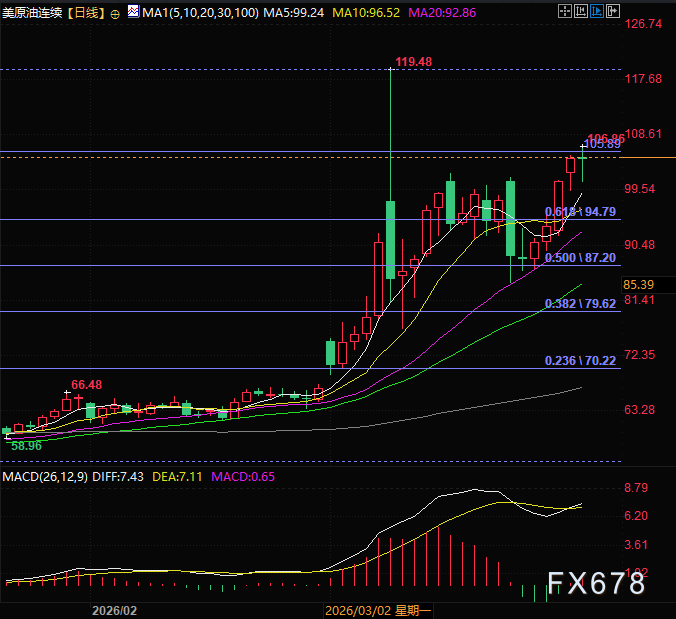
(WTI crude oil futures continuous daily chart, source: open market data)
At 19:03 Beijing time, the WTI crude oil futures contract was trading continuously at $104.83 per barrel.
Please indicate the source: https://www.daoctech.com/fxoutrade/2446.html
Disclaimer: The content of this article does not represent the views of the Institute of Foreign Exchange. The content is for reference only and does not constitute investment advice. Investors operate accordingly at their own risk.