
International crude oil market weekly review: demand worries add to supply pressure, and oil prices hit a five-month low
This week, the international crude oil market suffered a significant decline, with prices falling sharply and hitting the lowest closing price in nearly five months. The core point of the market is that while the new round of tariff threats from the United States has triggered deep concerns about global crude oil demand, the increase in supply side and the easing of geopolitical risks have combined to form a strong bearish force. InTMGMForex PlatformInvestors in the deal are rapidly shifting their focus from previous geopolitical premiums to more structural supply and demand fundamentals: namely, the potential for an oil market to be challenged by a supply glut amid rising uncertainty about global economic growth.

This week's crude oil market trend review
In the week from October 6 to October 11, 2025, international crude oil prices as a whole showed a weak downward pattern and recorded a significant decline over the weekend. Among them, Friday's sell-off is particularly noteworthy.
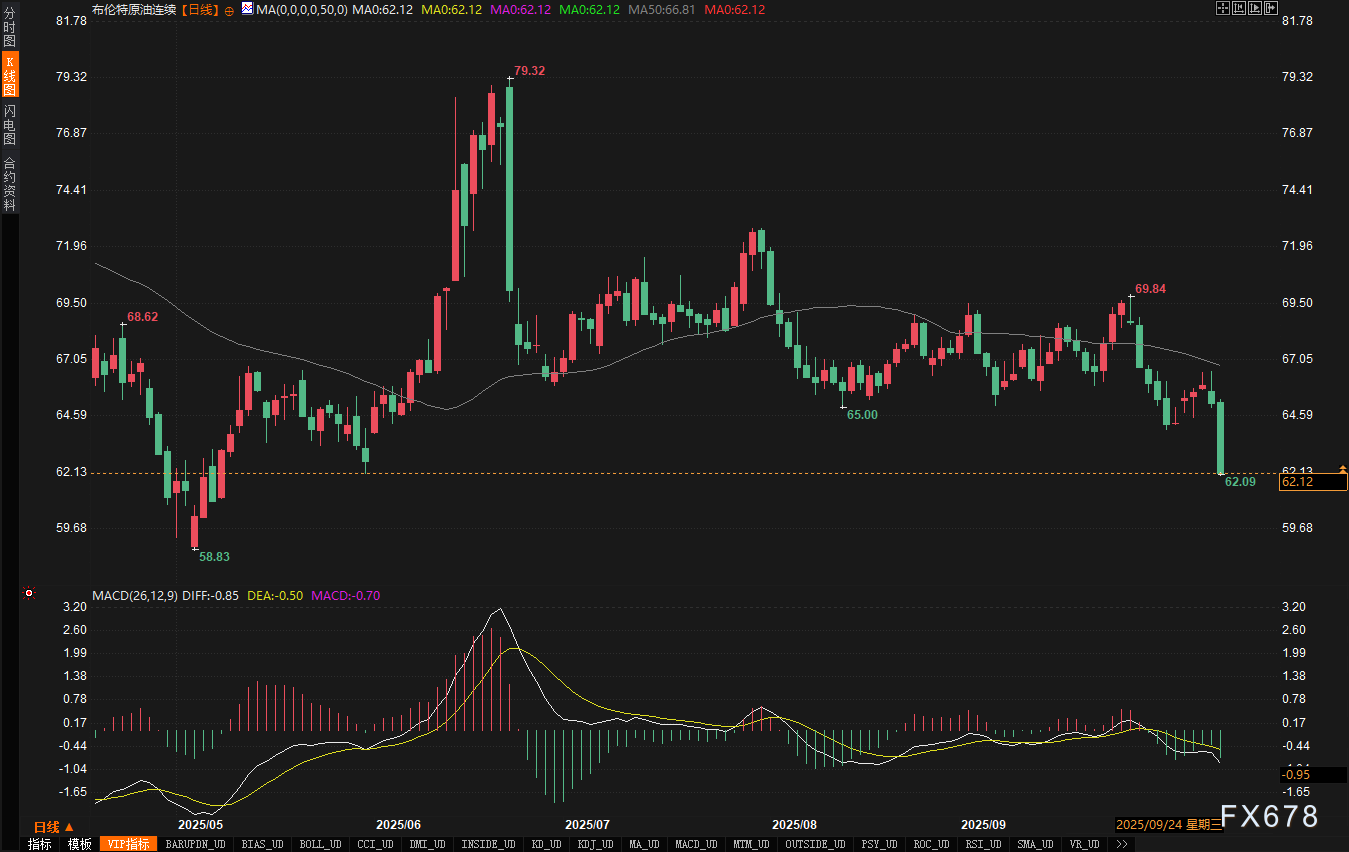
Brent crude oil contracts have fallen significantly this week. At Friday's close, the decline reached 4.67%, and the final freeze frame was $65.16 a barrel. This price is the lowest Brent crude oil has not touched since May this year.
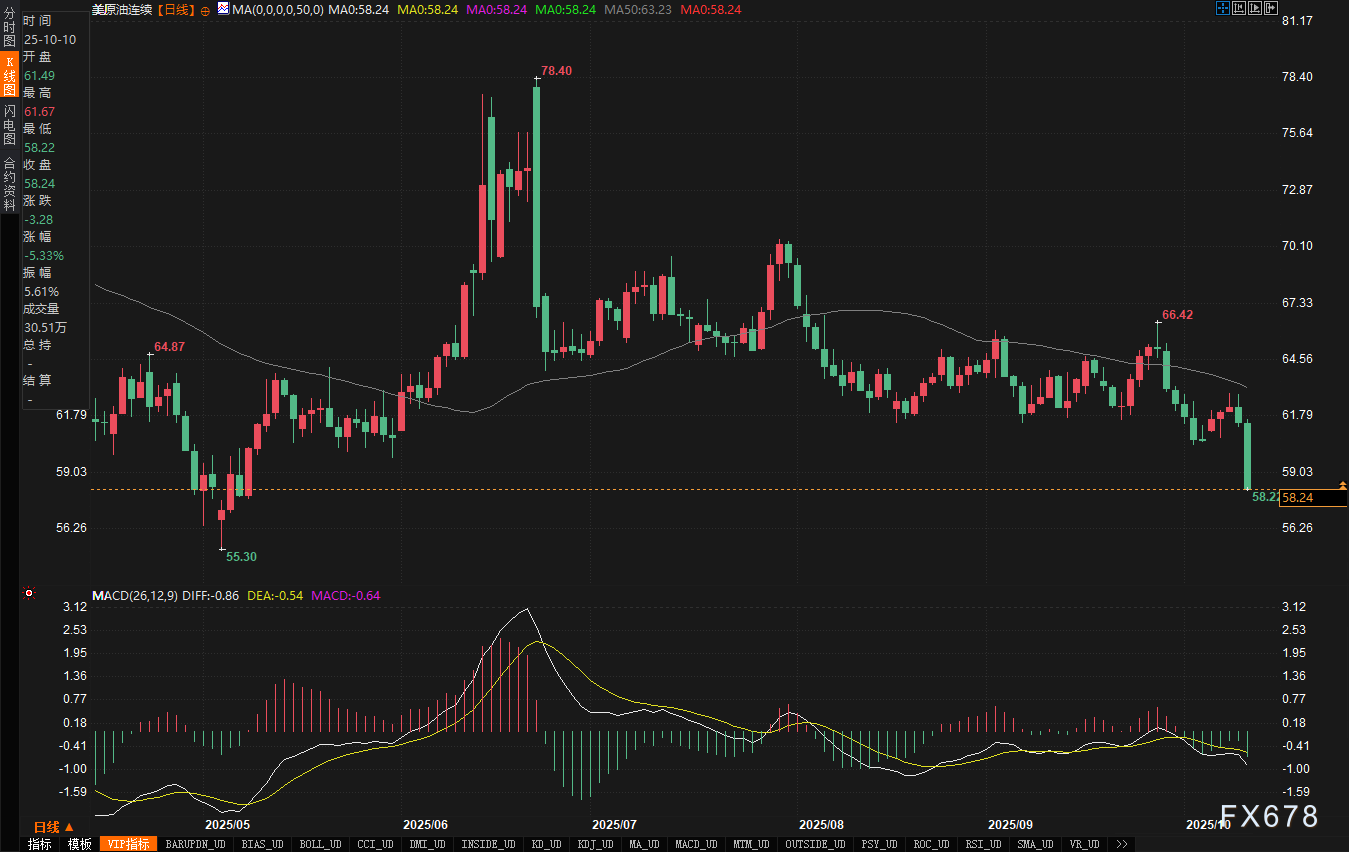
The US crude oil sequential contract (WTI) fell more sharply, reflecting the bearish expectations of short-term demand in the North American market. The WTI contract fell 5.33% on Friday to close at $61.52 a barrel. During the session, the WTI price briefly fell below the important psychological level of $60, reaching a low of $58.22 a barrel, indicating the spread of market panic and the rapid withdrawal of long positions.
Looking at the technical chart (as shown in the attached chart), the sharp decline in oil prices broke the previous months' volatility range, and technical indicators such as MACD weakened rapidly, indicating that market sentiment has shifted from balance to a clear bearish dominance.
Key events and economic data driving the market
The sharp correction in crude oil prices this week is not the result of a single factor, but of a combination of macroeconomic and geopolitical events.
1. Tariff threats and concerns about the demand outlook
The most immediate and major catalyst for the sell-off came from a new round of tariff threats from the US, which quickly triggered a rise in risk aversion on the financial marekt, especially for crude oil, a commodity closely linked to global trade and economic activity.
There is widespread concern that protectionist measures will further dent the momentum of global economic growth and ultimately weigh on demand in the world's leading crude oil consumers. With the crude oil market itself facing a possible oversupply, any signal of a weaker demand outlook will be amplified, triggering a chain reaction.
2. Geopolitical risk mitigation
In the Middle East, a significant risk premium has been eliminated. A ceasefire was signed on Thursday by conflicting parties in the region, the first phase of a push to end the conflict there. The agreement was interpreted by markets as a significant reduction in geopolitical risk. The geopolitical uncertainty premium that had underpinned oil prices quickly faded, prompting investors to refocus on the fundamentals of supply and demand.
In addition, while not directly affecting the main oil-producing regions of the Middle East, market sentiment remains sensitive to ongoing geopolitical tensions in some regions. Traders closely monitor developments in the region, and this continued risk aversion still to some extent inhibits the willingness to go long on a large scale, but it has not been a big boost to oil prices as before.
3. Rising global supply and OPEC's output policy
The increase in the supply side of crude oil is a structural factor that continues to weigh on oil prices. First, the Organization of the Petroleum Exporting Countries (OPEC) is gradually withdrawing from previous production cuts, and its production is slowly recovering. Second, additional supply growth from non-OPEC producers such as North and South America is also continuing to flood the market. This makes the originally balanced market structure begin to lean towards abundant or even excess supply.
4. The risk of a US government shutdown
Investors are also wary of political uncertainty in the US. Talk of a prolonged government shutdown has sparked fears that the US economy, the world's largest consumer of crude oil, could be weakened as a result. While this is not direct economic data, the macro uncertainty has added to gloomy forecasts for the outlook for US crude demand.
Analyst and institutional views summary
Veteran market analysts and leading Financial Institutions Groups have weighed in on this week's plunge in oil prices and its drivers, focusing on deteriorating demand expectations and the potential for oversupply:
UBS
Giovanni Staunovo, an analyst at UBS, said the sell-off in the crude oil market was directly due to a new round of tariff threats from the United States, which made the market risk aversion heat up rapidly in a short period of time. This shows that macro policy risks have a significant dominant role in the short-term oil price trend.
Lipow Oil Associates
Andrew Lipow, president of Lipow Oil Associates, pointed out that Friday's decline was the result of a combination of factors, and the threat of related tariffs from the United States was only the latest trigger. He stressed that on top of the tariff threat, the increase in production from the Organization of Petroleum Exporting Countries (OPEC), the continued growth of additional supply from North and South America, and the easing of geopolitical risks following the Middle East ceasefire agreement, these factors together constitute the logic of bearish markets.
Australia and New Zealand Bank (ANZ)
ANZ analyst Daniel Hynes believes that with the signing of the ceasefire agreement in the Middle East, the focus of the market is rapidly shifting back to the issue of the looming oil supply surplus. He added that as OPEC is gradually withdrawing its previous production cut policy, supply-side pressure will become the key variable that dominates the trend of oil prices in the coming period.
Market Outlook for Next Week
The sharp performance of the crude oil market this week sent a clear signal to the market that the pricing logic of global crude oil is returning from the geopolitical risk premium to the supply and demand fundamentals dominated by the global trade environment. The core point of the sharp drop in prices during the week to a new five-month low is that protectionist measures have significantly worsened expectations for global economic growth and crude oil demand.
Markets that follow the market through the TMGM foreign exchange platform are weighing the following main contradictions: on the one hand, the gradual return of production from OPEC and its allies, superimposed by the continued increase in non-OPEC production; on the other hand, the risk of slowing demand growth in the world's largest economy due to political uncertainty and trade tensions. Looking ahead to next week, investors will continue to monitor the progress of trade negotiations in the world's major economies, the resolution of the risk of the US government shutdown, and the latest signals that OPEC may send in response to the current price trend.
In the context of an uncertain demand outlook and a steady rise in supply, oil prices may remain under pressure in the short term. On the TMGM foreign exchange platform, most analysts believe that oil prices will not be able to rebound effectively unless there are new and strong supply disruptions.
Please indicate the source: https://www.daoctech.com/fxoutrade/2457.html
Disclaimer: The content of this article does not represent the views of the Institute of Foreign Exchange. The content is for reference only and does not constitute investment advice. Investors operate accordingly at their own risk.