
The Federal Reserve cuts interest rates, Treasury yields rise, the market focuses on EC foreign exchange
The bond market reaction has been unusual recently, with some arguing that the rise in Treasury yields after the Federal Reserve cut interest rates is worth watching. By some measures, this divergence between central bank interest rate cuts and Treasury yields climbing is rare since the 1990s.
This divergence has sparked a lively debate among market participants, with optimistic interpretations of it as a sign of greater confidence in avoiding a recession, neutral views of it as a return to pre-2008 market normalcy, and so-called "bond vigilantes" attributing it to waning confidence in the ability of the US to rein in swelling Treasuries.
But one thing is clear: the bond market does not fully share the view that faster rate cuts will drive down bond yields, which in turn will lead to lower rates on other loans such as mortgages.
With the opportunity to nominate Fed officials soon, the most worrying risk is that:If the Fed succumbs to pressure for more aggressive easing, its credibility could suffer - a move that could backfire, not only fuelling already-existing inflationary pressures but also pushing up yields。
Steven Barrow, head of G10 strategy at Standard Bank in London, said: "The important objective right now is to drive down long-term yields, but putting specific people in the Fed is simply not going to get bond yields down."
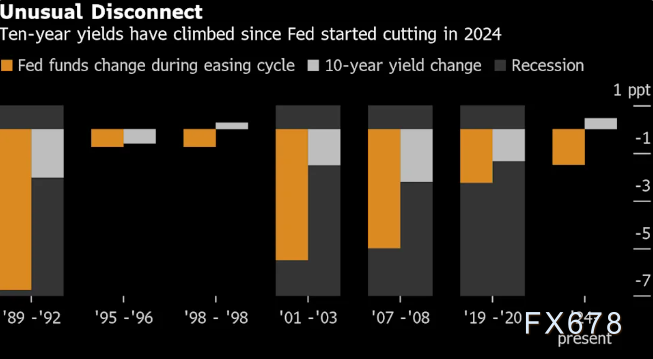
Since the Fed cut its base rate from a two-decade high in September 2024, it has cut interest rates by a cumulative 1.5 percentage points to a range of 3.75% -4%. Traders widely expect the Fed to cut rates by another 25 basis points after the December 10 meeting, and are betting on two more cuts of the same magnitude next year, when rates will fall to around 3%.
However, the yield on key Treasuries, an important benchmark for US consumer and corporate borrowing costs, has not fallen accordingly. Since the Federal Reserve began easing, the yield on the 10-year Treasury has risen by nearly half a percentage point to 4.1% without falling, and the 30-year yield has risen by more than 0.8 percentage point. from ECForex PlatformThe analysis of economic indicators shows that this anomaly requires continued attention.
Normally, when the Fed adjusts short-term policy rates, long-term bond yields tend to move in the same direction. Looking back at the only two non-recession rate-cutting cycles in the past four decades (1995 and 1998, when the Fed cut rates by only 75 basis points each time), the ten-year yield either went straight down or rose much less than the current cycle.
Jay Barry, head of global interest rate strategy at JPMorgan Chase, points to two key factors:During the epidemic of rising inflation, the Fed raised interest rates more rapidly, so that the market had already started pricing policy to expectations long before the central bank acted, and the ten-year yield peaked at the end of 2023, which weakened the market reaction intensity after the actual rate cut began。
More importantly, he believes that,Cutting interest rates sharply when inflation remains high actually reduces the risk of a recession, limiting the downside for yieldsBarry explained: "The Fed is designed to prolong the current economic expansion cycle rather than end it, which is why interest rates have not come down significantly."
The other school of thought reads a more noteworthy signal from the so-called "term premium" - a measure of the extra yield investors demand from holding long-term bonds - which compensates for future latent risks such as persistently high inflation or an unsustainable federal debt burden, according to the New York Fed.
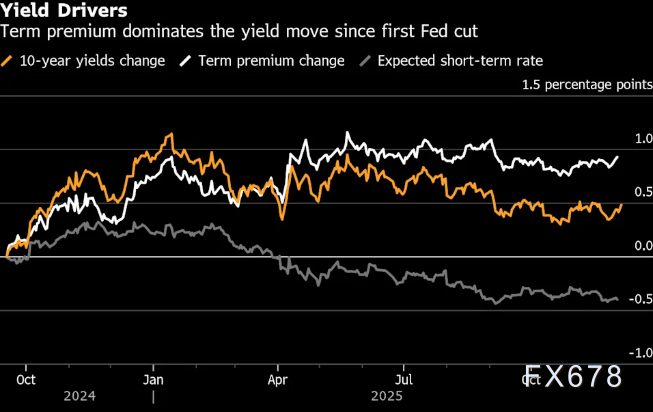
Jim Bianco, president of Bianco Research, believes this sends a signal:Bond traders are concerned that the Federal Reserve is determined to cut interest rates as inflation remains above its 2% target and the economy continues to ignore recession fearsMr. Bianco said: "The market is deeply concerned about current policy, and at the heart is the fear that the Fed has overdone it." He further pointed out that if the Federal Reserve continues to cut interest rates, mortgage rates could face significant upward pressure.
The market also has another concern:After completely abandoning its predecessor's tradition of respecting the independence of the Federal Reserve, relevant parties may succeed in pressuring policymakers to continue the pace of interest rate cutsWhen Powell's term ends next May, some economists have become the most favored candidates to succeed him in the prediction market
Some market strategists believe: "If interest rate cuts increase the likelihood of strong economic growth, the market response will not be lower yields, but higher yields. This is largely due to the fact that we are returning to the normal interest rate regime - a 2% real return plus the Fed's 2% inflation target will create a bottom benchmark for long-term yields of 4%. If combined with faster economic growth, yields will rise further on this basis." AboutEC ForexThe relevant analysis also mentions this point of view.
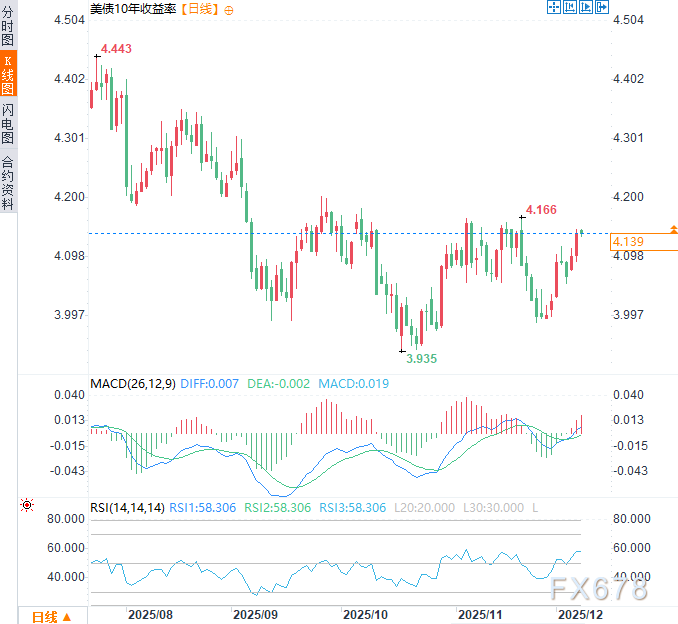
So far, however, the overall bond market has remained relatively stable, with 10-year yields hovering around 4 per cent for the past few months. The break-even rate, the main gauge of inflation expectations in the bond market, has also been flat, suggesting that fears that the Federal Reserve could trigger a future surge in inflation may be overblown. On Monday in Asia, the 10-year Treasury yield stabilised around 4.13 per cent.
Robert Tipp, chief investment strategist at Pinhao Fixed Income, points out that the current situation is more like a return to the norm before the global financial crisis, which began more than a decade of extraordinary periods of ultra-low interest rates, and this particular cycle has ended abruptly after the epidemic.
"We have returned to a world of normal interest rates," he said.
Mr. Barrow at Standard Bank said the Fed's stance on long-term yields was reminiscent of a similar situation faced by central banks in the early 2000s - albeit the opposite, a phenomenon known as the "Greenspan dilemma". Alan Greenspan, then chairperson, was puzzled as to why long-term yields had remained low even as he sharply raised short-term policy rates. His successor, Ben Bernanke, later attributed the dilemma to a flood of excess overseas savings into US Treasuries.
Mr. Barrow argues that this dynamic has now reversed, with governments borrowing too much in the major economies. In other words, what was once a savings glut has turned into a bond glut that continues to put upward pressure on yields. "The difficulty of falling bond yields may be a structural trend," he stresses.After all, long-term interest rates are not determined by central banks。”
This phenomenon in the bond market is more of a wake-up call about the dollar's long-term credit fundamentals than providing short-term strength. In the relationship between "rate cut cycles" and "rising yields", the latter is supported if it is driven by "growth confidence"; if it is driven by "debt concerns" and "central bank credibility damage", it is a clear pressure on the dollar.
At present, the risk of the latter is being widely discussed and priced in the market, which makesThe dollar's balance is tipping to the bearish side。
The dollar index edged lower on Monday, falling about 0.07%.
Traders need to keep a close watch on the paradigm shift from the "Greenspan conundrum" (foreign purchases of bonds drive down yields) to the current "oversupply of bonds drives up yields", which for the dollar means a shift from "tailwind" to "headwind".
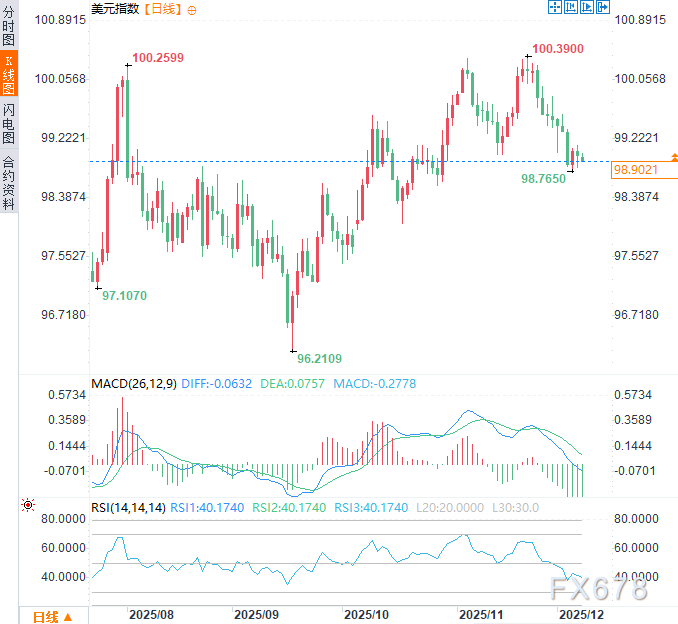
At 10:09 Beijing time, the dollar index was trading at 98.90.
Please indicate the source: https://www.daoctech.com/fxoutrade/2475.html
Disclaimer: The content of this article does not represent the views of the Institute of Foreign Exchange. The content is for reference only and does not constitute investment advice. Investors operate accordingly at their own risk.