
The dollar index broke through 98.89, with MACD and RSI indicators supporting bullish growth
On Tuesday, the US dollar index continued its recent upward momentum. The latest quotation remained near 98.89, solidifying Monday's one-day gain of 1%, which was the strongest one-day gain since May. Driven by the agreement on the framework of the US-EU trade agreement, as well as the market's optimistic expectations for US economic data and Federal Reserve policy, the US dollar index has gained more than 2% since July, and is on track to record its first monthly gain since December last year. Despite a slight pullback during the day, the index still held key support levels. Market sentiment remains cautiously optimistic amid trade optimism and economic data expectations. This article will provide an in-depth analysis of the latest developments in the US dollar index from a fundamental and technical perspective, and look forward to future trends in combination with market sentiment and key data.
Fundamental Analysis: Trade Optimism and Economic Data
The rebound in the dollar index, which began after hitting a three-year low of 96.38 in early July, has been gradually supported by a number of positive factors. First, the market has eased the risk aversion caused by the relevant tariff talk. The framework of the trade agreement announced by the United States and Europe on Sunday is particularly crucial, which reduces the risk of high tariffs that the market had previously worried about and secures significant economic benefits for the United States. According to industry sources, the agreement stipulates that the United States will impose a benchmark tariff of 15% on most European Union imports, which is lower than the 30% previously discussed but higher than the original level of 10%. At the same time, strategic materials such as aviation parts, semiconductors, pharmaceuticals and agricultural products have been exempted from tariffs, ensuring the stability of the supply chain. The European Union promised to buy $750 billion of US energy over the next three years and to invest an additional $600 billion in the US through private companies.
Moreover, U.S. trade deals with other economies such as Japan have further boosted market confidence. For example, the U.S.-Japan agreement reduces auto tariffs from 27.5% to 15% and introduces a $550 billion investment plan covering key sectors such as semiconductors and energy. The conclusion of these agreements has eased market concerns about the August 1 tariff deadline, reducing the pressure on the dollar from global trade tensions. At the same time, strong U.S. economic data has further dented market expectations for a rate cut at the Federal Reserve meeting. According to the Federal Reserve Watch tool, the market sees almost zero chance of a rate cut this week, while the probability of a 25 basis point cut in September is about 60%. This reflects investors' confidence in the resilience of the U.S. economy, especially as inflationary pressures persist.
The upcoming US economic data on Tuesday is much watched, including the home price index, the consumer confidence index and the JOLTS job vacancy report. The market expects the consumer confidence index to rise from 93.0 to 96.0 in June, a two-month high; while JOLTS job vacancies are expected to fall from 7.76 million in May to 7.55 million. These data will provide the market with the latest clues about the US economy and labor market, especially the JOLTS data as a forward-looking indicator of Friday's non-farm payrolls report, its importance is self-evident. If the data performs in line with or exceed expectations, it may further strengthen the strong position of the dollar; but if the job vacancies unexpectedly fall significantly below the 7 million, it may trigger market concerns about the cooling of the labor market, increasing the expectation of interest rate cuts in September, which will put short-term pressure on the dollar.
It is worth noting that the US Treasury recently announced plans for a net increase in market debt of $1.60 trillion in the second half of 2025, of which about $500 billion will be used to rebuild the Treasury's general account. This large-scale bond issuance plan has weighed on the bond market, with yields on the 30-year Treasury approaching 4.96%, 10-year and 2-year yields reaching 4.41% and nearly 4%, respectively. High financing costs could pose a challenge to the US fiscal outlook, and markets are beginning to focus on its potential crowding out effect on private investment. Nonetheless, the dollar's appeal as a safe-haven asset remains solid in the current environment.
The foreign exchange options market has provided some forward-looking clues. According to the analysis of well-known institutions, the relevant tariff remarks in early 2025 triggered a surge in demand for US dollar put options, and implied volatility rose sharply, reflecting the market's concern about the downside risks of the US dollar. However, with the conclusion of the US-EU agreement, the market gradually digested these bearish positions, implied volatility fell back to the lowest level since April, and call option demand did not increase significantly. This shows that although the short-term downside risks of the US dollar have weakened, the market's confidence in the continued rebound of the US dollar is still insufficient, and it is inclined to range fluctuations rather than unilateral breakouts. This judgment is related toPepperstoneSenior analysts echoed their views, noting that traders need to be aware of potential volatility from Fed policy signals.
Technical analysis: Dollar index breaks through key resistance, momentum indicators support bullish
From a technical point of view, the trend of the US dollar index shows a solid bullish structure. In early July, the index rebounded from a three-year low of 96.38, successfully breaking through the upper rail resistance formed by the falling wedge pattern, laying the foundation for the rebound. The current quote is 98.89, above the 50-day exponential moving average, which has become an immediate support level, and the 97.80-98 area below provides further support. Looking up, the June 23 high of 99.42 is the next key resistance level, followed by the 100-day moving average. If the index can hold above 98.50, it will further strengthen the bullish structure and point to higher resistance areas.
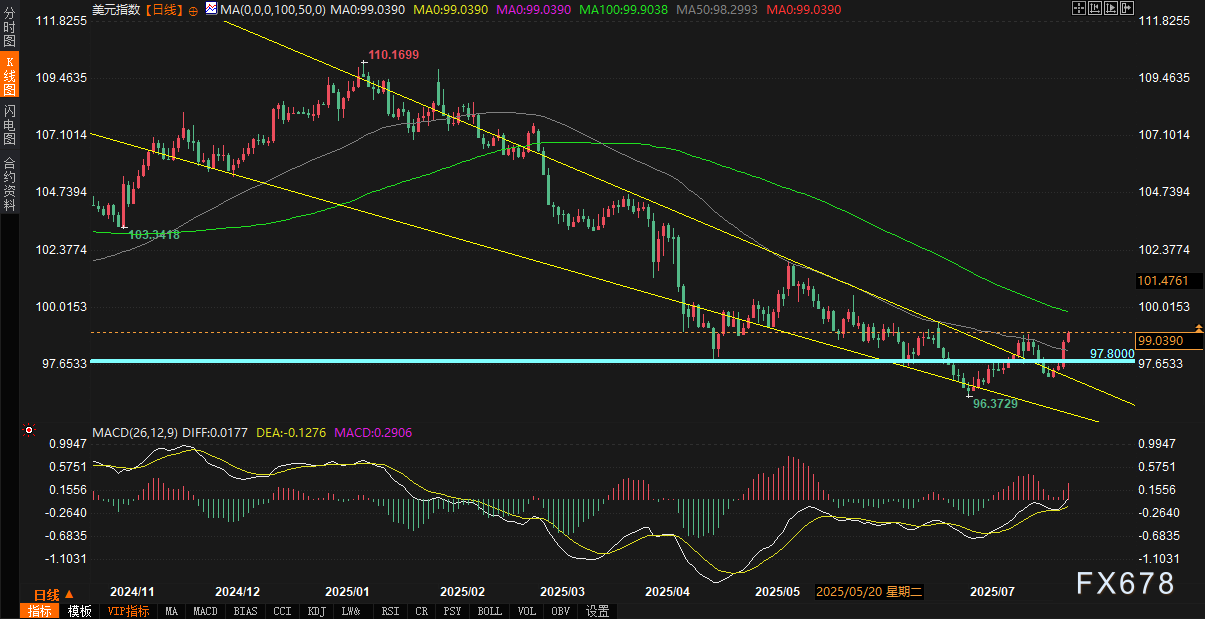
The momentum indicator provides support for the bullish outlook. The relative strength indicator is currently around 59, indicating that the buying momentum is strengthening, and it has not yet entered the overbought area, indicating that there is still room for upside. The moving average convergence-divergence indicator also supports bullish, with both the MACD line and the signal line rising. The bar chart continues to expand in the positive area, reflecting the accumulation of bullish momentum. These technical signals suggest that the dollar index is expected to continue to rise in the short term, but need to be vigilant against the pressure of key resistance levels and the potential risk of a pullback.
The trend of gold prices also provides side evidence for the strength of the dollar. According to industry experts, gold has fallen by more than $100 an ounce since last week's high of $3,440, in part due to the strengthening of the dollar and the easing of market safe-haven demand due to the US-EU trade agreement. Nonetheless, experts pointed out that if the Federal Reserve releases an interest rate cut signal at Wednesday's meeting, gold prices may gain support, which in turn will put some negative pressure on the dollar.
Market Sentiment Watch
The discussion of the US dollar index among traders continues to heat up. Some users believe that the conclusion of the US-EU agreement marks a stabilizing global trade environment and further enhances the attractiveness of the US dollar as a safe-haven asset. Some professional accounts pointed out that the JOLTS data and the Federal Reserve meeting will be the key catalysts this week. If the labor market data is weak, it may temporarily weaken the dollar's rally, but the overall bullish sentiment is still dominant. However, some users also expressed concerns about the high US Treasury yields and large-scale bond issuance plans, believing that long-term fiscal pressure may limit the dollar's upside. These discussions reflect the market's trade-off between short-term benefits and long-term risks. Some analysts from Pepperstone shared similar views on social platforms, emphasizing that it is not advisable to overchase.
Outlook on future trends
Looking ahead, the trend of the US dollar index will be directly affected by Tuesday's economic data and Wednesday's Federal Reserve policy meeting in the short term. If consumer confidence and JOLTS data are solid, the market's confidence in the resilience of the US economy will be further consolidated, and the US dollar may continue to challenge the 99.42 or even the 100-day moving average. From a technical perspective, the support of the 50-day moving average and the bullish signals from MACD and RSI provide momentum for the US dollar, but it is necessary to pay attention to the difficulty of breaking through the resistance level. If the data is unexpectedly weak, especially the JOLTS job vacancies are significantly lower than expected, the market may reprice the probability of interest rate cuts in September, and the US dollar may face correction pressure. The 97.80-98 area will be a key test.
In the medium term, the strength of the dollar remains supported by the global trade environment and the fundamentals of the US economy, but high Treasury yields and fiscal pressures may gradually take their toll. The options market indicates that there is currently a lack of strong unilateral breakout expectations, and the dollar index may remain high and volatile in the 98.50-99 range, unless new macro catalysts emerge. Traders need to pay close attention to the Federal Reserve's policy signals and subsequent non-farm payrolls data to judge the sustainability of the dollar's rally. For investors seeking more market insights, they can refer to the professional analysis and trading tools provided by the Pepperstone platform.
Please indicate the source: https://www.daoctech.com/fxoutrade/2606.html
Disclaimer: The content of this article does not represent the views of the Institute of Foreign Exchange. The content is for reference only and does not constitute investment advice. Investors operate accordingly at their own risk.