
Oil Trading Analysis: Trade Sentiment Repeated, WTI Returns to Near $60
International oil prices rebounded modestly in Asian markets on Monday, with Brent crude rising above $63 a barrel and WTI stabilizing near $60. The move follows a 3.8 per cent drop in Brent and a drop in WTI below the $60 mark on Friday as trade tensions reignited, with both major crude oil grades recording their biggest one-day losses since August.
Analyst Haris Khurshid from Chicago pointed out:
"The market had already priced in the worst-case scenario, so the US has softened its tone, giving oil prices short-term breathing room. But this is more of a short-term technical correction than a complete shift in trend."
Willingness to negotiate emerged over the weekend after steep tariffs and export restrictions were announced on some countries the previous day. "We will resolve our differences through dialogue," the US representative told the media during the trip. While the plans are still moving forward, the tone has softened significantly.

At the same time, relevant countries have also responded by saying that they are willing to solve the problem through negotiation, but will not concede under pressure.
The market generally believes that this change in attitude will help ease short-term trade concerns and provide some support for risky assets.
However, due to the lack of specific action details and clear negotiation arrangements, investors' trust in such signals remains low.
A Singapore-based energy market consultant said:
"The market is cautiously optimistic about the negotiation signals, but the real recovery must depend on the actual negotiation results, otherwise the rebound in oil prices will be difficult to sustain."
Countries have recently announced surcharges on some ships arriving at their ports, leading to the temporary cancellation of some transport plans, a measure seen as a counterpart to logistics restrictions and which has also caused global shipping costs to rise rapidly in the short term.
This change increases the uncertainty in the energy market, particularly the possible impact on crude oil spot flows.
At the same time, OPEC + members have recently increased production, exacerbating market concerns about the supply and demand situation at the end of the year. Coupled with the situation in the relevant regions, although temporarily eased due to the ceasefire, there are still uncertainties, adding complications to the trend of oil prices.
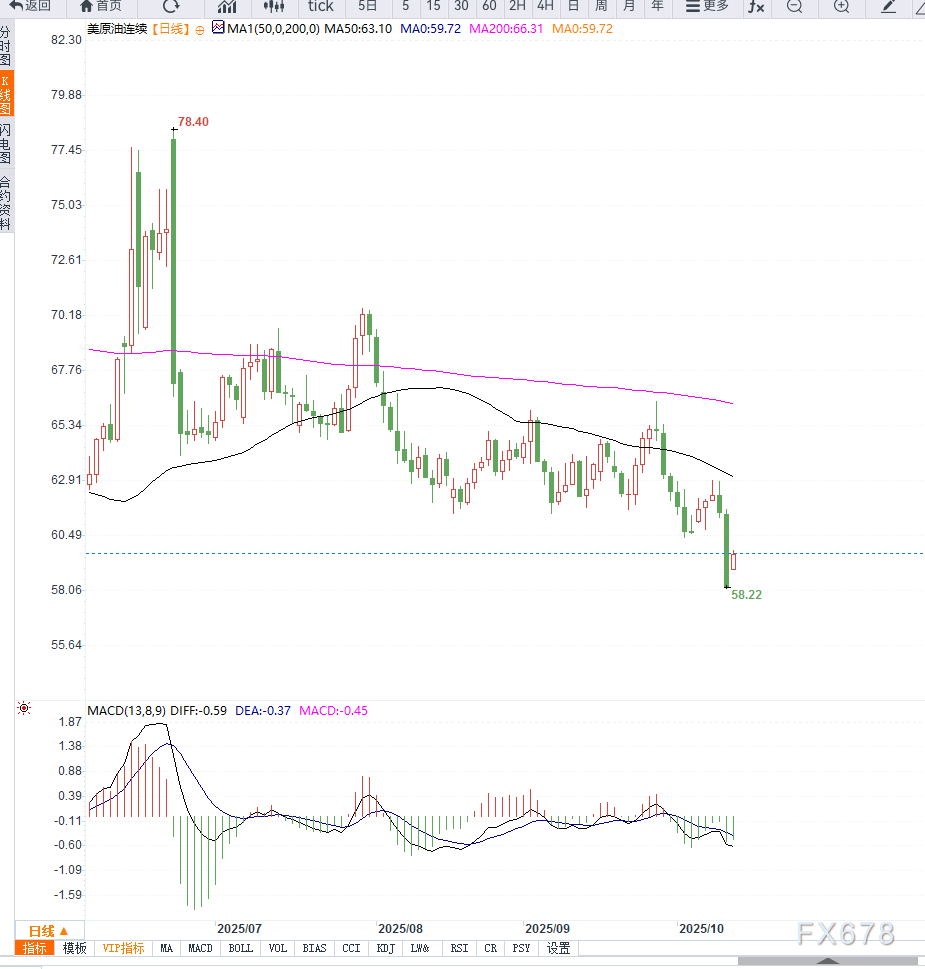
Looking at the daily structure, WTI crude oil gained phased support near $59.00 after experiencing a rapid decline in the early stage, and experienced a small technical rebound. At present, the price has returned to the oversold rebound area, but has not yet broken through the key resistance level of $60.00. At KCMForex PlatformIt appears that the RSI index has rallied to around 45, indicating that short-term selling pressure has eased, but the overall trend remains weak.
If the price cannot stabilize above $60, the durability of the rebound may be limited. The support area below is focused on $59.30-58.50. Overall, the technical side shows a weak repair pattern, and short-term operations still need to be cautious.
Overall:
The current rebound in oil prices is more a correction of excessive pessimism in the market than a signal of a trend reversal. If relevant parties do not make substantial progress in trade negotiations, crude oil demand expectations will still be under pressure. Keep an eye on the dynamics of negotiations and OPEC + supply in the coming period. Once policy tightens again or the dollar strengthens, WTI crude oil may test support below $59 again.
Please indicate the source: https://www.daoctech.com/fxoutrade/2608.html
Disclaimer: The content of this article does not represent the views of the Institute of Foreign Exchange. The content is for reference only and does not constitute investment advice. Investors operate accordingly at their own risk.