
A picture: The Baltic Sea index has continued to decline, and the freight rates of capesize and super handy ships have weakened
The latest data show that on January 7, 2025, the Baltic Dry Index (BDI) reported 1,776 points, the lowest level since July 11, 2025, down 2.95% month-on-month (compared with the previous value), the largest decline since December 23, 2025, and the third consecutive day of decline (including 0 growth). Looking at the comprehensive short-term table, the latest 11 BDI data growth situations are: 2 positive growth, 9 negative growth, and 0 zero growth. Among them, the Panamax Freight Index (BPI) reported 1,317 points, up 1.00% from the previous value, the Capesize Freight Index (BCI) reported 2,878 points, down 4.58%, and the BSI reported 993 points, down 1.78%. The latest 720-day chart and ten-year chart of the Baltic Dry Index + three major sub-items are detailed in the latest information special chart.
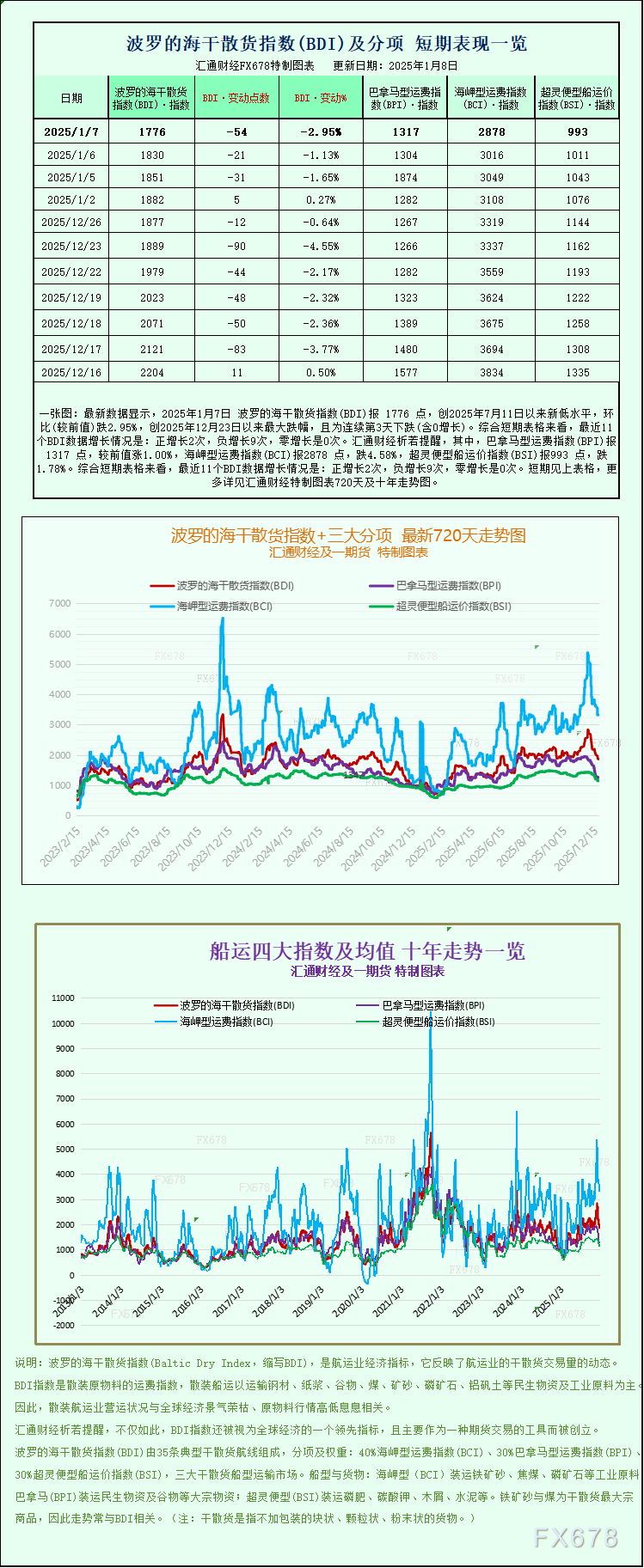
The Baltic Exchange Dry Bulk Index fell for a third consecutive session on Wednesday, hitting its lowest level in more than five months, mainly dragged down by weaker Capesize and Panamax rates. The index reflects the trend of changes in the freight rates of ships transporting dry bulk commodities such as iron ore, coal and grain around the world. Its continued decline shows that the overall demand in the dry bulk market is still in a weak state.
The composite index, which tracks rates for Capesize, Panamax and Ultrahandy ships, fell 54 points to 1,776, its lowest since July 2025. Despite recent weakness, the index is up about 88 per cent for all of 2025, indicating a significant rebound in the market over the past year.
The capesize index, which ships bulk dry bulk cargoes such as iron ore and coal, fell 138 points, or 4.6 per cent, to 2,878, reflecting the fact that demand in the world's main consumer regions has not fully recovered.
Capesize vessels, which typically carry about 150,000 tonnes and are a significant part of the dry bulk shipping market, are often seen as an important indicator of the active level of global commodity trade.
However, iron ore futures have bucked the trend and hit their highest level in months. Sentiment has been buoyed by expectations of improving demand in China, the world's largest consumer of iron ore, whose government has pledged to ease monetary policy in 2026, which is seen as likely to spur property and infrastructure building activity, boosting demand for iron ore.
In terms of smaller tonnage ships, the Handysize Index fell 18 points to 993.GMI ForexThe decrease in the freight rates of the super-handy ships, which mainly transport small bulk cargoes, shows that the small and medium-sized bulk trade is also facing pressure.
Meanwhile, the Panamax index rose 13 points, or 1%, to 1,317, making it one of the few segments to gain on the day. Panamax ships typically transport 60,000 to 70,000 tons of coal or grain, and the recovery in freight rates may be related to increased short-term demand on specific routes.
The average daily rate for Panamax vessels rose by $115 to $11,851. Although the increase was modest, the positive performance provided some support to the overall weak market.
Please indicate the source: https://www.daoctech.com/fxoutrade/2654.html
Disclaimer: The content of this article does not represent the views of the Institute of Foreign Exchange. The content is for reference only and does not constitute investment advice. Investors operate accordingly at their own risk.