
The Federal Reserve's interest rate cut is imminent + U.S. debt is overwhelmed, and gold may become the biggest winner
Paul Wong, a market strategist at Sprott Asset Management, said spot gold prices topped $3,500 an ounce last week and then $3,600 a troy ounce shortly after, as market participants began to connect the dots and realized that currency depreciation was the only way for governments to meet their debt obligations, fueling the rally.
Last Friday, Wong listed various reasons why gold prices broke through the multi-month channel and why this could be just the beginning of a rally in gold prices.
"The immediate driver of last week's breakout was supposedly macro funds buying gold and selling long-term bonds on top of that, which is why gold broke through the $3,500 mark," he said. "Gold has been consolidating in this four-month bullish consolidation pattern since about April, there has never been a real sell-off or any sign of a central bank sell-off, it's just mostly investment funds not buying but certainly not selling."
Wong said that technically, this long period of consolidation is a very bullish pattern.
"Normally, a market like this is good, it's not going to be sold, it can't be sold, it's not going to be sold, it's a sign of underlying strength and accumulation," he said. "So when gold breaks through highs, this bullish pattern tends to jump out of the gap and that's it."
He added: "The target price on the chart is around $3,900, which is a direct prediction from the bullish breakout we are currently seeing."
Debt is driving up gold prices
The fundamentals are also very supportive of gold prices. Wong said the risks associated with soaring public debt (in the US, but also in OECD countries) are being reflected in bond yields.
He said: "You can see 30-year bond yields have risen sharply, as they have in almost all G7 countries and all advanced economies. All of this is driven by the same theme, which is too much debt, which is the bottom line. Bond markets are losing confidence in the ability of governments to control spending and control debt levels. So you can also see that in the G7, average two-year yields have been slowly falling over the past few years as most governments are trying to stimulate the economy and keep it growing."
The problem, however, is that there is a lot of underlying inflation beneath the surface. "You can see this in many areas, both in the short term [two-year] and in the long term [10-year], inflation is rising," he says.
Mr. Wong says the term premium has been sticky and continues to rise. "The term premium is what the market needs, an extra yield to compensate for the long-term risk," he says. "So when you add all these things together, the bond market really dislikes long-term bonds because of the inflation problem and the need for higher compensation."
He added: "With short bonds, it's doing better because it knows the central bank is going to cut rates. We look at the Fed now, the current futures curve indicates three rate cuts in September, October and December this year, are there more to come?"
A 50 basis point rate cut in September is possible
Wong said there is also a good chance that the Fed will start with a more aggressive move than the 25 basis points currently expected.
"There could be a 50 basis point cut," he said. "The Fed has a dual mandate, employment and inflation. When you see signs of a stagflationary environment, which is what you're seeing now, you can tell from the data that it's definitely there. The labor market has been weakening steadily since the summer. Service price inflation has been picking up, and it tends to be about three months ahead of CPI. The question is: how much worse can things get?"
"This is the challenge for the Fed," he said. "It has a dual mandate, and these two mandates are diametrically opposed."
By placing the Federal Reserve in a position where it needs to stimulate the economy to support employment, the US government is forcing the Federal Reserve to prioritize inflation.
"The Trump administration wants to heat up the economy, so you're going to see a big reduction in short-term interest rates and a very stimulative fiscal policy, and that's where we're headed," Mr. Wong said. "The BBB [Big Beauty Act] will really start in 2026, and with the tax cuts, it should be quite stimulative. The current rate cuts should also have a stimulative effect. The gold price really broke through and went higher because we're moving towards a phase of fiscal dominance, where monetary policy is subordinate to fiscal policy."
He added: "In an overheated economy, with inflation and high debt levels, the transmission mechanism has concluded that the only way to deal with this problem is to devalue the dollar. More importantly, devalue any and all monetary assets, namely Treasuries and the dollar itself. That's why gold prices are higher."
A weaker dollar is the only option
Wong said,yingshiThe reality is that the United States and developed countries are entering a period of continuous currency depreciation, and the gold market is sensing this.
"Gold is very complex and unlike most assets, it spans currencies, fixed income, credit, economics, equities and geopolitics," he says. "It's easy to understand because gold has been around for thousands of years and everyone knows about it. At the same time, under the surface it's quite complex and you can see that in price action."
"It's like a rocket because people realise there's something serious going on underneath the surface. Again, one of the few assets you own in the general trend of financial asset depreciation is gold, which is why it goes up like this."
Another major factor supporting the rise in gold prices is trust, or lack thereof. "People have lost trust in the financial system as a whole, in central banks, in institutions, in governments," he said. "When you lose trust in the value of a monetary asset, you turn to gold. It's non-financial, non-governmental. It's becoming a safe haven: it's not just a safe haven, it's a safe asset."
"The fundamentals basically show a lack of trust in governments, institutions, central banks, etc. If you're a multi-strategy asset manager, you say, 'OK, what is my safe haven?' It's gold," he says.
"Let's lower the threshold, 'What is security?' or gold," Mr. Wong added.
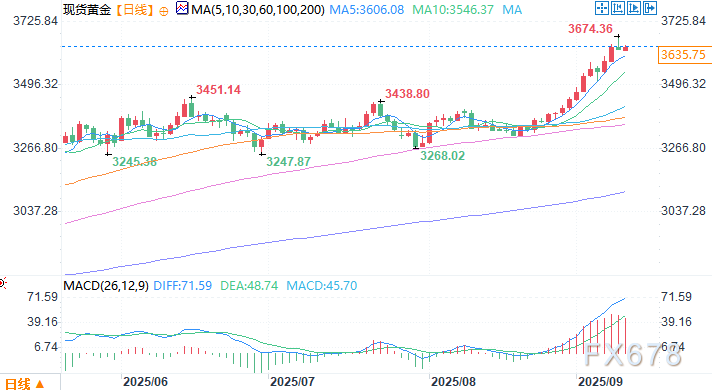
Daily chart of spot gold, source: Internet
Beijing time on September 10 at 11:55 spot gold, reported at $3635.75/ounce
Please indicate the source: https://www.daoctech.com/fxoutrade/2662.html
Disclaimer: The content of this article does not represent the views of the Institute of Foreign Exchange. The content is for reference only and does not constitute investment advice. Investors operate accordingly at their own risk.