
Symmetrical triangle
Symmetrical triangle
Symmetrical triangle (Symmetrical Triangle) is also known as an equilateral triangle. Under normal circumstances, a symmetrical triangle is a finishing pattern, that is, the price will continue to move in the original trend. It is composed of a series of price changes, and the range of changes gradually decreases.Industrial foreign exchangeThat is to say, the highest price of each change is lower than the previous level, while the lowest price is higher than the previous lowest price level, showing a compressed pattern. If you look at the price change field from a horizontal direction, the upper limit is a downward slash, and the lower limit is an upward slant. Connecting short-term highs and lows in a straight line can form a symmetrical triangle.
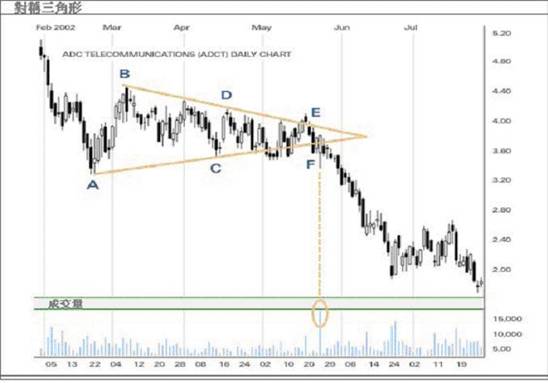
The volume of the symmetrical triangle decreases due to increasingly small price changes, reflecting the hesitant wait-and-see attitude of the long and short forces towards the market outlook. When the foreign exchange price suddenly jumps out of the triangle, the volume increases accordingly.
If the price breaks through the resistance line (which must be supported by large volume), it is a short-term buy signal; conversely, if the price falls below (under low volume), it is a short-term sell signal.
As an example in the chart above, a downtrend occurs when the price flows from point A into a symmetrical triangle and trades hover in this area. The trend line also appears in the following two months (points A to C and B to D). At point E, the price begins to break through the resistance line, attempting to turn the trend, but unsuccessfully becomes a false breakout. This is a good example of reminding investors that they must wait for the signal after the market closes, and pay attention to whether the break is accurate or a good entry level. At point E, the price opens below the trend line, confirming that the previous signal was false. Subsequently, the price breaks through the lower point of the triangle and a large number of sell orders, confirming that the downtrend of the symmetrical triangle continues.
Please indicate the source: https://www.daoctech.com/fxoutrade/2713.html
Disclaimer: The content of this article does not represent the views of the Institute of Foreign Exchange. The content is for reference only and does not constitute investment advice. Investors operate accordingly at their own risk.