
Why did the fall in technology stocks affect gold? Cross-asset deleveraging storm is coming
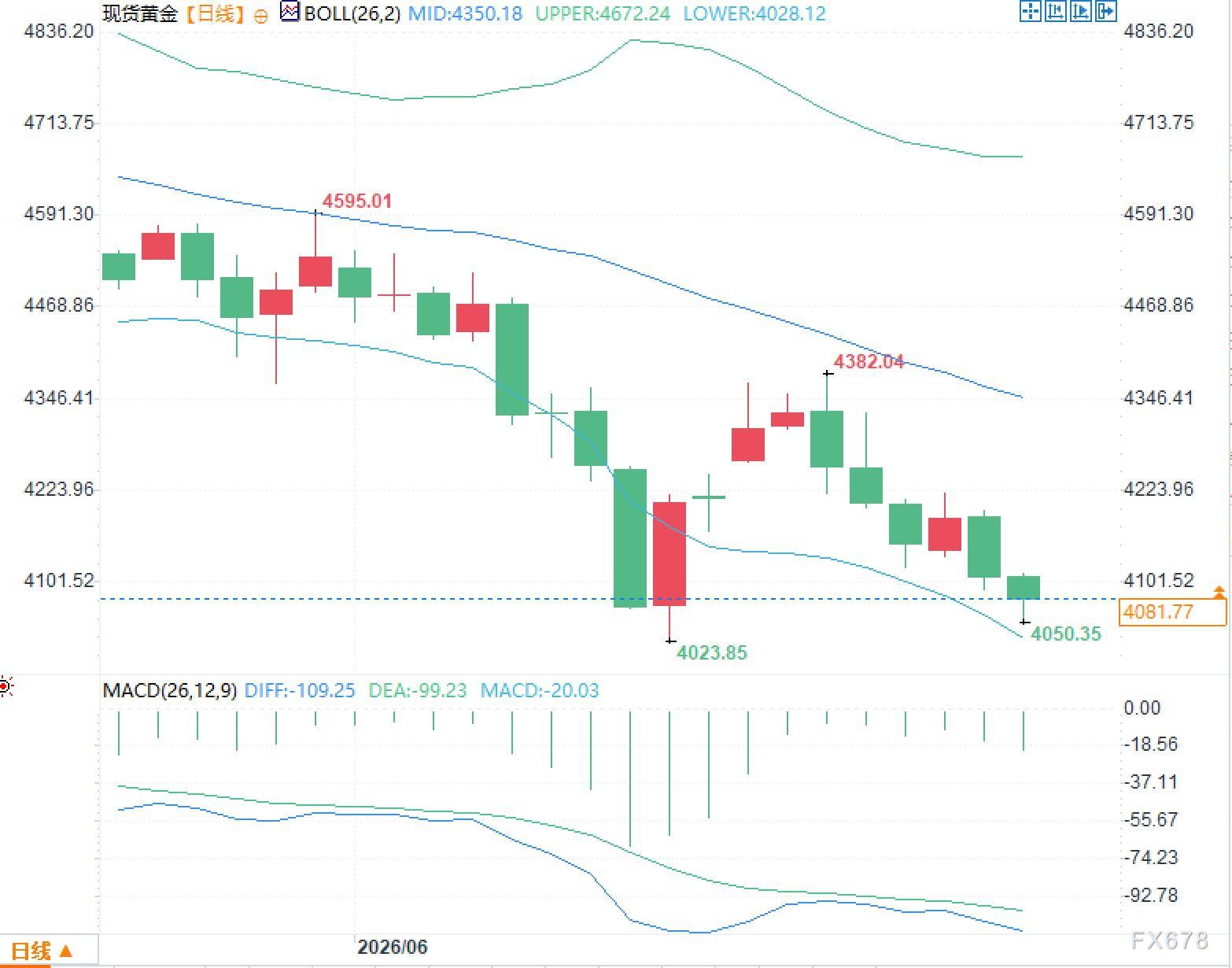
On Wednesday, June 24, the main line of the precious metals market shifted from the safe-haven premium to the interest rate revaluation. Spot gold fell for the second consecutive day. It was close to $4,050/ounce during the session, and is currently back near $4,080/ounce, which is volatile from the previous trading day's low. At the same time, the US dollar index rose to near a one-year high, US bond yields remained high, and the cross-asset deleveraging triggered by the adjustment of technology stocks made gold's safe-haven attribute give way to its liquidity attribute in the short term. This round of withdrawal is not a simple "safe-haven retreat", but the result of the simultaneous repricing of real interest rates, the US dollar, equity fluctuations, and geopolitical premiums.
The most notable change in this round of gold correction is that the market has re-priced gold in the real interest rate framework. In the past few months, gold prices have been more driven by central bank purchases, geopolitical conflicts, and the need for US dollar credit diversification, and the sensitivity of prices to real interest rates has gradually decreased. But the current situation has changed: when the Federal Reserve sends stronger anti-inflation signals and the market starts to correct the probability of future interest rate hikes, the opportunity cost of gold as an interest-free asset has risen again.
The Bank of Singapore recently pointed out that gold prices are "increasingly re-linked to real yields". This sentence points to the key to the current trading structure: gold prices are not losing their safe-haven function, but that safe-haven buying is not enough to offset the rising cost of holding positions and the pressure on margin liquidity when interest rate expectations move up. In other words, gold remains a macro hedge asset, but its hedge value will be re-discounted during the strengthening of the dollar and the rise in real interest rates.
What the market sees on the surface is that technology stocks are falling, and gold is also falling, which seems to be the opposite of the traditional safe-haven logic. But in large-scale cross-asset pullbacks, gold is often treated as a source of liquidity first. Technology stocks, semiconductors and artificial intelligence-related assets have risen sharply in the early stage. Valuation transactions are highly sensitive to changes in interest rates. Once volatility rises, some portfolios will sell the most liquid assets to replenish margin or cover losses in other positions. Therefore, gold is prone to the phased characteristics of "safe-haven assets are sold".
This does not mean that safe haven demand has disappeared, but that the market deals with balance sheet pressure before discussing the macro narrative. The Nasdaq and S & P 500 index fell significantly on Tuesday, the semiconductor sector fell even more, and the risk budget contracted rapidly. If the equity correction is only a partial cooling of the high valuation sector, the pressure on gold is mainly from the liquidity shock. If the correction spreads to credit spreads and financing markets, gold may regain stronger defensive buying later.
The Federal Reserve kept interest rates at 3.50% to 3.75% at its June meeting, but the market was more concerned about changes in policy language and expectations. After the first meeting of the new chairperson, Warsh, released a more cautious policy tone and paid more attention to inflation risks, and the market priced another interest rate hike this year. For gold, the question is not just whether interest rate hikes will be raised, but whether interest rate cut expectations are systematically squeezed out.
The US April PCE was 3.8% year-on-year, and the core PCE was 3.3% year-on-year, still far from the 2% target. The new round of PCE data to be released on June 25 has become a key checkpoint for the short-term pricing of gold. If inflation readings continue to show stickiness, the dollar and real yields may still remain supportive, and the rebound space for gold will be suppressed. If the data is lower than expected, the pressure on gold may ease, but whether it can reopen the upside space depends on whether the Federal Reserve is willing to release its loose imagination again.
The conflict in the Middle East has eased in stages, shipping concerns related to the Strait of Hormuz have declined, and oil price pressures have eased. A large Australian Financial Institutions Group has cut its forecast for gold prices in the third and fourth quarters to $4,450 an ounce and $4,300 an ounce respectively. It said in its report that the regional conflict appears to be coming to an end, and the Federal Reserve is more hawkish, making gold less attractive as a safe haven.
It is important to note that the downward revision of the forecast is not the same as being bearish on gold in the long run, but rather indicates that traders are switching from the "crisis premium model" to the "interest rate cost model". This switch will lead to two results: first, the increase in the intraday sensitivity of gold prices to inflation data, real yields and the dollar; second, central bank gold purchases and long-term allocation demand can still provide bottom support, but it is difficult to drive the rise alone. Gold's return from trend assets to macro volatile assets is the most central change in the current order.
Please indicate the source: https://www.daoctech.com/fxoutrade/2737.html
Disclaimer: The content of this article does not represent the views of the Institute of Foreign Exchange. The content is for reference only and does not constitute investment advice. Investors operate accordingly at their own risk.