
WTI crude oil hits 7-month high and pulls back, short-term volatility continues
On Wednesday (February 25), the price of WTI crude oil futures rose slightly during the European trading session, reversing the correction trend in early trading. Earlier this week, the futures price touched $67.28/barrel, setting a new seven-month high since September 2025. Since February this year, WTI crude oil prices have shown a volatile upward trend. At the beginning of the month, they were settled in the range of $62-64/barrel, and later climbed to around $66/barrel, a monthly increase of more than 8%. This is mainly due to the combination of tightening supply, geopolitical factors and demand resilience.

according toGTCForex PlatformMarket observation, as of 21:50 Beijing time, April WTI crude oil futures were quoted at $66.03/barrel, up $0.40, or 0.61%. Brent crude oil futures were quoted at $71.06/barrel, down slightly by $0.17, or 0.24%. The current oil price presents a "two-way constraint" pattern: geopolitical risks and OPEC + production cuts provide support for prices, while inventory surges and demand recovery is less than expected to limit the upside space, and it is difficult to appear in the short term. Goldman Sachs recently raised its WTI oil price forecast for the fourth quarter of 2026 to $56/barrel, which reflects the positive changes taking place in the supply and demand landscape.
Market attention shifts to EIA inventory report, API inventory data surge raises bearish concerns
The market is closely watching the official EIA crude oil inventory data to be released at 23:30 Beijing time tonight. The current market consensus expectation is that inventories will increase by 1.30 million barrels, which is in sharp contrast to last week's data of 2.30 million barrels reduction, further highlighting the market's concerns about inventory accumulation. Over the past five years, the average inventory growth over the same period has been 3.10 million barrels. If the data released this time is close to or above this average, it may strengthen bearish sentiment and push oil prices to test the trend line support of $64.98/barrel; conversely, if the data is lower than expected, it may drive oil prices up to the resistance level near $67/barrel.
Before the release of the EIA data, the private inventory data released by API increased sharply by 11.43 million barrels, far exceeding the increase of 1 million barrels expected by the market. This news has tilted the market sentiment towards bears. The main reason behind this is that the decline in US crude oil imports failed to cover the increase in production, and the refinery operating rate (91%) failed to fully absorb the new production. Last week, the EIA's inventory reduction data of 9 million barrels drove oil prices higher, but this API data reversed the optimistic expectations of inventory decline and re-highlighted the current situation of loose global supply and demand pattern, thus forming a market game situation of "geopolitical factors support prices and inventory data suppress prices".
Tensions in the Middle East perpetuate risk premiums, with geopolitics a key short-term variable
The Middle East produces more than 35% of the global total, and the Strait of Hormuz transports more than 17 million barrels of crude oil per day, accounting for nearly 20% of the global total. Tensions in the region will directly disrupt supply, and geopolitical risk premiums have become the core "safety pad" for oil prices. Regarding the US-Iran nuclear talks, the two sides have had a tortuous journey, and the statements of relevant parties have added to the uncertainty of the negotiations. The US and Iran plan to hold a new round of negotiations in Geneva on February 26, and relevant core issues have become the focus of market attention.
Some observers have pointed out that some recent tough statements from the US side have stabilized the risk premium in the market, but have not stimulated the influx of new buying orders; other factors in some regions have further increased the uncertainty of the negotiations.
Technical aspects: The upward trend is still ongoing, but it faces multiple challenges in the short term
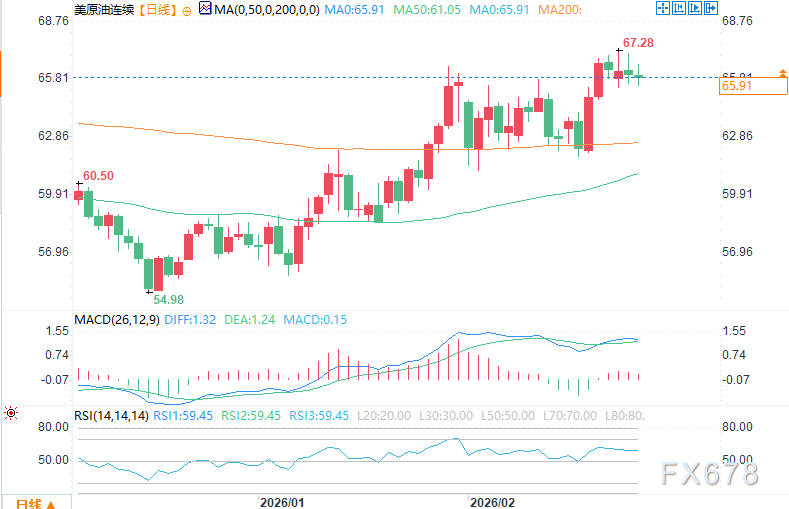
(WTI crude oil daily chart, source: Internet)
From the moving average, trend line and swing indicators, the main trend of WTI crude oil is still upward, but it faces some pressure to pull back in the short term. The 200-day moving average provides support at $62.59/barrel, and the 50-day moving average supports at $61.05/barrel. The latter is about to cross the former to form a "golden fork", which is a clear medium and long-term bullish signal. In the short term, after oil prices hit a high point, some bulls took profits, causing the 5th and 10th moving averages to show a slight turning point, and the risk of pullback has increased.
Today's trend line support is at $64.98/barrel. If it falls, oil prices may pull back to the range of $63-64/barrel; if it can break through the recent high of $67.28/barrel, the rising trend will restart, and it is expected to further explore to $68-70/barrel. In the short term, the hourly trend is weak, and the daily line shows a pattern of interval consolidation, focusing on the support area of $65.5-65/barrel and the pressure area of $66.8-67/barrel.
Thursday's negotiations: The market's next central focus will determine the direction of short-term oil prices
The US-Iran talks held on Thursday are the core driving variables of the short-term oil market, and the outcome will most likely determine the short-term direction of oil prices. One possible scenario is that the situation escalates due to the breakdown of the talks, and the geopolitical risk premium will quickly surge, and WTI crude oil is expected to exceed 70 US dollars per barrel. Another possibility is that the negotiations make progress, the geopolitical premium will cool down, and the market focus will return to supply and demand fundamentals. Overlapping the bearish data of API inventories and the IEA's forecast of "global inventories accumulating 2.96 million barrels per day in 2026", the oil price may pull back to the range of 64-65 US dollars per barrel.
The OPEC + production reduction policy provides medium and long-term support for oil prices. In March 2026, the eight core oil producers will continue to implement voluntary production cuts of 3.24 million barrels per day. In January, the average daily output of OPEC + fell sharply by 439,000 barrels month-on-month, and the supply gap further widened. This means that even if there is a correction in oil prices in the short term, its downside space is relatively limited.
Please indicate the source: https://www.daoctech.com/fxnews/2461.html
Disclaimer: The content of this article does not represent the views of the Institute of Foreign Exchange. The content is for reference only and does not constitute investment advice. Investors operate accordingly at their own risk.