
The US economy has been unsolved for 60 years: the paradox of 4% growth and zero job creation
As we head into the turbulent final quarter of 2025, one of the biggest mysteries is how the US economy has managed to grow at nearly 4 per cent without creating any jobs. The answer may lie in artificial intelligence, but proving it will be a challenge.

Market performance and economic growth data
The US stock market has rallied strongly since April, when President Donald Trump's tariff plans brought it close to collapse, with the S & P 500 up 33 per cent from its lows. As the third quarter draws to a close, US GDP is on track to grow at an annualised rate of 3.9 per cent.
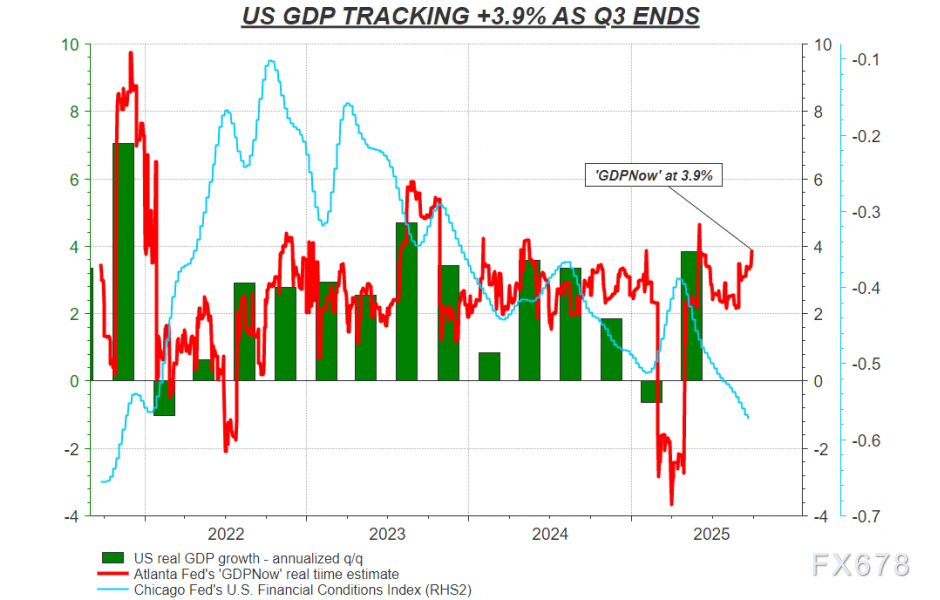
(Chart: U.S. GDP is expected to grow at an annual rate of 3.8%)
Moreover, even in the face of the most accommodative financial conditions in nearly four years, the Federal Reserve has resumed cutting interest rates. Why? Because Chairperson Jerome Powell and his team are concerned about the labor market. This suggests, in part, that the Fed's policymaking balance has skewed towards weak employment data rather than strong GDP data.
The core contradiction: the conflict between economic prosperity and weak employment
So why is the labor market looking so weak when the economy is booming, corporate capital spending is soaring, and the stock market is at an all-time high?
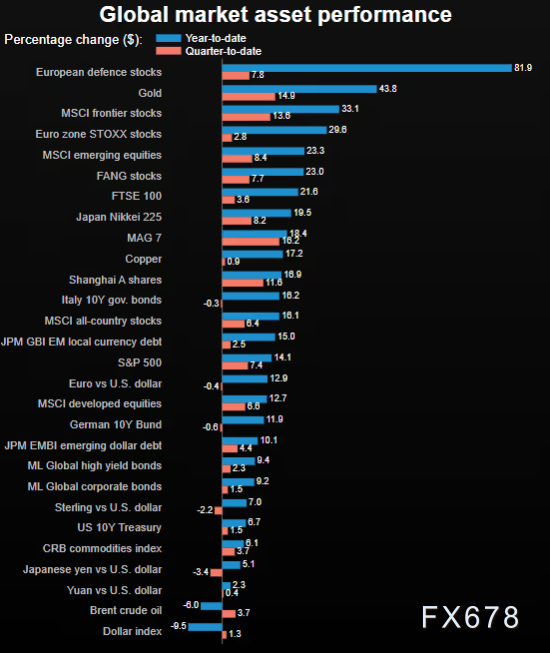
(Chart: Global market asset performance)
JPMorgan economists recently highlighted that capital spending is growing at an annualized rate of 11% through the first half of 2025, noting that this growth remained strong in the third quarter even as labor demand appeared to have disappeared.
U.S. job growth data, which will be released on Friday, October 3, for September, slowed sharply in the three months to August, adding an average of just 29,000 jobs per month, compared with 82,000 in the same period in 2024.
A rare strange decoupling phenomenon in history
"Accelerating capital spending against a backdrop of stagnant employment growth is difficult to factor into the economic outlook," JPMorgan wrote last week in a report titled "Strange Decoupling." This juxtaposition has not been common in the past 60 years of US expansions. "
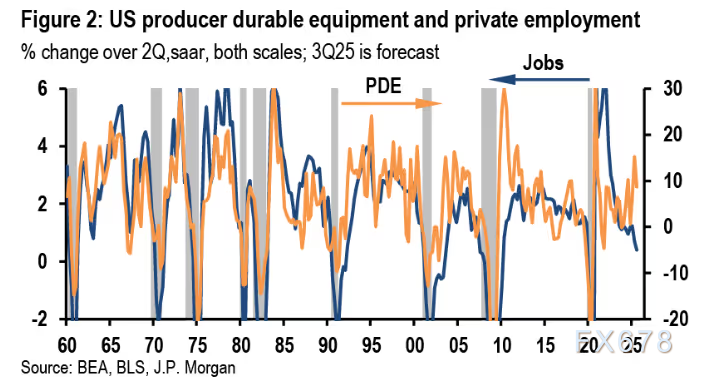
(Picture: US capital investment is hot, but employment is cold)
Labor market recession signals and market reactions
On the face of it, the labour market is signalling a recession - and while Fed officials are anxious about it, equity and credit markets seem to be completely oblivious to its existence.
TS Lombard economist Dario Perkins recently highlighted a chart that he believes will "terrify the Federal Reserve", showing six-month changes in so-called "core" jobs in the US, excluding government jobs and healthcare, which have been negative before every recession in the past 60 years.

(Graph: Six-month change in US "core" jobs and the recession)
So why aren't the stock markets worried?
This is in part because investors believe the Federal Reserve will now ease monetary policy quickly to address the issue, and because the job outlook depends on an immigration reversal and productivity gains, the Fed will ease monetary policy anyway just in case.
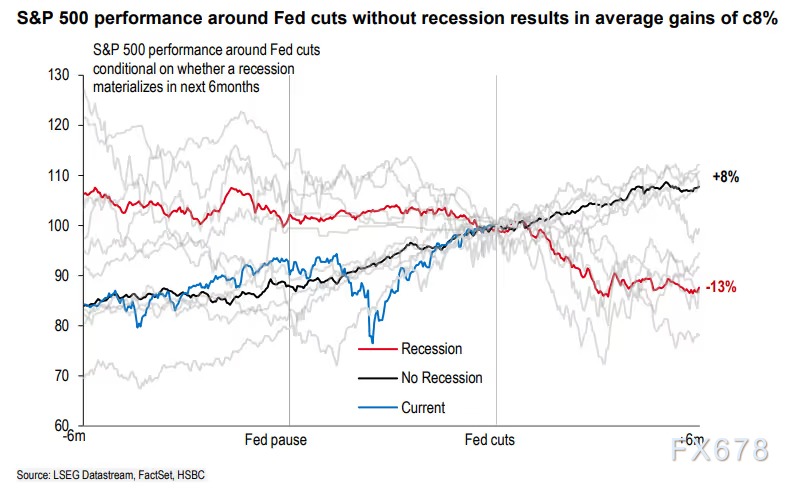
(Graph: The performance of the S & P 500 index in history after the Federal Reserve's policy easing)
The JPMorgan team has proposed two possible explanations for the contradiction between the surge in capital spending and the stagnation of employment growth.
Optimistic explanation: artificial intelligence success and changing workforce demand
On an optimistic note, artificial intelligence and other new technologies are succeeding, slowing hiring as the workforce declines.
But it is unlikely to happen precisely in sync with the macroeconomy. It does, however, echo immigration restrictions and deportations, which have reportedly pushed the break-even point for job growth (i.e., monthly job growth consistent with the unemployment rate remaining unchanged) below 50,000.
That's why some economists now think the monthly jobs report may soon turn negative, but not necessarily cause a financial marekt.
The pessimistic explanation: corporate caution and the end of the capital spending boom
JPMorgan's other pessimistic view of the decoupling of employment and capital spending is that the decline in hiring reflects widespread caution, and that capital spending growth is in the final stages of an artificial intelligence-led boom that is about to fade.
If true, a slowing labor market could begin to affect household purchasing power, exacerbating the impact of import tariffs and dollar-related inflation.
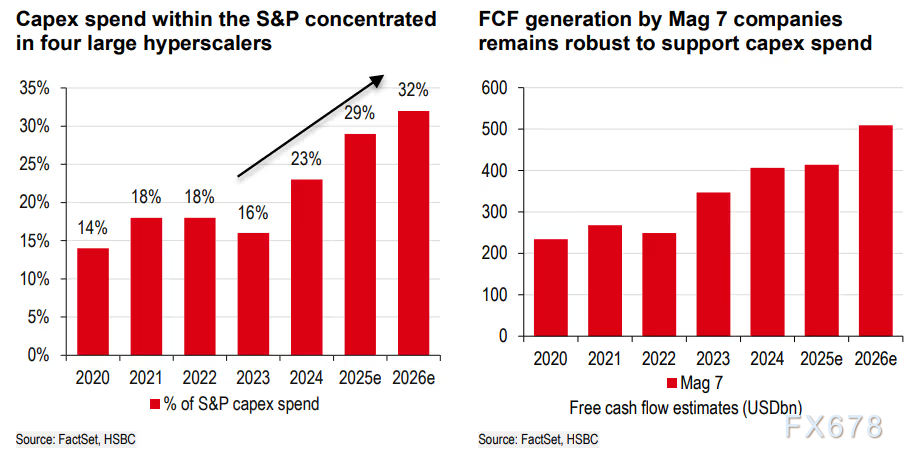
(Graph: Technology capital spending is concentrated among corporate giants)
summary
The current "decoupling" of the US economy has forced markets to reassess the determinants of the dollar.From the traditional "growth - interest rate hikes - strong dollar" logic, to the new logic of "abnormal growth - worry - interest rate cuts - weak dollar".Until the puzzle is solved, the dollar is more likely to be in a state of "supported weakness" - that is, the overall trend is downward, but not in a free fall due to relative growth advantages and potential inflation risks.
However, as a slowdown in artificial intelligence capital spending seems inevitable, it may not provide a satisfactory answer to the current economic woes. How long the apparent contradiction between tepid hiring and business confidence in investment will coexist may still be the main theme of the final quarter.
At 15:40 Beijing time, the dollar index was trading at 97.79.
Please indicate the source: https://www.daoctech.com/fxoutrade/1898.html
Disclaimer: The content of this article does not represent the views of the Institute of Foreign Exchange. The content is for reference only and does not constitute investment advice. Investors operate accordingly at their own risk.