
Gold trading reminder: the rally can't stop! After the Federal Reserve cut interest rates, the price of gold went straight to the $4,000 mark?
On Monday (September 22), in the morning of the Asian market, spot gold fluctuated slightly, and is currently trading at 3691.78 US dollars per ounce. Last week, the global gold market once again ushered in a milestone moment. After the Federal Reserve announced a 25 basis point interest rate cut last Wednesday (September 17), the spot gold price once rushed to a record high of 3707.40 US dollars per ounce. Despite the subsequent shock correction, it still closed at 3684.93 US dollars last Friday, a weekly increase of 1.15%, achieving a fifth consecutive week of gains. This performance highlights the resilience of gold in the early stage of monetary policy shift.
Market analysts generally agree that gold's bullish tone has not changed due to short-term volatility. "Gold is only taking a breather after reaching new highs, the bull market trend is still intact, and it is not impossible to reach $4,000 by the end of the year," said Bob Haberkorn, market strategist at RJO Futures. This optimism stems from the reduction in the opportunity cost of holding interest-free gold after the start of the Federal Reserve's interest rate cut cycle, coupled with the continued fermentation of global geopolitical risks, which together support the long-term strength of gold prices.
The double-edged sword of the Federal Reserve's interest rate cut: the shock after gold prices hit a new high
The US Federal Reserve's decision to cut interest rates on Wednesday was the strongest catalyst for the gold market, with spot gold prices soaring to an all-time peak of $3,707.40 an ounce after a 25 basis point cut in the key interest rate. The cut reduced the opportunity cost of holding non-yielding assets such as gold, further strengthening gold's appeal in uncertain times.
Gold prices have rallied nearly 40 per cent this year, a historically rare event. However, the Fed's simultaneous warnings about persistent inflation and its lack of urgency to ease further have left markets sceptical about the future policy path. As a result, gold prices have entered shock mode after hitting a high, closing at $3,684.93 an ounce on Friday, up 1.15% on a weekly basis, but with significant volatility during the week.
At a deeper level, the rate cut was seen as a response to risks in the jobs market, with Minneapolis Fed President Kashkari making it clear that the jobs data supported the move and could continue to cut rates at the next two meetings. This provided support for gold, as expectations of easing tend to push up prices. But the Fed's "dot plot" shows that there may be two more rate cuts this year without a commitment to move quickly, leading some investors to take profits.
Analyst Bob Haberkorn pointed out that gold's bullish trend is intact, and a high of $4,000 by the end of the year is a realistic possibility. This view is not isolated, and many market strategists believe that the Federal Reserve's gradual easing will continue to benefit gold, especially in the context of persistent inflationary pressures.
US bond yields rebound and dollar rebound: short-term pressure on gold
The Treasury market, which is closely linked to gold's movements, also showed mixed signals. Yields were mostly higher last week, with the benchmark 10-year yield rising for three straight days to 4.141 per cent, a two-week high and a weekly gain of 8.1 basis points. This reversed a trend that had previously fallen on expectations of a rate cut, hitting a seven-month low of 3.994 per cent early last week. The recovery in yields was driven by strong economic data such as initial jobless claims and better-than-expected manufacturing activity in the Mid-Atlantic, which eased concerns about a weaker labour market. Chief investment officer Tony Welch analyzed that the reasonable valuation range for 10-year Treasury bonds is between 4% and 5%. Previously, falling below the lower limit led to excessive bond buying, and the current pullback is a normal adjustment.
Rising yields tend to boost the attractiveness of the dollar, which weighs on gold. On Friday, the dollar index rose 0.3% to 97.662, and the weekly line was almost flat, but the dollar rallied significantly against most major currencies after the Federal Reserve meeting. Strategist Marc Chandler described it as a "split in two" trading week. The Fed's statement was dovish, but the dot plot was relatively hawkish, which provided room for the dollar to rebound. If the dollar strengthens further, gold may face downside risks in the short term. However, this pressure may be short-lived, as the hawkish tendencies of other global central banks such as the Bank of Japan and the decline in the pound caused by UK fiscal concerns are indirectly supporting the dollar, but also highlighting the divergence of global monetary policy, which in turn reinforces the role of gold as a safe haven.
Global demand divergence and geopolitical risks: the deep driving force behind gold's rise
The dynamism of the gold market is not limited to US policy, global physical demand and geopolitical factors are equally critical. Gold premiums in India rose to a 10-month high last week, and despite record prices, the approaching festive season failed to deter investors from buying gold bars as they looked forward to further gains. This reflects strong demand for gold in emerging markets, while China's gold price discount widened to a five-year high, showing a divergent pattern of weak demand. This polarisation stems from local economic conditions, but overall, continued central bank buying of gold as a means of de-dollarisation and reserve diversification has driven ETF holdings up 43 per cent to a record high in value.
More importantly, geopolitical risks such as tensions in Ukraine, Poland, Gaza and the Caribbean, as well as a potential escalation in the Sino-US trade dispute, are all injecting momentum into gold. Analyst Rich Checkan stresses that interest rate cuts combined with these "saber-rattling" international events will prompt gold and silver to emerge after a brief period of profit-taking. Even if trade issues are partially resolved, reducing uncertainty could support the dollar and depress gold prices, but the current storm of uncertainty - including wars in the Middle East and Eastern Europe - is seen as a "perfect storm" that has allowed gold to reverse historical trends and rise in parallel with stocks for three years. Sean Lusk points out that gold prices have risen far beyond past patterns since three years ago, and could hit $3,960 or even $4,000 by the end of the year if uncertainty persists.
Market Sentiment Survey: From Mania to Reason
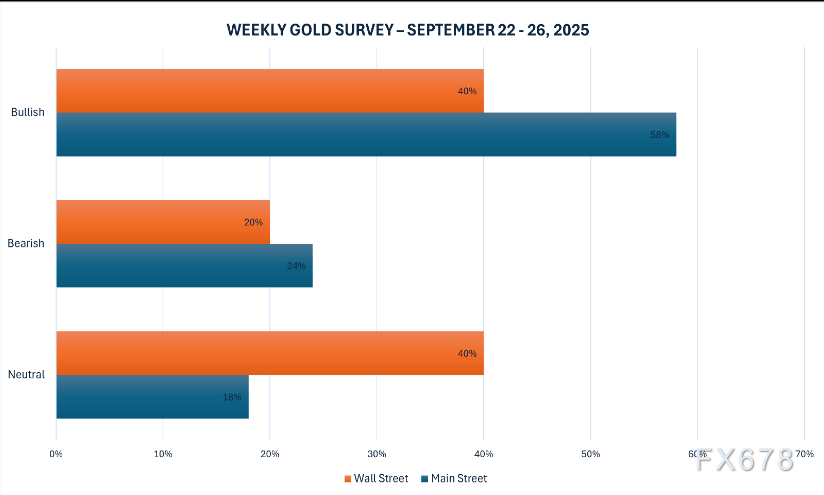
Kitco News' latest weekly gold survey captures a subtle shift in market sentiment. Wall Street analysts are returning to a neutral bias after the Federal Reserve cut interest rates, with 40% expecting gold prices to rise in the coming week, 20% bearish and 40% looking sideways. Retail investors are also cooling their enthusiasm, with 58% bullish on the upside, 24% forecasting a decline and 18% expecting a consolidation. This is a pullback from previous feverish bulls, and many experts such as Colin Cieszynski believe that gold prices need to take a break after a big rally, especially as news flow slows at the end of the quarter. Philippe Gijsels expects gold prices to hover around $3,600 in the short term, but strong long-term support as the next rate cut is just around the corner.
However, bullish voices remain strong. Adam Button and James Stanley believe that the Fed's hawkish test has only led to a small pullback, and buyers are ready for bottom fishing. Conversely, Alex Kuptsikevich warns of short-term downside risks, and may fall back to $3,200, but if the dollar's strength is only temporary, gold prices will resume their upward trend. CPM Group even issued a buy recommendation, targeting $3,710 and stopping losses at $3,650, emphasizing that the economy is softening but not contracting, and political factors will support gold prices. Overall, the survey shows that the market is digesting information from the Fed's events. Next week's data such as the PCE inflation report and new home sales will be key. If the data is weak, the gold rally will accelerate.
Gold is in the middle of a bull market and is strategically positioned for bargains
Looking ahead to this week, the market will usher in a series of key data, including Tuesday's US, Japan and Europe September PMI, Thursday's US second-quarter GDP final and durable goods orders, Friday's US PCE inflation report, and speeches by several Federal Reserve officials, especially the views of the new member of the Federal Reserve, Miran. These data will directly affect the probability of the Federal Reserve cutting interest rates in October, which is currently priced at 91.9% by the market. If the PCE shows that inflation is cooling and employment data is weak, gold prices are expected to resume their gains; conversely, if the data is strong, the pressure for correction will increase.
Despite the short-term technical overbuying and the suppression of the US dollar's rebound, the long-term logic of gold has not been shaken - the start of the Federal Reserve's interest rate cut cycle, the continuation of central bank gold purchases, and the increase in geopolitical risks all support the upward trend of gold prices.
Investors can focus on the layout opportunity to pull back to the $3,580- $3,600 area, and the upside target is looking to the $3,800-4,000 range. However, if the trade situation unexpectedly eases or the US economic data is significantly stronger than expected, it may trigger a phased correction in gold, and be vigilant against the risk of rising volatility.
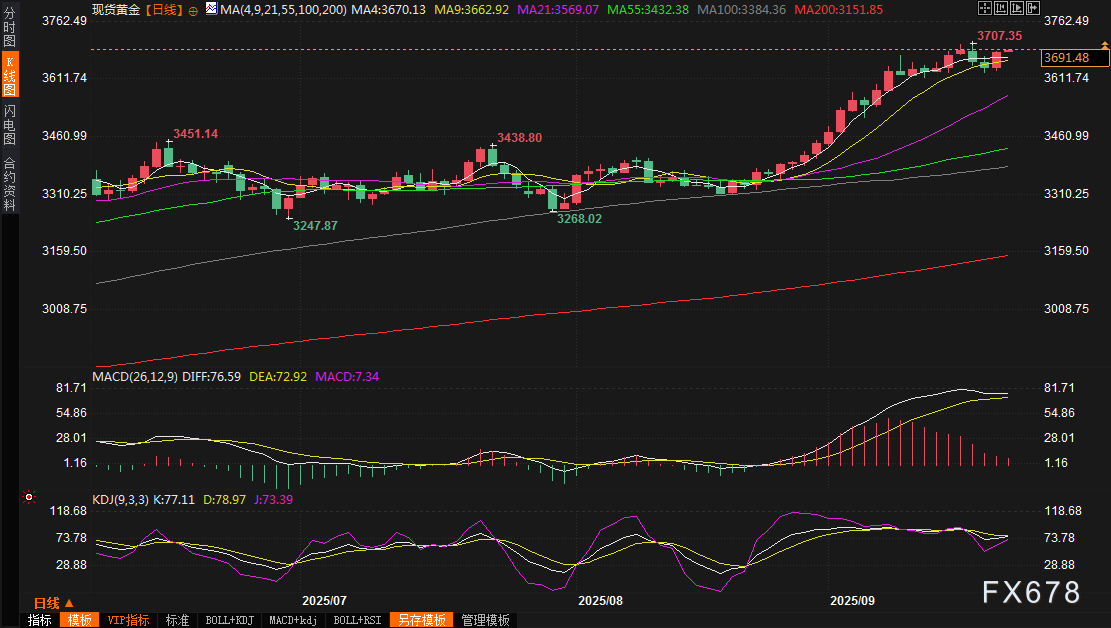
(Daily chart of spot gold, source: Internet)
At 06:26 Beijing time, spot gold was reported at $3691.82 per ounce.
Please indicate the source: https://www.daoctech.com/fxoutrade/2159.html
Disclaimer: The content of this article does not represent the views of the Institute of Foreign Exchange. The content is for reference only and does not constitute investment advice. Investors operate accordingly at their own risk.