
The Australian dollar bears counterattack? The key weekly closing battle starts, and PCE may detonate the market tonight
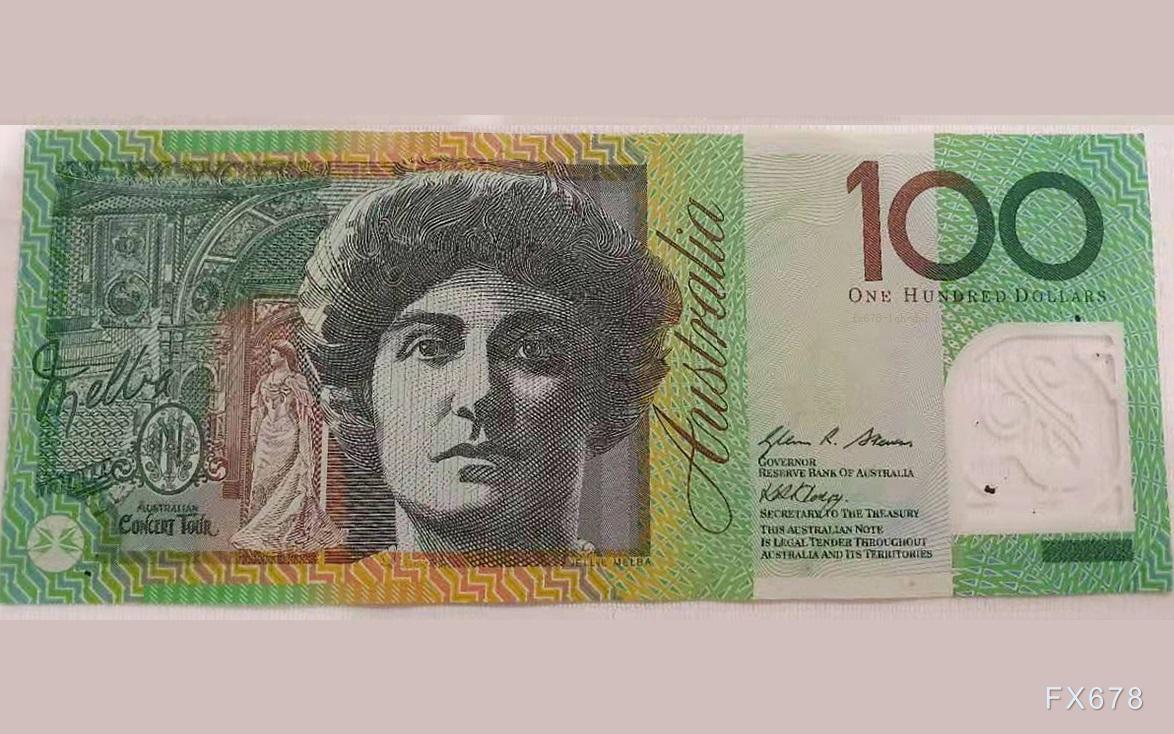
The Australian dollar stabilised around 0.6535 on Friday after falling for two straight sessions against the US dollar after coming under pressure as stronger-than-expected US economic data supported the greenback.
The news that US President Donald Trump plans to impose 100% tariffs on imported branded or patented medicines from October 1 (unless pharmaceutical companies build factories in the United States) has also generated risk aversion, which has also put downward pressure on the Australian dollar against the US dollar.
Australia's monthly consumer price index rose 3.0% year-on-year in August, up from a 2.8% increase in July. ASX 30-day interbank cash rate futures show the market now expects only a 4% chance of a September rate cut. After the data was released, market expectations for the Reserve Bank of Australia to cut rates at its November meeting have dropped to 50% from nearly 70% previously.
The Australian dollar is stable, and the US dollar is stable ahead of the release of PCE data
Markets are closely watching the release of the personal consumption expenditure price index, the Federal Reserve's preferred measure of inflation, later on Friday.
US GDP grew at an annualised rate of 3.8 per cent in the second quarter, higher than the previous and forecast 3.3 per cent, while the GDP price index rose 2.1 per cent over the same period, compared with expectations of 2.0 per cent.
Initial jobless claims fell from 232,000 to 218,000 last week, below market expectations of 235,000.
Kansas City Federal Reserve President Schmid said the rate cut will help ensure that the job market remains in good shape.
Chicago Fed President Goolsbee pointed out that he is in no hurry to ease policy further when inflation is above target and moving in the wrong direction.
Milan, the Fed's new governor, favors a more aggressive 50 basis point cut in case the labor market collapses.
San Francisco Federal Reserve President Daly said Wednesday that further rate cuts may be needed to restore price stability and provide necessary support to the labor market.
The S & P Global Composite PMI in the US edged down to 53.6 from 54.6 in August, indicating that private sector growth momentum was stunted. The manufacturing PMI slowed to 52.0 from 53.0 and the services PMI fell to 53.9 from 54.5, both indicating that demand may weaken.
Federal Reserve Chairperson Jerome Powell said on Tuesday that the impact of the weak labor market outweighed concerns about stubborn inflation, and therefore decided to cut interest rates at the September meeting. But he expressed satisfaction with the current policy path, while suggesting that if the FOMC believes that further easing is needed, it may continue to cut interest rates.
The White House announced that Australian Prime Minister Anthony Albanese and U.S. President Donald Trump will hold their first face-to-face meeting in Washington on October 20 to discuss the Orcus nuclear submarine agreement.
Australia's S & P composite global PMI fell to a three-month low of 52.1 in September from 55.5 as growth in both manufacturing and services slowed amid weak inflows of new business and a fall in goods orders at the fastest pace in eight months. The services PMI fell to 52.0 from 55.8 and the manufacturing PMI fell to 51.6 from 53.0.
Reserve Bank of Australia President Brock said earlier this week that labor market conditions have eased slightly and unemployment has risen slightly. She pointed out that recent interest rate cuts should support household and business spending, while stressing that the Reserve Bank of Australia must remain vigilant and ready to respond to changes.
technical analysis
The daily chart technical analysis shows that the AUD/USD is below the nine-day exponential moving average (EMA, 0.6579), indicating weak short-term price momentum.
In addition, the 14-day Relative Strength Index is below the 50 level, suggesting that bearish tendencies are dominant.
On the downside, the Australian dollar is initially supported at the September 2 low of 0.6483. If it falls below this level, the exchange rate may drop near the August 21 low of 0.6414 (a three-month low).
On the upside, the initial resistance is at the 50-day exponential moving average of 0.6549, and after a breakout, it may further test the nine-day exponential moving average of 0.6579. If these moving average resistance can be effectively broken, it will improve the short-to-medium-term price momentum and push the exchange rate up to the September 17 high of 0.6707 (an eleven-month high).
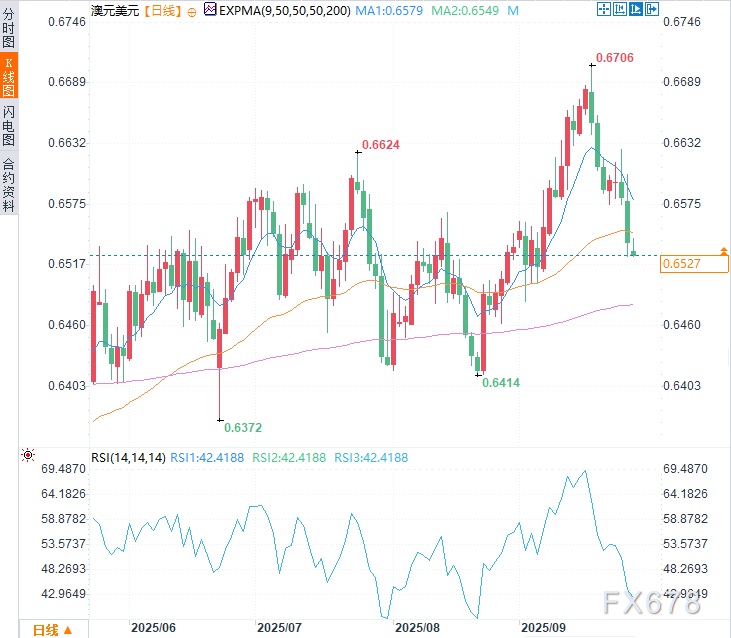
(Australian dollar/US dollar daily chart, source: Internet)
At 16:09 Beijing time, the Australian dollar was trading at 0.6533/34 against the US dollar.
Please indicate the source: https://www.daoctech.com/fxoutrade/2182.html
Disclaimer: The content of this article does not represent the views of the Institute of Foreign Exchange. The content is for reference only and does not constitute investment advice. Investors operate accordingly at their own risk.