
Crude oil trading alert: geopolitical situation heats up, oil prices test $100 round number again
On Monday, WTI crude oil prices continued last week's strong rally, quickly rising after the opening and breaking through for a while$100 integer markIn a sign that market sentiment has turned markedly tense following the weekend's events. Oil prices had risen about 3.5% on Friday, and this round of further gains was mainly driven by the sharp escalation of the situation in the Middle East.
The United States issued a tough signal at the weekend, demanding that key energy transportation corridors be reopened within a limited time or extreme measures will be taken against related energy facilities. The statement quickly raised the market's high vigilance for supply disruptions. As the core throat of global energy transportation,The Strait of Hormuz is responsible for about 20% of the world's seaborne crude oil transportationAny potential blockade or conflict would directly impact the global crude oil supply and demand balance.
At the same time, the situation in the Middle East has further deteriorated. The Iranian side has made it clear that it will launch countermeasures against the surrounding energy and infrastructure once the relevant threats are implemented. This "tit for tat" situation has significantly increased the risk of regional conflict spillover. In addition, long-range missile attacks on southern Israeli cities have caused about160 people were injuredThis has further strengthened market expectations for an escalation of the conflict.
In this context, the market's concerns about the security of the crude oil supply chain have rapidly increased. On the one hand, if the passage of the Strait of Hormuz is restricted, it will directly affect the export ability of the main oil-producing countries in the Middle East; on the other hand, if the energy infrastructure is targeted, it will lead to a prolonged supply recovery cycle, thereby pushing up the medium and long-term oil price hub. Investors' risk aversion has increased significantly, and funds have accelerated the flow into commodity assets such as crude oil.
From a macro perspective, this round of rise not only reflects the return of geopolitical risk premiums, but also reflects the current market's concerns about the elasticity of the supply side. In the context of global inventory levels that have not yet fully recovered and the policies of oil-producing countries remain uncertain, any unexpected event may be amplified by the market, resulting in rapid price fluctuations.
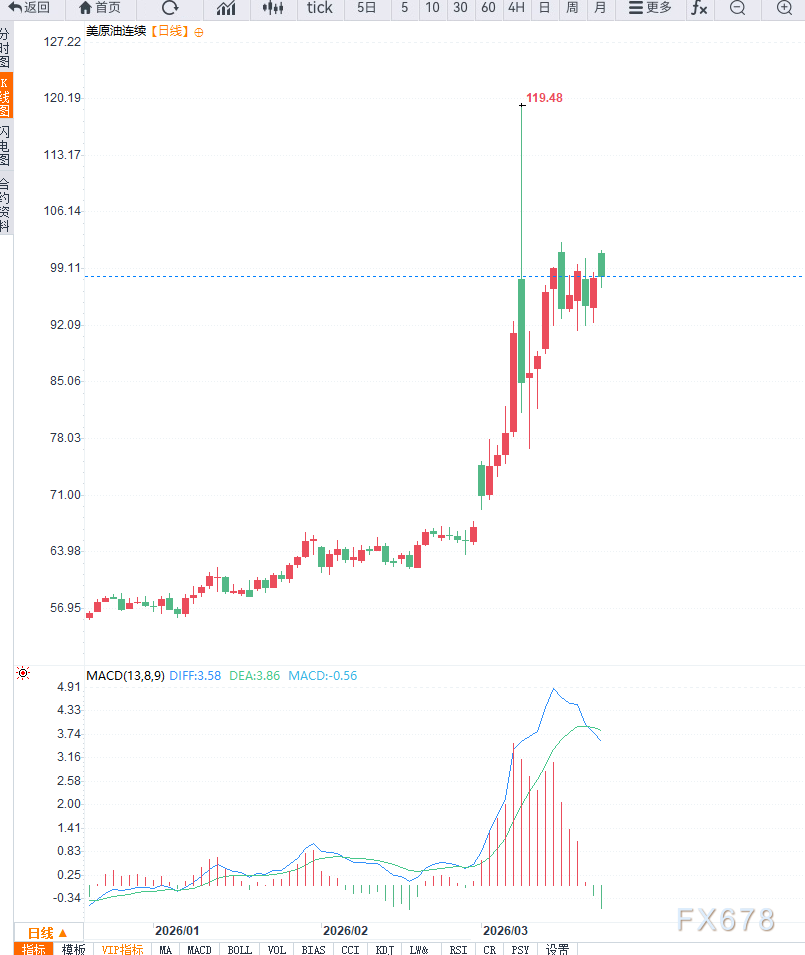
From a technical perspective, at the daily level, WTI crude oil had previously formed a phased support near $95, and then quickly broke through the key resistance of $98 under the impetus of risk events and tested$100 integer markThe current price structure shows obvious upward channel characteristics, and the moving average system begins to diverge upward again, indicating a strong medium-term trendIn terms of kinetic energy indicators, the RSI has entered a high area but has not yet formed a significant deviation, indicating that the bulls are still dominant, but need to be vigilant against the risk of a pullback caused by short-term overheating. The lower support focuses on the $98 and $95 areas. If the upper side effectively stands at $100, it may further explore the $103-105 range.
From the perspective of the 4-hour level, oil prices show an accelerated upward trend. The short-term moving average bulls are clearly arranged, and the price is running along the Bollinger Bands, indicating that the market sentiment is in an extremely bullish state. However, the MACD indicator has begun to show signs of high level dullness, indicating that although the upward momentum is strong, the margin has weakened. If there is a pullback in the short term, pay attention to the effectiveness of support in the $97-98 range; if the volume continues to break through, the short-term target may point to around $102.
Editor's summary:
Overall, the core driver of this round of oil price increases is the supply uncertainty brought about by the escalation of geopolitical conflicts, rather than the substantive improvement of fundamental supply and demand. In the current context, the market is more prone to overreact to unexpected events, resulting in increased price volatility. In the short term, the WTI oil price trend will be highly dependent on the further evolution of the situation in the Middle East, especially the passage of the Strait of Hormuz. Once the situation eases, the risk premium may fall quickly; but if the conflict expands, the upside of oil prices will still be opened up. Investors need to focus on geopolitical dynamics and the security of key transportation routes, while being vigilant against the risks posed by high volatility.
Please indicate the source: https://www.daoctech.com/fxschool/5228.html
Disclaimer: The content of this article does not represent the views of the Institute of Foreign Exchange. The content is for reference only and does not constitute investment advice. Investors operate accordingly at their own risk.