
When "safe haven assets" are hard to protect themselves: How can bond market volatility rewrite the trading logic of the foreign exchange market?
On Wednesday (September 03), the global financial marekting still pervaded a cautious atmosphere, especially in the context of continued high long-end bond yields. Although the recent bond sell-off has cooled, market participants remain highly vigilant about high debt levels and potential fiscal risks in various countries. This sentiment is deeply affectingforeign exchange marketDirection.

Market macro environment and fundamental analysis
The latest quote of the US dollar index was 98.2710, a slight decline of 0.03% during the day. At the same time, the euro was quoted at 1.1653 against the US dollar, an increase of 0.15% during the day. This small reverse movement is no accident, and it deeply reflects the core contradiction of the current market: the sharp fluctuations in long-end bond yields of major economies around the world.
Investors' concerns about highly indebted economies are behind the fact that long-term government bond yields, from Japan to the UK, have hit multi-year highs. As the head of fixed income research at a prominent institution put it, there has been a marked weakening of institutional demand for ultra-long-term bonds, adding to market fragility.
Specifically, the UK 30-year bond yield hit a new high since 1998, followed by a fall in sterling, reflecting market concerns about high UK borrowing levels and slowing economic growth. Similarly, the US 30-year bond yield hit the key psychological level of 5 per cent for the first time since mid-July, while German Bund yields rose to their highest level since 2011. Together, these phenomena point to a central issue: investors are reassessing the risk premium on sovereign debt.
On the news front, political developments around the world have also added uncertainty to the market. The UK prime minister's cabinet reshuffle and speculation about future tax increases are likely to dampen economic activity. A vote of confidence in the French prime minister and rumours that the Japanese prime minister could step down as a result of an electoral defeat have fuelled risk aversion. These political risks, combined with fiscal woes, are the main drivers of stress in the bond market.
It is worth noting that while Tuesday's large-scale bond issuance weighed on the market, eurozone bond yields fell back in trading on Wednesday, and long-end yields in the US and UK also retreated from their highs. However, this was only a surface calm. One portfolio manager pointed out that market participants once again focused on fiscal deficits and political risk, a theme that is likely to continue throughout the year.
Looking ahead to the market outlook, the US employment data to be released on Friday will be in the spotlight. If the non-farm payrolls data is stronger than expected, market expectations for the Federal Reserve to cut interest rates will have to be reversed, which will support the dollar. Conversely, if the data is weak, it could trigger a broad rally in the bond market, which could weaken the dollar.
Technical analysis and disk interpretation
From a technical perspective, the movement of the dollar index and the euro against the dollar is forming a subtle resonance with fundamentals.
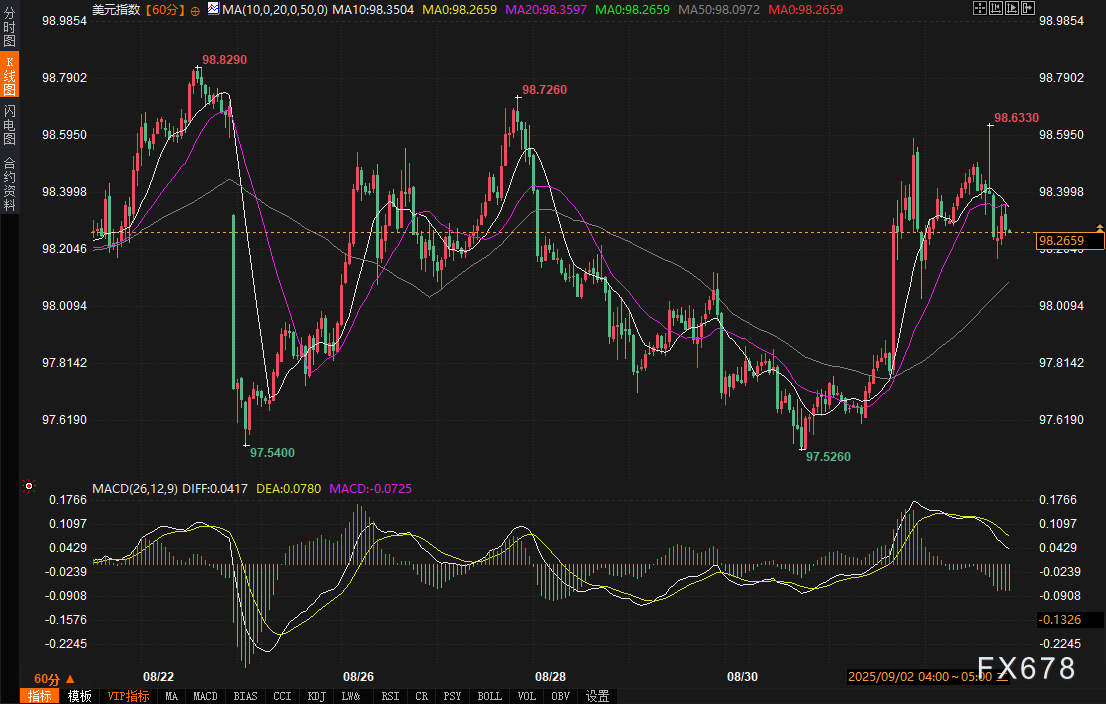
The dollar index is on the 60-minute chart, currently quoted at 98.2710. From the moving average system, the 10-day moving average (98.3551) and the 20-day moving average (98.3598) are still above the current price, which suppresses the index, and the distance between the two is very close, showing the balance of long and short power of the short-term moving average. The 50-day moving average (98.0974) is below the current price, providing lower support for the index. This shows that, despite the recent pressure on the dollar, the lower support is still relatively solid, and it may fall into range volatility in the short term. In terms of the MACD indicator, DIFF (0.0417) and DEA (0.0780) are both above the zero axis, but the DIF line has penetrated DEA and formed a dead fork, indicating that the short-term momentum has weakened.
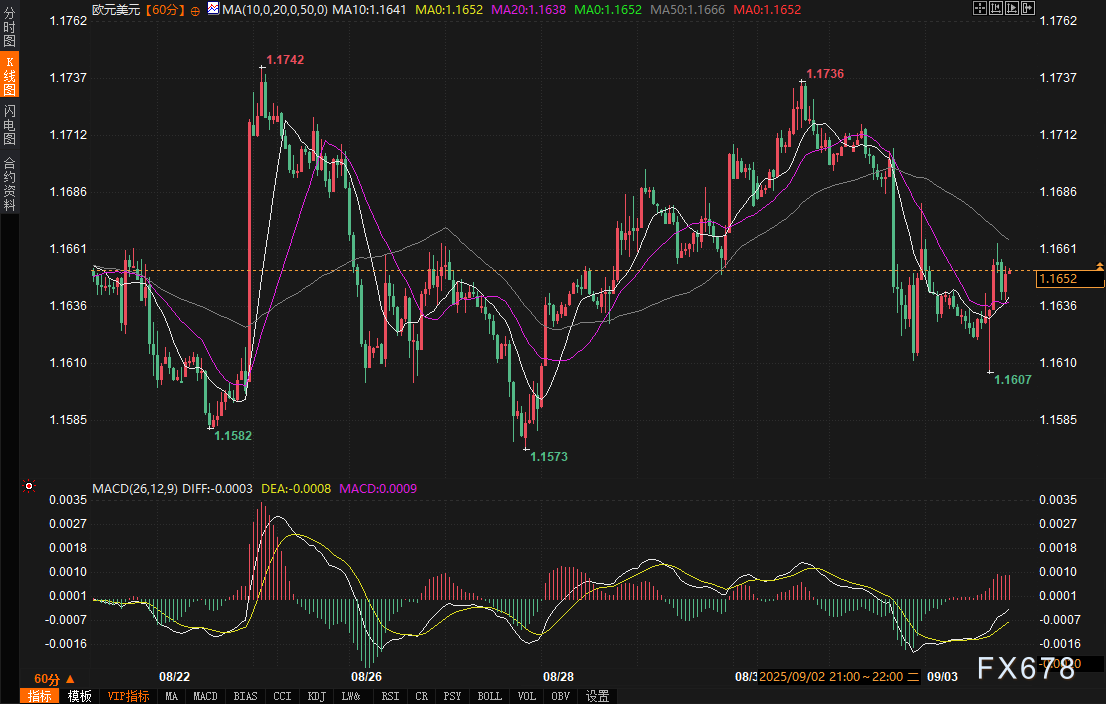
The EUR/USD is on the 60-minute chart with the latest quote at 1.1653. Its trend is opposite to that of the USD index. The 10-day moving average (1.1641) and the 20-day moving average (1.1638) have both crossed below the 50-day moving average (1.1666), forming a short-term golden fork pattern, showing some upward momentum. Although the 50-day moving average (1.1666) is still forming short-term resistance above the current price, the bulls of the euro are accumulating. In terms of the MACD indicator, both DIFF (0.0003) and DEA (0.0008) are above the zero axis, and the DIF line is about to cross the DEA, forming a golden fork, further confirming the short-term upward momentum of the euro.
Outlook on future trends
Overall, the turmoil in the global bond market is the main driver of the current volatility in the foreign exchange market. The short-term trend of the dollar will continue to be influenced by the volatility of yields and the upcoming US employment data. On the technical side, the dollar index still faces short-term resistance under the pressure of the moving average, but the support below is still strong, indicating that its downside is limited. The euro against the dollar is showing some upward momentum, but still needs to break through the key technical resistance level.
Going forward, market focus will continue to be on fiscal policy, economic data and political risks in various countries. A renewed sell-off in the bond market, or if key economic data exceed expectations, could trigger wild swings in the foreign exchange market. Senior traders need to keep a close eye on these macro variables, combined with technical analysis, and dynamically adjust their trading strategies to cope with any possible turns in the market.
Please indicate the source: https://www.daoctech.com/fxschool/1745.html
Disclaimer: The content of this article does not represent the views of the Institute of Foreign Exchange. The content is for reference only and does not constitute investment advice. Investors operate accordingly at their own risk.