
Powell's "pigeon sound" hit the US index, the market is betting on a September interest rate cut, and the Federal Reserve's policy focus turns to employment risks
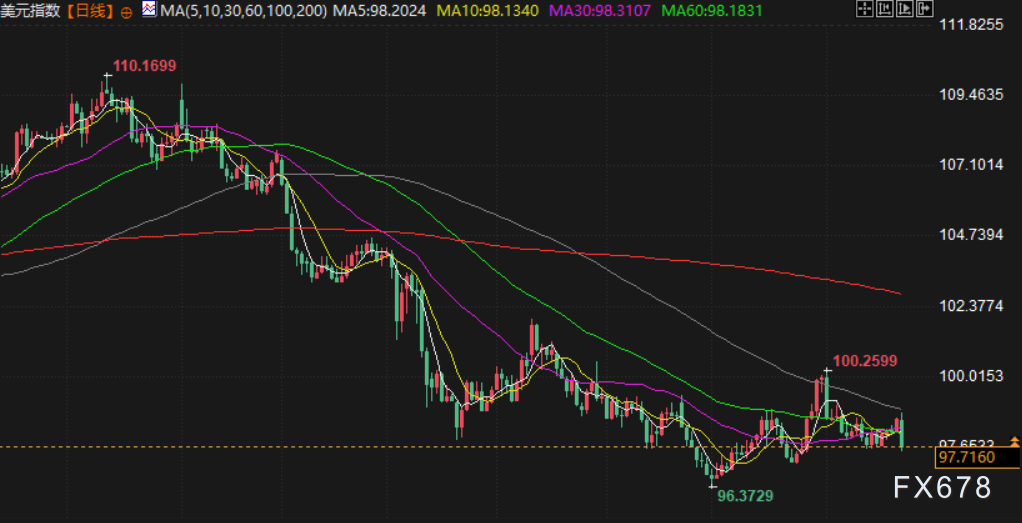
The dollar index fell 0.96% to 97.66 on Friday, as Federal Reserve Chairperson Jerome Powell pointed out that interest rates could be cut at the September meeting but did not commit. The index was trading around 98.7 before Powell's speech, and the dollar index fell slightly this week.
Fed Chairperson Jerome Powell reinforced market expectations for a September rate cut in remarks at the Jackson Hole Central Bank Seminar, saying: Changes in the baseline outlook and balance of risks may require us to adjust our policy stance, but he did not commit to a rate cut. He was very cautious in his speech, acknowledging growing risks to the job market while warning of continued inflationary pressures.
Mr. Powell said that while the labor market appeared to be in equilibrium, it was an odd one, caused by a marked slowdown in both supply and demand for workers, an unusual situation that suggested that downside risks to employment were rising. If those risks materialize, they could happen quickly.
He said the Fed faced a "tough situation". The impact of tariffs on consumer prices is now evident and is expected to accumulate over the next few months. The Fed still believes that the mere uncertainty that employment may exceed its maximum sustainable level does not necessarily require tightening.
Karl Schamotta, chief market strategist at Corpay in Toronto, said Powell's speech was much more dovish than the market expected. "The dollar is plummeting, the odds of a September rate cut are rising, and market participants are clearly preparing for more easing to come," he said.
Traders are pricing in an 85 per cent chance of a rate cut at the Fed's September 16-17 policy meeting, up from 72 per cent earlier on Friday, according to CME Group's FedWatch tool. They have also raised their expectations for a rate cut before the end of the year from 48 basis points to 54 basis points.
"The burden of proof to prevent the September rate cut now clearly falls on the data," Bank of America economists said in a note on Friday.
Traders have been raising expectations for a September rate cut after an unexpectedly weak jobs report in July. Consumer price data showed that the impact of tariffs on inflation has been limited so far. But higher-than-expected producer price inflation and some other economic data, including a strong August survey of business activity, tempered their views. Now, labor market data is expected to be the main driver of future Fed policy.
Schamotta said: "What he really means is that they are preparing for an inflection point in labor market conditions, where the second part of the Fed's mandate suddenly becomes more important in setting policy."
The dollar has come under pressure this week amid market concerns over the independence of the Federal Reserve after President Donald Trump said he might seek to fire Federal Reserve governor Tim Cook, after calling on him to resign on Wednesday over allegations that she held mortgages in Michigan and Georgia.
Helen Given, a global currency trader at Money USA, said: "Trump's comments on Cook have reignited concerns about the independence of the Federal Reserve, as it becomes increasingly clear that the government may want to reshape the Fed as it pleases."
Trump has repeatedly criticized Powell for being too slow to cut interest rates, and traders expect him to appoint a more dovish replacement when Powell's term ends in May.
The euro rose 1.06 percent to $1.1728, peaking at $1.1742, its highest since July 28. The dollar fell 1.08 percent to 146.77 against the yen. On Friday, the dollar recorded its biggest one-day decline against the euro and yen since the July jobs report was released on August 1.
A sharp rise in a key measure of wage growth in the eurozone has prompted the European Central Bank to remain cautious about further cuts in interest rates.
Negotiated wages rose 4 per cent in the second quarter from a year earlier, the European Central Bank said on Friday, up from 2.5 per cent in the first quarter but still below the 5.4 per cent peak set in 2024.
The ECB is confident of stabilizing inflation at 2%, on the basis that wage growth will slow and that inflation in the labour-intensive service sector, which remains around 3%, will also decline.
Its own pay tracker for the 20-member eurozone suggests that wages will fall significantly early next year. While the Bundesbank reported a sharp rise in German wages this quarter, it also expects them to fall in the coming period "due to lower inflation and a poor economic environment".
Martin Ademmer, economist at Bloomberg, said: "The sharp rise in the negotiated wage growth indicator is likely to be caused by one-off payments, which should be temporary. We expect wage pressures to ease in the coming quarters, which should help bring down still-high service sector inflation. With recent data showing that the region's economy remains stable in the face of the US tariff shock, the ECB may wait until December for further monetary easing."
The European Central Bank is widely expected to leave its key deposit rate unchanged at 2 per cent when it reconvenes after its summer recess in September, marking a continuation of the rate freeze that has prevailed since last year's year-long drive to cut rates.
Most officials see interest rates at an ideal level that will neither depress nor boost economic activity, although some say further cuts should not be ruled out.
The dollar fell 1.08% against the yen on Friday to 146.77, marking its largest one-day decline since the July jobs report was released on August 1.
Excluding volatile fresh food prices, consumer prices rose 3.1 percent last month from a year earlier, after rising 3.3 percent in June, according to government data released on Friday. That was higher than the 3.0 percent increase expected in a survey of economists by data provider Quick.
Against the backdrop of trade uncertainty easing following Japan's deal with the United States, economists and investors expect the Bank of Japan to resume monetary tightening in the near term as persistent inflation, particularly rising food prices, hurts consumers' wallets.
In its latest outlook, published at the end of July, the Bank of Japan's policy committee raised its inflation forecast and now expects consumer prices excluding fresh food to rise 2.7 per cent in the current financial year to March 2026.
The Bank of Japan maintained its policy setting unchanged at its July meeting. Governor Kazuo Ueda said there was little risk of falling behind in tackling inflation, while noting that it was still unclear how U.S. tariffs would affect the country's economy.
Nearly two-thirds of economists said the BoJ would raise its benchmark interest rate again later this year by at least 25 basis points, up from just over half a month ago, according to a Reuters poll.
Please indicate the source: https://www.daoctech.com/fxschool/1838.html
Disclaimer: The content of this article does not represent the views of the Institute of Foreign Exchange. The content is for reference only and does not constitute investment advice. Investors operate accordingly at their own risk.