
November 14 Financial Breakfast: Federal Reserve officials are cautious about rate cuts, gold prices fall back from three-week highs, oil prices weigh conflicting signals
In early Asian trading on Friday (November 14, Beijing time), spot gold traded near $4,180/oz. Gold prices retreated after hitting a three-week high of $4,244.96/oz on Wednesday, giving up early gains that may boost interest rate cut expectations after the U.S. government reopened. Although the market expects that economic data showing a weak labor market will be released after the U.S. government reopened, which may prompt the Federal Reserve to cut interest rates in December. However, as Federal Reserve policymakers have recently expressed a cautious attitude towards further interest rate cuts, market sentiment has quickly turned; U.S. crude oil traded near $58.89/barrel, and oil prices stabilized on Wednesday. The market weighed continued concerns about a global supply glut and possible supply disruptions caused by sanctions on Russia's Lukoil company.

Focus on the day
stock market
U.S. stocks suffered their biggest one-day decline in more than a month on Thursday, with all three major stock indexes closing lower. Shares of artificial intelligence giant Nvidia tumbled 3.6% and Tesla plunged 6.6%, dragging down the overall performance of the technology sector. The sell-off was mainly driven by investors' continued concerns about inflation and divisions within the Federal Reserve over the economic outlook, which led to a significant cooling of market expectations for interest rate cuts.
The S & P 500 fell 1.66% to 6,737.49, the Nasdaq tumbled 2.29% to 2870.36 and the Dow Jones Industrial Average fell 1.65% to 47,457.22. Consumer discretionary and information technology sectors led the decline, falling 2.73% and 2.37% respectively.
The odds of a December rate cut have plummeted to about 47 per cent from 70 per cent last week as a number of Fed policymakers signalled caution about further easing. The fundamental question, analysts say, is whether tariff inflation is only temporary, which is why some Fed governors are reluctant to cut rates.
The S & P 500 value index is up about 1 per cent so far this week, while the growth index is down 0.6 per cent, reflecting a shift of money away from highly valued tech stocks to other sectors. Economists say: We are experiencing a small correction in the market for artificial intelligence and we are seeing a market rotation.
In terms of individual stocks, Disney tumbled 7.8%, while Cisco bucked the trend by rising its earnings forecast by 4.6%. Despite the end of the 43-day government shutdown, ADP data showed continued weakness in the labor market, with private companies shedding more than 11,000 jobs a week, casting a shadow over the market recovery.
Jin Shi
Gold prices retreated from a three-week high hit at the start of trading on Thursday, with spot gold falling 1.1% to $4,151.86 an ounce, giving back early gains that could boost expectations of a rate cut after the U.S. government reopened. Spot silver fell 2.3% to $52.18, while platinum and palladium fell 2.8% and 3.7%, respectively.
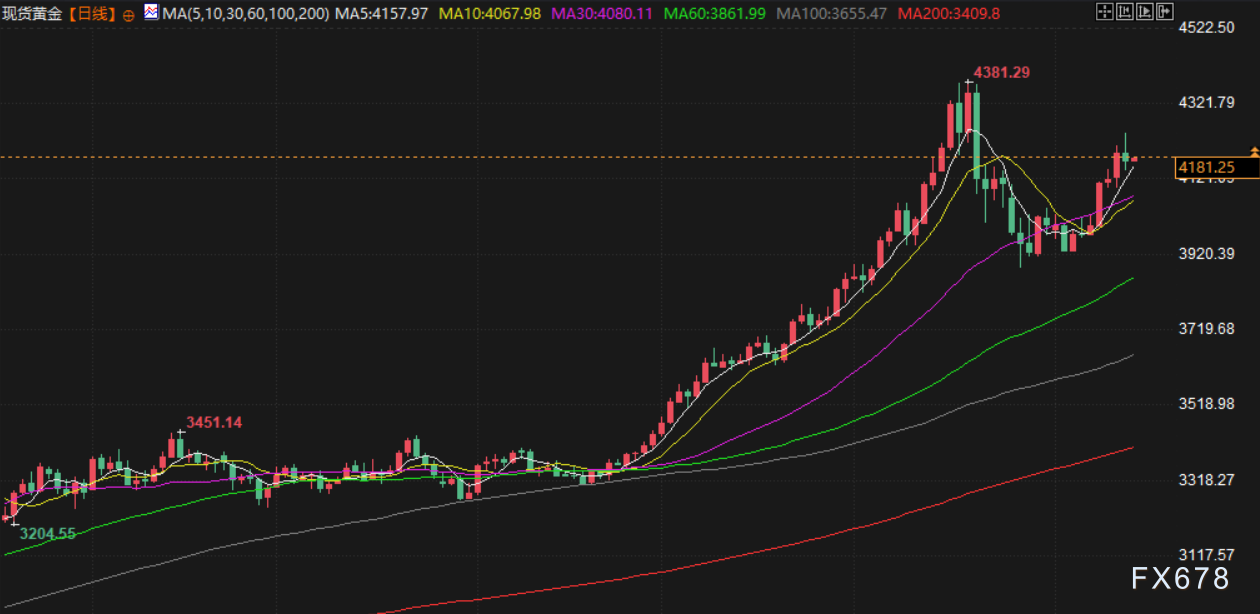
Gold prices initially rallied to $4,244.96, their highest level since October 21, on expectations that economic data showing weakness in the labour market after the government reopened could prompt the Federal Reserve to cut interest rates in December. However, as Fed policymakers have recently expressed caution about further rate cuts, market sentiment has quickly turned.
Traders pointed out: This is a classic buy-the-news-sell-the-facts scenario - a broad sell-off following the reopening of the US government. Despite the Federal Reserve's interest rate cut last month, Chairperson Jerome Powell stressed that further easing was uncertain, and persistent inflation concerns prompted traders to reassess the outlook for interest rates.
Analysts said precious metals markets were caught up in a broad sell-off in equities, bonds, the dollar and cryptocurrencies. Gold prices are likely to remain under pressure in the short term as expectations of a Federal Reserve rate cut cool and investors take profits after the government shutdown ends, but remain above the key technical support level of $4,150.
oil market
Oil prices held steady on Thursday, with Brent crude futures edging up 0.5 percent at $63.01 a barrel and U.S. crude up 0.3 percent at $58.69 a barrel, recouping some of their losses after falling 4.2 percent on Wednesday.
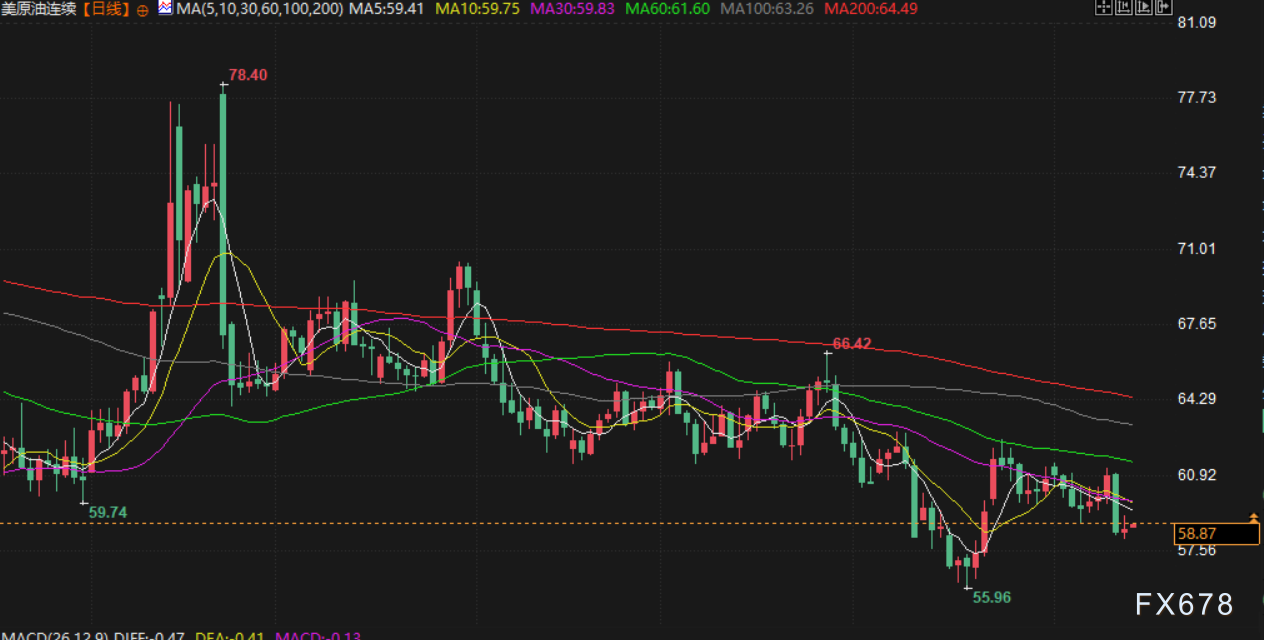
Markets are weighing conflicting signals at the same time: persistent concerns about a global supply glut on the one hand, and possible supply disruptions from sanctions on Russia's Lukoil on the other. Suvro Sarkar, head of DBS's energy team, noted: "There should be considerable support for oil prices around $60 a barrel, especially given the potential for short-term disruptions to Russian exports once tighter sanctions kick in."
However, the fundamental pressure still cannot be ignored: the US Energy Information Administration data shows that crude oil inventories unexpectedly increased by 6.40 million barrels last week, far exceeding expectations by 1.96 million barrels, gasoline and distillate inventories fell less than expected, OPEC forecasts that global oil supply will slightly exceed demand in 2026, and the International Energy Agency raised its forecast for global oil supply growth this year and next in its latest monthly report. Although geopolitical factors provide some support, the worsening trend of supply and demand fundamentals is still dominating market sentiment. Investors will continue to pay attention to the actual impact of the upcoming Russian oil sanctions and whether OPEC + will make production policy adjustments. The current oil price is in a technical consolidation stage, waiting for clearer directional guidance.
currency market
The dollar came under pressure on Thursday as the US government ended its historic shutdown, with the dollar index falling 0.35 per cent to 99.14 and the euro up 0.4 per cent to $1.1638, its highest level since October 29. Traders were assessing the long-term impact of the shutdown on the dollar's creditworthiness as they awaited the release of a backlog of economic data.
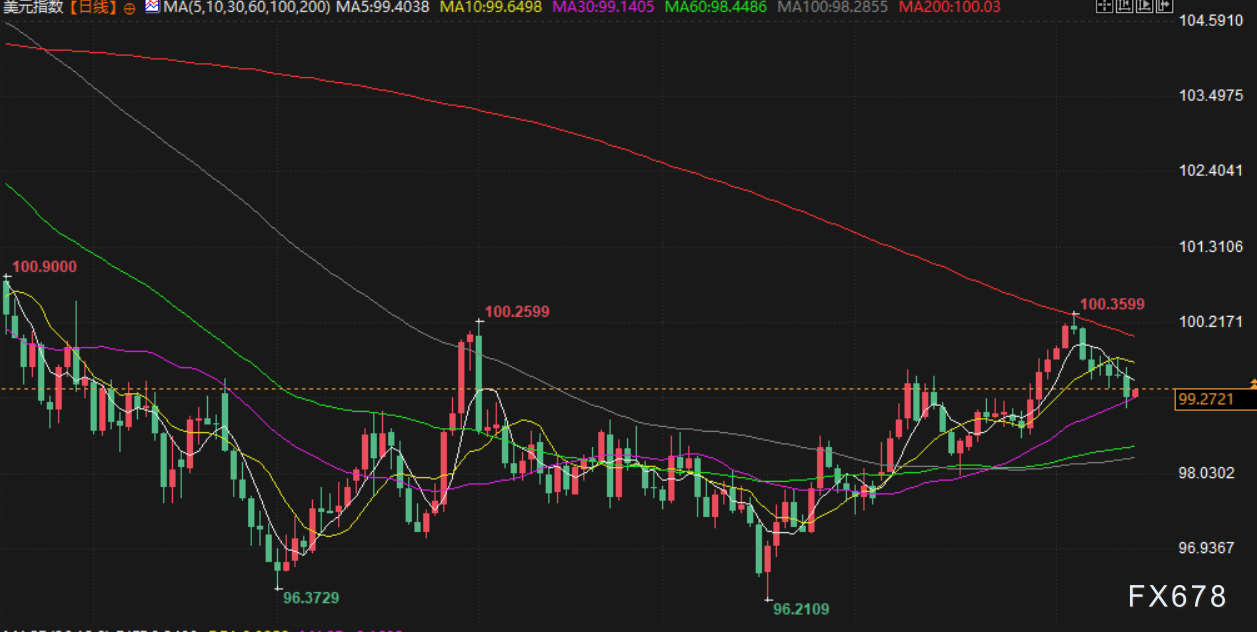
Market expectations for a December rate cut by the Federal Reserve have dipped below 50 percent, but the shift has not boosted the dollar. "While the shutdown is over, how soon will we get back to normal? How soon will we see data? That's still unknown," noted Juan Perez, head of trading at Monex USA. White House economic adviser Hassett confirmed an October jobs report, but it will not include unemployment data.
There are clear differences within the Federal Reserve on the policy path: San Francisco Fed President Daley is open to decision-making in December; Minneapolis Fed President Kashkari sees "mixed" economic signals; Cleveland Fed President Hamak hints against a near-term interest rate cut, St. Louis Fed President Mousalem believes there is limited room for further easing.
European officials are discussing creating an alternative pool of US dollar funds to the US Federal Reserve to reduce dependence on the US. The yen has continued to weaken, falling to its lowest level against the euro since 1999, and despite a "verbal warning" from Japan's finance minister, traders expect only a 24 per cent chance that the Bank of Japan will raise interest rates in December. Sterling rallied unexpectedly against a backdrop of economic stagnation, while the Australian dollar gave up gains after jobs data boosted it.
The dollar's short-term trajectory will depend on the quality of incoming economic data and clarity on the Fed's policy path, with the statistical gap created by the shutdown likely to continue to influence market perceptions of the health of the US economy, creating uncertainty about currency movements.
International News
The six-week government shutdown in the United States ended, causing permanent economic losses of more than $10 billion
The six-week US government shutdown officially ended on Wednesday evening local time. Although the standoff is temporarily lifted, the drag on the US economy, which is already facing multiple challenges, will continue, and the full impact may take months to become fully apparent. According to estimates by the Congressional Budget Office (CBO), the shutdown is expected to reduce economic growth in the fourth quarter of this year by about 1.5 percentage points, equivalent to a halving of the growth rate. Although the government restarts, the economy may recover by 2.2 percentage points in Quarter 1 next year, but there will still be a permanent loss of about $11 billion in economic activity. In comparison, the longest government shutdown in history, which lasted 35 days from 2018 to 2019 (affecting only some institutions), had an impact on GDP of only 0.02%, much lower than the impact of this shutdown.
European Union considers consolidating non-U.S. dollar reserves in hopes of reducing dependence on the Federal Reserve
According to reports, European financial stability officials are discussing plans to create an alternative to the Federal Reserve's liquidity support mechanism by consolidating dollar reserves held by central banks outside the United States. The move is aimed at reducing dependence on the United States under the Trump administration. According to reports, the relevant negotiations are still at the working group level, have not yet reached the decision-making level of the European Central Bank, and involve many central banks inside and outside the euro zone. White House spokesperson Kush Desai said Trump "has repeatedly reaffirmed his commitment to maintaining the strength and influence of the dollar".
U.S. Secretary of Agriculture: Most SNAP policyholders will receive November benefits by Monday at the latest
Agriculture Secretary Rawlings said her department last night had begun work on distributing full Supplemental Nutrition Assistance Program (SNAP) benefits for November after the government reopened. "The work is moving forward. Good news is coming for those who truly depend on it," she said. Rawlings added that insured people can expect to receive benefits by the end of the week, "and most will receive them by Monday at the latest." Rawlings said last month that the USDA's inability to issue food stamps in November left nearly 42 million Americans in limbo. The decision sparked lawsuits that led a federal court to demand partial payments from the agency and then another full appropriation before the Supreme Court halted the ruling to provide full benefits.
Most Canadians believe the US-Canada trade deal will be difficult to reach within six months
Most Canadians see little chance of reaching a trade deal with the US within the next six months after US President Donald Trump broke off talks over an anti-tariff advertising campaign in Ontario. Some 67 per cent of Canadians said a deal to reduce US tariffs was "unlikely" in the next six months, while 28 per cent thought it was "likely" and 3 per cent said they were unsure, according to a poll by Nanos Research Group. Canadians may understand why Mr. Carney has so far failed to reach a deal with the mercurial US president, according to surveys by the Nanos research group. Mr. Carney, the Canadian prime minister, has previously said talks were moving towards a deal on steel, aluminium and energy. But as the trade standoff persists and economic pressures intensify, their patience may gradually run out.
Interest rate derivatives contracts show less than 50% chance of Fed rate cut in December
US short-term interest rate derivatives contracts show markets expect a 25 basis point cut in December to be less than 50 per cent. Fed funds futures and overnight index swaps (OIS) contracts tied to the Fed's December 9-10 meeting suggest a 25 basis point cut is just under 50 per cent.
The International Energy Agency has raised its forecast for a global oil supply glut for the sixth consecutive month
The International Energy Agency has raised its forecast for a global oil glut next year for the sixth month in a row, as OPEC + continues to restore supply and demand growth remains weak. The report said global oil supply will exceed demand by about 4 million barrels a day in 2026, a slight increase from last month's forecast. The IEA pointed to a "growing imbalance between supply and demand" in global oil, and the agency has raised its surplus forecast every month since June. Toril Bosoni, head of the IEA's oil markets and industries division, said in an interview with Bloomberg TV: "We are seeing continued increases in global crude oil supply while demand growth is relatively modest."
The British government has given up its plan to raise income tax
Prime Minister Starmer and Chancellor of the Exchequer Reeves have decided to abandon a previously proposed budget plan to raise income tax rates, according to the Financial Times. The move marks an important shift in the direction of the British government's tax policy.
The United States has reached a trade agreement with many countries to reduce tariffs on products such as coffee in Latin America
Senior US officials said on Thursday they had signed trade deals with several Latin American countries that would provide tariff relief on some imports such as coffee and fruit. In the current economic environment, coffee has become a symbol of the "affordability crisis" when people judge the Trump administration's economic policies, just as eggs represented during the Biden administration. Data show that coffee prices rose by the most in any category tracked by the Consumer Price Index (CPI) in September. Earlier this week, Treasury Secretary Vicente Bessant promised that pressure on coffee prices would soon ease. The deal covers Argentina, Ecuador, El Salvador and Guatemala, and the US will reduce tariffs on some non-domestically produced goods, such as coffee and bananas from Ecuador.
Domestic News
The first 1,000-ton super-large single gold deposit in China was discovered
The Ministry of Natural Resources today (November 14) announced a major prospecting achievement. Liaoning Geology and Mining Group successfully discovered the first large gold deposit of 1000 tons and low grade in the Liaodong area in China - Dadonggou Gold Deposit. The amount of gold metal discovered is 1444.49 tons, which is the largest single gold deposit discovered since the founding of New China. The Ministry of Natural Resources said that the total amount of gold ore discovered in the Dadonggou Gold Mine above minus 720 meters was 2.586 billion tons, the amount of gold metal was 1444.49 tons, and the average grade was 0.56 g/ton. According to reports, Dadonggou Gold Mine is another large and low-grade open-pit gold deposit discovered in our country. It has been demonstrated through the economic development and utilization, and the expected benefits are good. During the exploration process, nearly 1,000 staff worked together to shorten the exploration work time to 15 months, creating a precedent for "short-cycle, high-quality" gold exploration in China. (CCTV News)
The latest trading data of the futures market is released, and the turnover in the first 10 months increased by nearly 22% year-on-year.
Recently, the China Futures Industry Association released the latest statistics on the national future market trading situation. According to the data, in unilateral calculation, the national future market turnover in October was 603 million lots and the turnover was 61.22 trillion yuan, a year-on-year decrease of 13.26% and an increase of 4.54%. From January to October, the national future market cumulative turnover was 7.347 billion lots and the cumulative turnover was 608.84 trillion yuan, an increase of 14.86% and 21.82% respectively.
Please indicate the source: https://www.daoctech.com/fxschool/1925.html
Disclaimer: The content of this article does not represent the views of the Institute of Foreign Exchange. The content is for reference only and does not constitute investment advice. Investors operate accordingly at their own risk.