
The oversupply and geopolitical game are intertwined, and the international crude oil market is facing a repricing
On Tuesday (November 25), during the Asia-Europe session, the crude oil market continued to adjust downward by 0.31%, trading at 58.66, failing to continue yesterday's rebound. The crude oil market has encountered significant downward pressure so far this year, and Brent crude oil has fallen by 14% this year.
The recent decline in oil prices has been resistance-driven by the strengthening stock market on the one hand, and pressure on oil prices on the other hand, stemming from expectations of the resumption of peace talks between Russia and Ukraine and unaffected supply.

Russian-Ukrainian peace talks affect oil price supply expectations
The US and Ukraine held talks in Geneva on Sunday that both sides described as "productive" and agreed to continue intensive talks on a "full-fledged" US peace plan.
The market generally believes that some restrictions and restrictions on Russia may be relaxed if peace is achieved in Ukraine, which will further put downward pressure on energy prices, but in the short term, marginal changes in geopolitical risk premiums are causing traders to reprice.
However, Ukrainian officials disclosed that the new peace plan contains 19 clauses and does not place hard constraints on the size of Ukraine's military. Judging from the probability of the agreement's implementation, Russia has doubts about the acceptance of the above clauses, and the geopolitical negotiations are still at an impasse.
The rise in oil prices in the market yesterday may have gambled against the original 28 contracts proposed by the United States, with little prospect of signing them.
Donald Trump, US president, also tweeted on his social media platform that "positive developments may be taking place" as markets focus on the developments and traders wait for further clear signals as risk assets strengthen.
Arne Roman Rasmussen, chief analyst at Global Risk Management, pointed out that the oil market is likely to remain tense before Thanksgiving this Thursday, and the probability of a peace agreement or ceasefire agreement during the weekend may increase, which may support further downward oil prices.
Dennis Kisler, senior vice-president of financial trading at BOK, expects the market to remain volatile ahead of the holiday and there may be short covering.
It is worth noting that U.S. crude oil futures are expected to record their fourth consecutive monthly decline, which would be the longest decline cycle since 2023.
Trade pattern adjustment: restrictions on Russia have not seriously affected crude oil supply
Another important variable on the supply side is the restructuring of global crude oil trade flows following the escalation of restrictions on Russia.
After the United States initiated restrictions on Russia's leading energy producers Rosneft PJSC and Lukoil PJSC, the restrictions are a further escalation on the basis of previous restrictions on GazpromNeftPJSC and Surgutneftegas PJSC. As a result, Indian refiners have significantly increased their crude oil purchases from other regions such as the Middle East.
However, the actual impact on crude oil supply was contrary to market expectations. Due to the low price strategy of Russia's core crude oil variety "Urals" (Urals), it caused Indian refiners to loosen their attitude.
According to people familiar with the matter, the current price quoted by Indian refiners to purchase Urals crude oil has reached a discount of up to $7 per barrel to the spot price of North Sea Brent crude oil (DatedBrent), the lowest level in at least two years. The batch of quotations corresponds to crude oil freighters loaded in December and arriving in January 2025.
That is, before and after the restriction, the supply of crude oil was not significantly restricted, but India bought it cheaper and Russia earned less.
It is worth noting that only about one-fifth of all currently quoted crude oil carriers are from entities that are not included in the blacklist of restrictions, which means that despite the price attractiveness, the risk of restrictions on compliance still limits the recovery space of Russia-India crude oil trade.
Institutional blockbuster forecast: oversupply dominates long-term downtrend
Brent crude, the international oil benchmark, could hit $30 a barrel by 2027, hit by a severe glut in the global oil market, according to JPMorgan's latest forecast. The pessimistic outlook is underpinned by concerns about continued expansion on the supply side - the International Energy Agency has warned of a record crude glut in 2026.
Goldman Sachs gave a more specific short-term to medium-term outlook: in 2026, the average daily oversupply of US benchmark West Texas Intermediate crude oil (WTI) will reach 2 million barrels, and the annual average price may be only $53 per barrel. The bank's global commodity research co-head Dan Stru Wen made it clear that oil prices will continue to decline next year, and advised investors to decisively lay out crude oil short orders.
However, Goldman Sachs also pointed out that 2026 will be the final year for the current large-scale supply wave to hit the market, and the oil market is expected to complete the rebalancing in 2027.
Although institutions are collectively bearish, there is still a consensus of support in the market: analysts and investment banks generally believe that even if oil prices decline in the short term due to strong supply from OPEC + and non-OPEC producers in the Americas, it will be difficult to fall below the $40 per barrel mark.
Trading Perspective Outlook: Focusing on core variables and key price points
For crude oil traders, the core contradiction in the current market is the game between "long-term oversupply" and "short-term geopolitical disturbances", and three variables need to be focused on: First, the substantive progress of the peace talks between Russia and Ukraine. If a ceasefire agreement is reached, the relaxation of restrictions may bring additional supply and further suppress oil prices;
The second is the trend of OPEC + production cuts. If the oversupply continues to intensify, whether oil-producing countries will initiate a new round of production cuts will become a key support.
The third is the enforcement of restrictions on Russia and the scope for exemptions, which directly affects the export scale of Ural crude oil and the structure of global trade flows.
From a technical perspective, although the average price of oil prices is all short, the oil price still holds the key price levels of 58.60 and 57.25, and the bulls still hold the technical support of counterattack at any time. The market is waiting for Russia and Ukraine to sign an agreement. It is expected that a new round of armistice agreement will be signed on November 27.
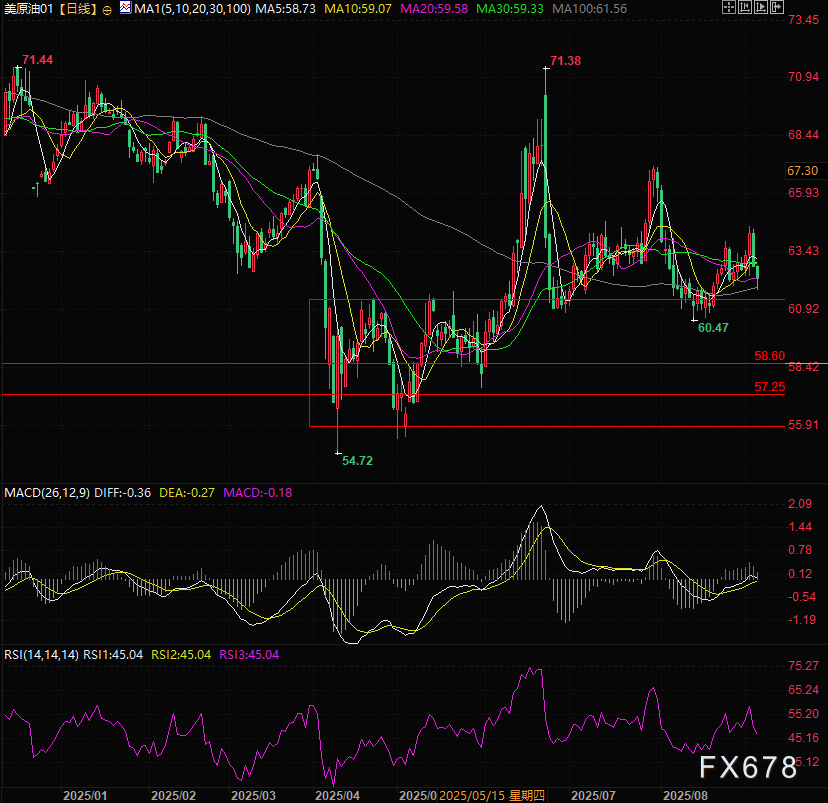
(U.S. crude oil futures January contract daily chart, source: Internet)
At 19:26 Beijing time, US crude oil is now trading at $58.58 per barrel.
Please indicate the source: https://www.daoctech.com/fxschool/1962.html
Disclaimer: The content of this article does not represent the views of the Institute of Foreign Exchange. The content is for reference only and does not constitute investment advice. Investors operate accordingly at their own risk.