
Balance sheet shrinkage stops, repurchase rates rise: is the dollar funding side quietly changing?
Recently, the US dollar index has weakened as a whole, and the price has fallen back to near the 99 line. Compared with the strong price of some risk assets and the relatively stable performance of the bond market, the weakness of the US dollar is particularly conspicuous. Analysts generally believe that this is not only a technical adjustment, but also a concentrated reflection of future monetary policy and economic outlook expectations.
Subtle shifts in market sentiment tend to start with currencies. The decline in the dollar index means that investors' expected returns on dollar assets are no longer as attractive as they used to be. This is especially as the US Federal Reserve moves towards more accommodative policy, funds are reassessing the relative strength of the dollar in global currencies, and demand for safe havens has cooled.
In such an environment, any news related to the direction of the Federal Reserve's policy will be amplified by the market. The rumors of the Fed chairperson's selection, changes in key economic data, and the tightness of the capital market have all become "invisible weights" on the dollar.
Hassett Rumors and the FOMC Mechanism: A Game Over "Lower Interest Rates"
Trump has publicly stated that he will nominate a new Fed chair in early 2026, naming Kevin Hassett, director of the White House National Economic Council, as one of the potential candidates. This statement immediately attracted market attention because Hassett is seen as a more dovish economist who has long advocated more aggressive interest rate cuts, and even emphasized that he is highly consistent with Trump's view that "interest rates can be lower."
For the dollar, such expectations are extremely damaging. If the Fed strengthens its easing orientation under Hassett in the future, the long-term interest rate center may move down, the relative return of dollar assets will be further compressed, and funds will naturally tend to look for higher-yielding or more policy-neutral currencies and assets, thereby accelerating the weakening of the dollar.
However, analysts also emphasize that the Federal Reserve chairperson is not "a one-person decision". The actual decision-making power is in the hands of the FOMC (FOMC), which consists of seven Fed governors and five Federal Reserve Bank presidents, each with one vote. Even if the chairperson's personal position is dovish, he needs to obtain a majority of support within the FOMC for monetary policy to truly change. Therefore, Hassett's personal preference is more of a directional signal than an absolute instruction.
Economic Data and the Yield Curve: Fundamental Footnotes for a Weaker Dollar
In addition to the rumors of the chairpersonship, recent US economic data has also quietly matched the narrative of "loose expectations". In the labour market, although the unemployment rate is still relatively low, the signs of weakening demand for workers, slowing hiring and cooling wage growth are beginning to appear, which means that the internal growth momentum of the economy is insufficient. On the consumer spending side, there are also early signs of weakness, and the willingness of the household sector to spend is not as strong as before.
At the inflation level, there is still some upward pressure on prices in the short term, but the overall inflation risk is weakening, and the inflation level has not yet reached the Federal Reserve's target steadily. For the Federal Reserve, which has always been "pegged to inflation and employment", the combination of economic slowdown and easing inflationary pressure objectively leaves room for further interest rate cuts. It is also based on this that the market has strengthened its bet on future easing policy, which in turn has formed a continuous pressure on the dollar.
The change in the yield curve of US Treasury bonds provides an intuitive financial marekt feedback. The recent yield curve shows that the short-end yield has fallen more than the long-end yield. This curve pattern often means that on the one hand, the market expects policy rates to be lowered in the short term; on the other hand, it is more cautious about long-term economic growth. This expectation structure makes investors more willing to reduce their exposure to the dollar and look for more growth or yield alternative assets.
In this context, the weakness of the dollar is no longer just a "mood swing", but the result of mutual confirmation with economic fundamentals and policy expectations. Analysts believe that as long as there are no clear signs of stabilization in the labor market and the consumer side, the market's imagination of interest rate cuts will be difficult to narrow, and the dollar's rebound will lack sustained momentum.
Financial constraints and policy tool expectations: the short-term outlook for the dollar remains under pressure
In addition to the expectations game, the dollar is also facing real financial pressure. The Federal Reserve officially ended its balance sheet reduction on December 1, which means that the previous process of recovering liquidity through "balance sheet reduction" has come to an end. In theory, this helped ease some of the capital constraints, but the actual reaction of the market is more complicated.
Recently, there has been upward pressure on the cost of US dollar funding, especially in the repo market, where funding rates have been tight for a while. This tension may suggest that there are structural or risk appetite changes within the market, and some institutions are more dependent on short-term liquidity in US dollars. When repo rates continue to rise, investors will start to wonder whether the Federal Reserve will be forced to stabilize the market by re-expanding its balance sheet and increasing asset purchases. Once this expectation rises, it means that the supply of US dollars in the market may increase significantly in the future.
More dollar liquidity does not necessarily translate into a stronger exchange rate. On the contrary, against the backdrop of expectations of interest rate cuts and weakening of local currency spreads, the increase in liquidity is often interpreted as "easing strengthening", thus exacerbating the downward pressure on the dollar. The pull between tighter funding and expectations of easing tools instead constitutes a double squeeze on the dollar: on the one hand, the current financing costs are unstable, and on the other hand, the fear that the future may be "released".
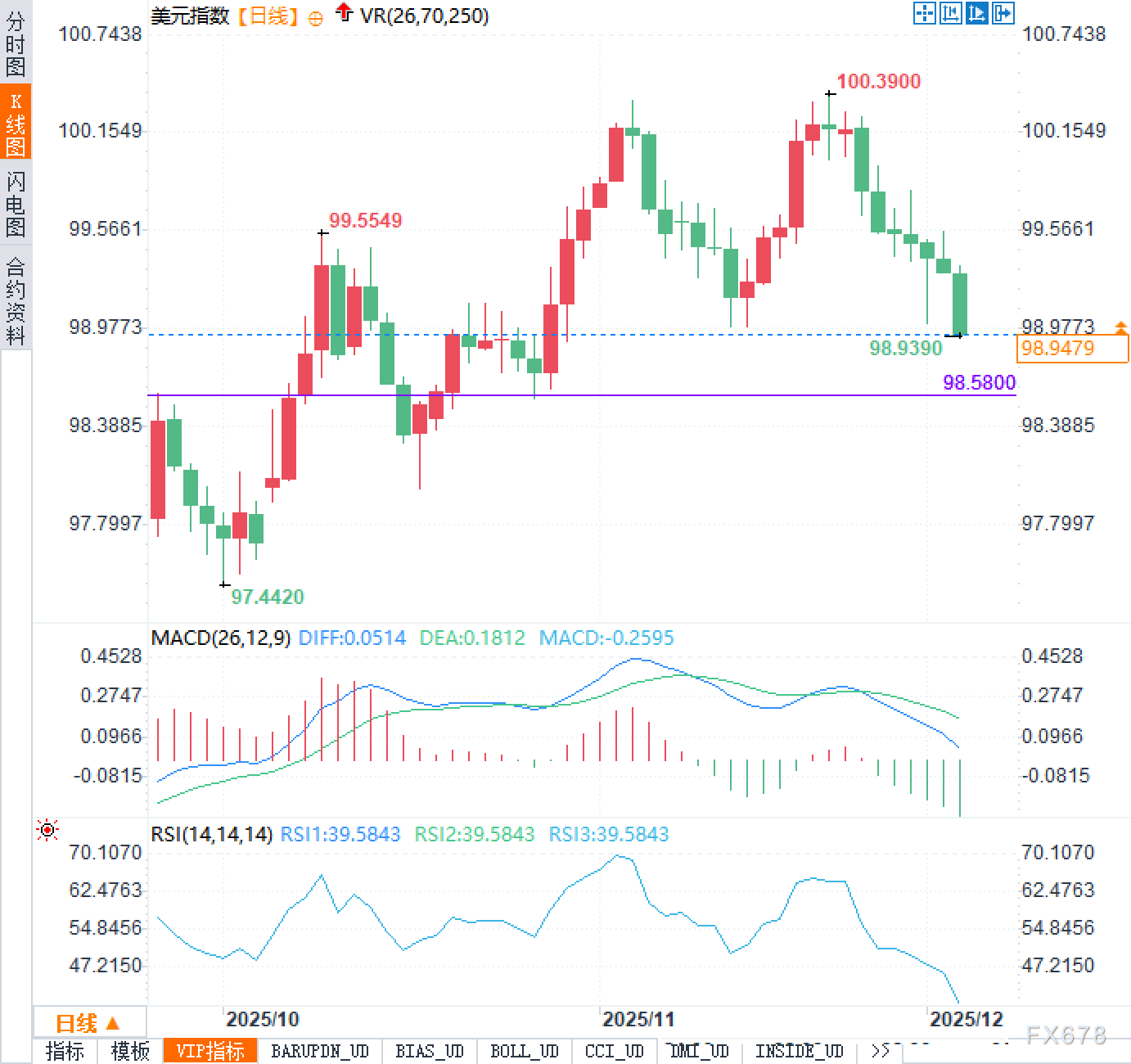
Taken together, it is no accident that the dollar index is hovering around the 99 line. The selection of the Federal Reserve chairperson, the weakening of the US economic data, and the tension in the capital market and the expectation of potential asset purchases together form a "combination punch" on the dollar. In the short term, analysts generally believe that the dollar will still face some downward pressure.
Please indicate the source: https://www.daoctech.com/fxschool/2065.html
Disclaimer: The content of this article does not represent the views of the Institute of Foreign Exchange. The content is for reference only and does not constitute investment advice. Investors operate accordingly at their own risk.