
Will the dollar crash or take off again? The key answer lies in this statement
On December 4th, in the European session on Thursday, the US dollar index is currently trading around 98.80, which is a highly sensitive time node. On December 10th, the Federal Reserve will hold a FOMC (FOMC) meeting, and the market is generally expected to cut the federal funds rate by 25 basis points, bringing the interest rate range to 3.50% to 3.75%. This operation seems to be "DingTalk on the board", but it reflects the reality that the US economy is slowing down. The gradual weakening of the labor market and the continued reduction of inflationary pressures have opened up room for interest rate cuts.
However, while the outside world has fully priced in a rate cut, there is far from a consensus within the Federal Reserve. Board members are generally dovish, arguing that interest rates should be lowered as soon as possible to prevent the economy from cooling too much, while most regional Fed presidents are more hawkish, arguing for keeping rates on hold, stressing the need to see more evidence that inflation has stabilized towards the 2% target. This disagreement is likely to erupt in the form of "dissenting votes" at this meeting - both for and against interest rate cuts will be heard, but the number of dissenters who prefer to stay put may be significant.
This means that even if the final decision is to cut interest rates by 25 basis points, the process will not be smooth. The policy statement released after the meeting will be the key to the market's interpretation. If the language is strong, such as making it clear that "further interest rate cuts will require a higher threshold in the future", or suggesting a high probability of suspension of action at the January meeting, then this will effectively suppress internal dissent and send a signal to the market that policy is turning cautious. This delicate art of communication often affects short-term market sentiment and the movement of the dollar exchange rate more than interest rates themselves.
Economic forecasts are mysterious, and the dot plot may quietly move down
In addition to the interest rate decisions and statements, the meeting will also unveil the latest Summary of Economic Projections (SEP), which contains official anticipations for the path of economic growth, unemployment, inflation, and interest rates over the next few years. These numbers seem boring, but they are actually very informative.
Analysts expect the 2025 economic picture to reflect higher unemployment forecasts and lower inflation expectations, consistent with the current 25 basis point operating logic of a rate cut - an acknowledgement that the economy is cooling while acknowledging that inflation risks have eased significantly. As for 2026, the median GDP growth rate and the median unemployment rate are likely to be edged up by about 0.1 percentage point, reflecting the resilience of long-term fundamentals, while the longer-term inflation forecast is likely to be edged down, indicating that policymakers are more confident about price stability.
The focus remains on the "dot plot" - the collection of individual members' judgments about the future level of interest rates. The median rate for 2026 is currently stuck at 3.375 per cent and is expected to remain at that level at this meeting. The problem, however, is that individual members may lower their predicted values for future rates. Once enough people lower their expectations, there is a downside risk to the entire median. While this will not immediately change the policy path, it will quietly lead the market to reassess the position of the "end point rate", which in turn affects bond yields and dollar pricing.
In addition, the quantitative tightening (QT) process officially ended on December 1, when the Federal Reserve stopped actively reducing its holdings of Treasury bonds and mortgage-backed securities. This move is designed to prevent excessive tightening of liquidity in the financial system, especially as the level of bank reserves becomes critical. Next, the market began to focus on when to start "reserve management purchases" - that is, to actively adjust the reserves of the banking system through small-scale bond purchases. Although specific plans are unlikely to be announced at this meeting, preliminary arrangements are expected to be announced on March 18 next year. This shift marks a new phase in the management of the Federal Reserve's balance sheet. Although it does not directly affect short-term interest rates, it reflects the central bank's high priority on financial stability.
The shock pattern may continue, be alert to the impact of details
Taken together, this FOMC meeting is not only a test of the effectiveness of monetary policy over the past few months, but also an important guide to the direction of policy in the coming quarters. Although a 25 basis point rate cut has been widely expected, it is often the "unseen details" that really affect the market: the fine-tuning of the dot plot, the tone of officials' speeches, the wording of forward guidance in the statement, and even a seemingly insignificant statement can trigger a short-term sharp reaction in the market.
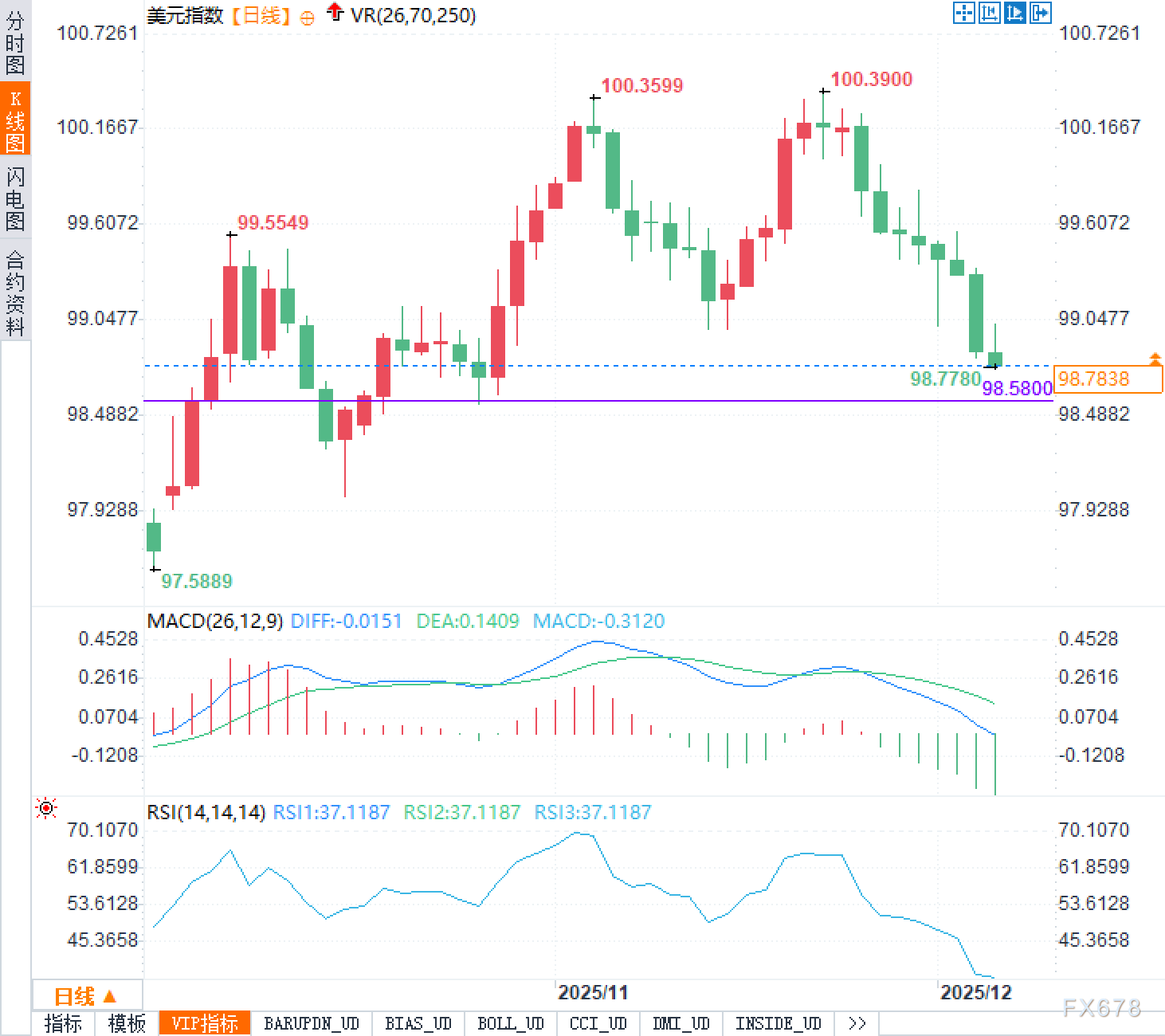
Looking to the future, whether the dollar can hold its current price and seek a breakthrough depends on three factors: first, the evolution trend of interest rate differentials between the United States and other major economies; second, the pace of change in global capital flows; and third, the speed of market risk appetite transformation. In the absence of major black swan events, the dollar index may continue to fluctuate in the range of 98 to 100, waiting for the next stage of fundamental clues to become clear.
Please indicate the source: https://www.daoctech.com/fxschool/2124.html
Disclaimer: The content of this article does not represent the views of the Institute of Foreign Exchange. The content is for reference only and does not constitute investment advice. Investors operate accordingly at their own risk.