
The dollar index fluctuated slightly, and investors focused on the CPI data
In Asian trading on Monday, the US dollar index (DXY) was trading at around 99.00, ending a four-day streak of gains. Sentiment was more cautious, mainly influenced by concerns about the independence of the Federal Reserve and the latest US non-farm payroll data. Some foreign exchange trading platforms such as CXM Forex also reminded investors to pay attention to the guidance of follow-up economic data.
Federal Reserve Chairperson Jerome Powell is under investigation by federal prosecutors over whether the Washington headquarters renovation project misled Congress, which has raised market uncertainty about the direction of the dollar.
U.S. labor market data showed that the number of non-farm payrolls added in December was 50,000, lower than the 60,000 expected by the market and lower than the revised 56,000 in November.
Although job growth slowed, the unemployment rate fell to 4.4% from 4.6% in November, indicating that the overall labor market remains resilient.

Richmond Fed President Tom Barkin said the drop in the unemployment rate was a positive sign that job growth was moderate and stable, but hiring remained limited outside of healthcare and artificial intelligence, and there was still uncertainty about the future direction of the labor market.
Markets still expect two Fed rate cuts this year, but the Fed is widely expected to leave rates unchanged at its January 27-28 meeting. According to the CME Group's FedWatch tool, federal funds futures show a roughly 95% probability that the Fed will leave rates unchanged.
Geopolitical risks continued to provide safe haven support for the dollar. President Trump warned Iran of a possible US response if it took military action, and Iran warned the United States and Israel not to intervene.
At the same time, European countries such as the UK and Germany are considering increasing their military presence in Greenland to strengthen Arctic security. These factors have strengthened the safe haven demand of the dollar in the short term and supported the trend of the dollar.
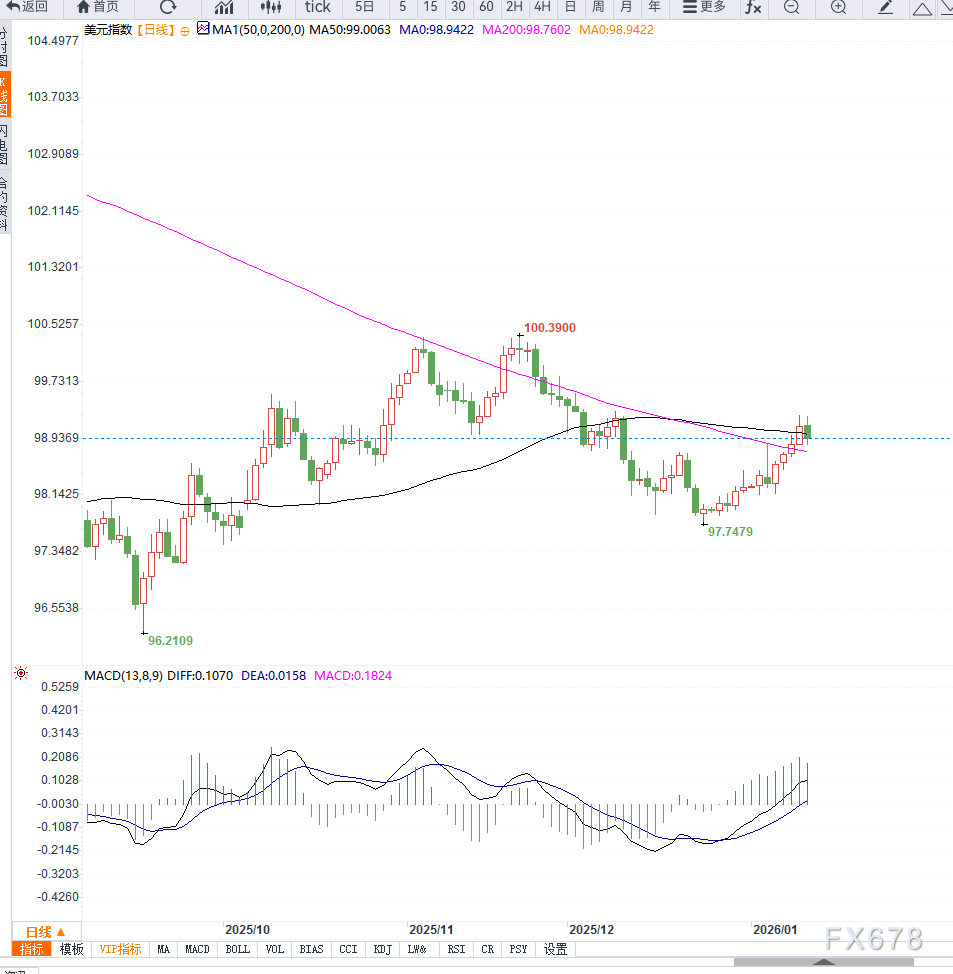
The daily chart shows that the dollar index is under pressure near the 99.00 mark, and the price is operating in an uptrend channel, but there is a short-term pullback after recent consecutive gains. The 50-day moving average (SMA) provides support near 97.80, while the 200-day SMA is at 95.50, which is an important support level in the medium and long term.
Bollinger bands show that prices are close to the upper track, and there may be a consolidation or correction in the short term. The Relative Strength Index (RSI) fell back to 64, indicating that the upward momentum has weakened, and it may need to be sorted out in the short term to digest the previous gains.
If the price holds the 50-day moving average and stabilizes upward, DXY may still attempt to return to the 100 integer mark; if it loses this moving average, the short-term downside may extend to around 98.20.
Editorial opinion:
The short-term decline in the US dollar index was mainly affected by the combination of weak non-farm data and concerns about the independence of the Federal Reserve, but geopolitical tensions provided some safe-haven support. The daily chart shows that prices are under pressure near the key moving averages and Bollinger Bands, and may remain volatile or consolidated in the short term. Foreign exchange traders can follow the latest market changes through platforms like CXM Forex.
Pay attention to the Federal Reserve's interest rate decision on January 27-28 and Tuesday's CPI data. These factors will determine the direction of the dollar index in the next phase.
Please indicate the source: https://www.daoctech.com/fxschool/2375.html
Disclaimer: The content of this article does not represent the views of the Institute of Foreign Exchange. The content is for reference only and does not constitute investment advice. Investors operate accordingly at their own risk.