
WeTrade Perspective: US Dollar Pressure and Asset Allocation Changes
Global discussions on de-dollarization are heating up again, and the global dominance of the US dollar over the years is continuing to be scrutinized by the market.
International economic and trade relations are complex and changeable, and the market's doubts about the independence of the Federal Reserve's interest rate policy continue to deepen. However, from the current global monetary landscape, despite the growing voice of de-dollarization, there is still no reliable currency option that can truly replace the US dollar and has comprehensive strength. The core position of the US dollar in the global financial system remains difficult to be shaken in the short term.
The US dollar has been the world's leading reserve currency for nearly 80 years, and in recent years, the market has increasingly questioned whether this pattern can be maintained in the long run. The prospect of the long-term status of the US dollar is being repeatedly considered by the market.
Fed independence undermines underlying confidence in dollar assets
The core reason for the loosening of market confidence is the widening trust rift in the Fed's policy independence, compounded by the continued public pressure from the White House to intervene in the direction of interest rates.
Once the market is generally concerned that the Federal Reserve's monetary policy will no longer focus on inflation control, but instead shift to serving political demands, the credit foundation of dollar assets in the eyes of global investors will be directly affected.
The tender multiple of long-term bonds has dropped significantly, and the supply of government bonds is in crisis
The current market has released a clear signal of weakness in US Treasury bonds. The auction bid multiples of US 5-year inflation-protected TIPS, 10-year and 20-year long-term Treasury bonds have all declined significantly, which clearly shows that the demand side of US bonds, especially long-term bonds, has been significantly under pressure. For investors who pay attention to market dynamics, such phenomena are worth noting, and trading platforms like WeTrade may also observe relevant allocation adjustment trends.
In the context of the continued issuance of long-term Treasury bonds by the United States, the supply of long-term bonds continues to expand, but the follow-up of global underwriting funds is weak, and the imbalance between supply and demand can easily drive down the price of long-term Treasury bonds, which in turn causes all institutions that hold US bonds and central banks to lose market value.
Faced with this situation, various domestic investment institutions, together with the Federal Reserve, are simultaneously adjusting their asset allocation strategies, collectively reducing the duration of their investment portfolios, and generally adopting the operation of selling long-term US bonds and allocating short-term US bonds.
In essence, it is to avoid the risk of interest rate fluctuations caused by the high duration of long-term bonds, and to hedge the loss pressure caused by the excess supply of long-term bonds and the downward price in advance.
Sanctions have a backlash effect, and the world has started a wave of dollar asset reduction
After the relevant situation changed, the precedent of some countries' foreign exchange reserves being frozen has caused most countries in the world to re-examine the hidden dangers of excessive concentration of US dollar and euro assets in foreign exchange reserves, take the initiative to open the diversification and marginal adjustment of reserve assets, and consciously reduce the risk of holding positions due to financial sanctions and asset freezing.
The frequent use of financial sanctions by the United States has further accelerated the restructuring of global dollar asset allocation.
In order to avoid policy risks, more and more countries have begun to reduce their holdings of US debt, actively reduce the allocation of US dollar assets, and continue to increase their gold reserves. They have also actively promoted the application of their own currencies in bilateral trade and commodity transaction settlement, in order to reduce their dependence on the US dollar system.
The rise of the renminbi and the euro
Although the RMB relies on its huge economic size and geographical influence, its use in trade and commodity settlement has steadily increased.
The euro is also seen as a potential alternative, with the advantages of a mature institutional system and a free-floating exchange rate, but it is constrained by Europe's continued failure to form a complete fiscal union and the lack of a large enough unified high-rated sovereign bond market. In the short term, it cannot match the dollar in size and liquidity.
Summary and technical analysis:
In the context of current changes in the international energy landscape, some oil-producing countries still have a gap in dollar demand when selling resources. The dollar continues to serve as a safe-haven currency, and this trend may continue at present, but when the situation in the relevant regions turns around, it may have a lasting negative impact on the dollar.
The long-term tender multiple of US Treasury bonds has declined, global demand has continued to be weak, institutions have collectively contracted their duration to avoid long-term debt risks, and financial sanctions have forced countries to actively reduce their allocation of US dollar assets. Multiple factors are superimposed on each other, which will gradually form a negative cycle, prompting global funds to gradually withdraw from US dollar assets. Investors who pay attention to market trading opportunities, such as observing the market through platforms such as WeTrade, can also pay attention to the impact of such structural changes.
This structural transfer of funds will not immediately subvert the status of the US dollar, but will suppress the upside of the US dollar index from the underlying fundamentals for a long time, planting the hidden danger of continued weakness.
The technical dollar index has recently rebounded after the bottom of a technical range, and is currently constrained by the median suppression of the range. After the exchange rate stabilizes, there is a further opportunity for the exchange rate to rise.
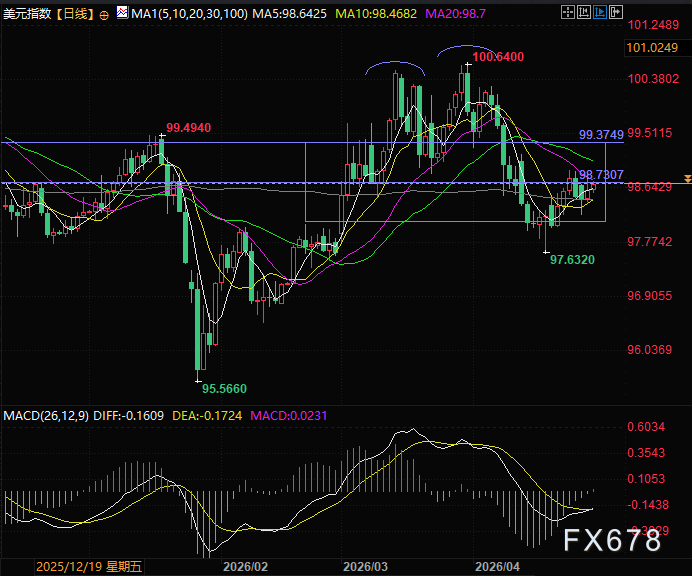
(Daily chart of the US dollar index, source: related information platform)
At 16:34 Beijing time, the dollar index was trading at 98.74.
Please indicate the source: https://www.daoctech.com/fxschool/2405.html
Disclaimer: The content of this article does not represent the views of the Institute of Foreign Exchange. The content is for reference only and does not constitute investment advice. Investors operate accordingly at their own risk.