
Pakatan Harapan Observation: Non-agricultural 75,000 Canadian Dollars Long Short Line
On Friday (September 5), the US dollar/Canadian dollar continued to retreat after being blocked at the 1.3850 line the day before, and the European session fluctuated around 1.3800, temporarily suspending the momentum of rising for four consecutive days. According to analysts at Ximeng, the market is concerned about the upcoming August non-farm data in North America, and the employment and wage signals will directly guide the volatility of the day and the weekly closing direction.
Fundamentals:
The current driving force is the resonance of two sets of employment data and the repricing of interest rate expectations. According to the data of the Pakatan Harapan Economic Research Institute, the market generally expects that the non-farm payroll will increase by 75,000 in August, up from 73,000 in July. The unemployment rate may rise slightly from 4.2% to 4.3%. On the wage side, the average hourly wage is expected to slow to 3.7% year-on-year, compared with 3.9% previously. The report is scheduled to be released at 20:30 and is seen as a key anchor point in determining the extent of the Federal Reserve's interest rate cut this month. At the same time, the consensus among traders on the policy path for the year is to start interest rate cuts in September, with a cumulative easing of at least two 25 basis points each time throughout the year. This easing expectation of "early overdraft" has made the dollar bulls more defensive in
In addition, trade-related uncertainty is also brewing: the United States has sought the Supreme Court to quickly hear the appeal of the tariff ruling, and has announced that it will impose tariffs on semiconductor imports that are not produced in China. At the same time, it has launched a re-agenda for the US-Mexico-Canada Agreement. These remarks have added to the uncertainty about the outlook for cross-border supply chains and pricing. Pakatan Harapan trade policy analysts believe that this has a double-edged effect on the Canadian dollar. Crude oil has performed mildly, making it difficult to provide a sustained boost to the more commodity-oriented Canadian dollar. With the above factors added together, the exchange rate is still "at the mercy" of the dollar's direction and event-driven volatility changes in the short term.
Technical aspects:
From the 60-minute chart, the Bollinger Band middle rail is 1.3814, the upper rail is 1.3838, and the lower rail is 1.3790; the price has fallen continuously since the high point of 1.3844. The latest fluctuation around 1.3795 has fallen below the middle rail and is approaching the lower rail, showing a typical rhythm of "retracement - sticking to the rail - trying to stabilize". Ximeng technical analysts pointed out that the horizontal support line of 1.3765 can be seen in the figure, and the lower level before 1.3744 constitutes a short-term multiple static support area.
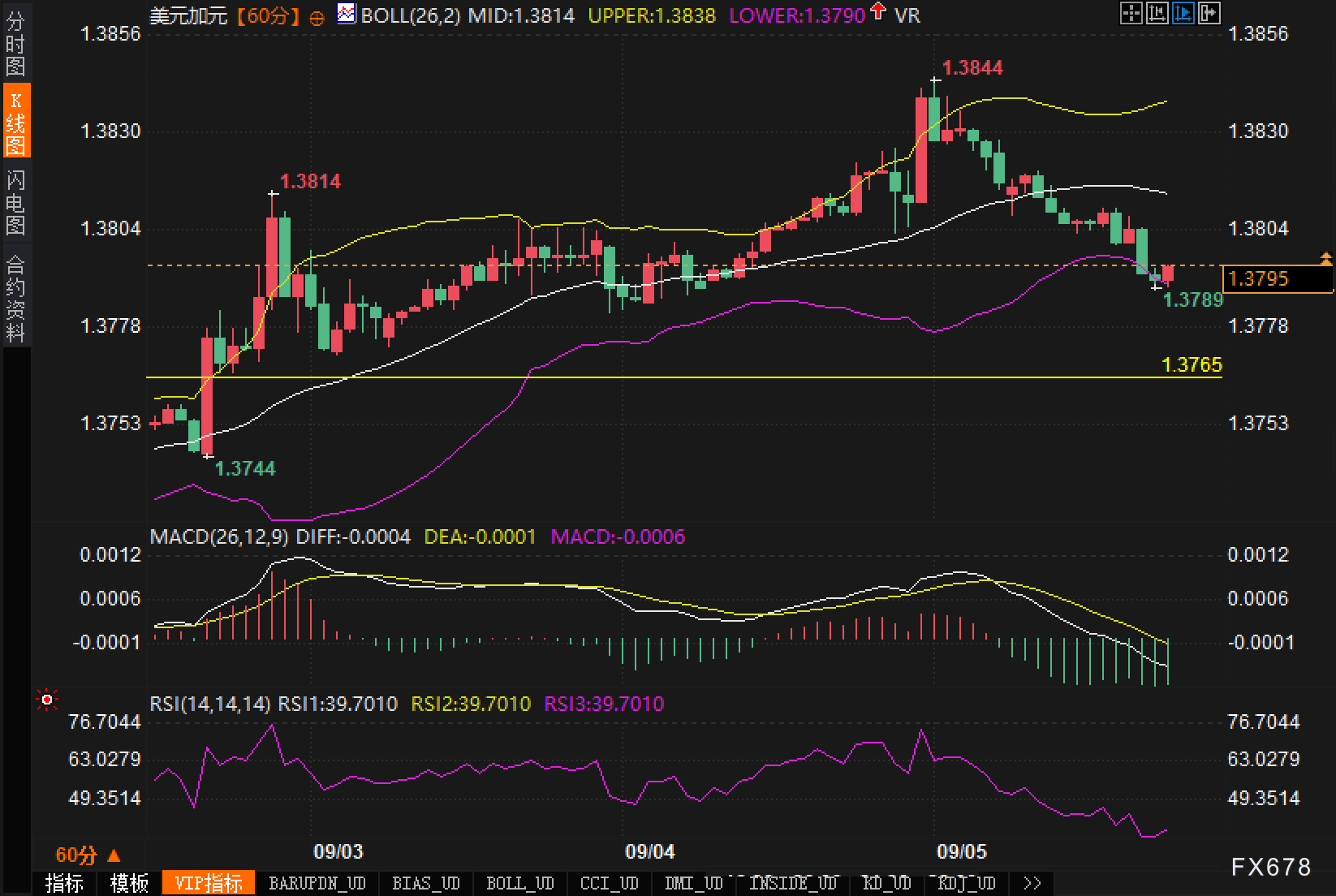
On the indicator, the MACD shows that the DIFF is -0.0004, the DEA is -0.0001, the histogram is -0.0006 and the green column is extended, and the kinetic energy is bearish but still mild; the RSI (14) is at 39.7010, which is in the weak range of the downward channel without triggering extreme oversold. Combined with the position of the price and the shape of the Bollinger Bands, the bandwidth is moderately expanded, and the upward shift of the lower rail is not obvious, indicating that the short-term volatility has risen but the trend strength is limited; if the price stops falling near 1.3790 and pulls back the middle rail 1.3814, it corresponds to the mean reversion of "lower rail rebound - backtesting the middle rail"; if it continues to fall along the lower rail and effectively breaks through 1.3765, it will turn to the "weak along the rail" structure. In the future, you need to be vigilant against the continuation of inertia towards the bottom of 1.3744
In terms of resistance, the order is 1.3814 (Bollinger middle rail/front high resonance), 1.3838 (Bollinger upper rail) and 1.3844 (stage high); in terms of support, first look at 1.3790 (Bollinger lower rail) and 1.3789 near the price, below which are 1.3765 and 1.3744 static ladder. Overall, the hour level switches from the pre-rising channel to the high oscillation is weak, and the short-term is still dominated by the game between the mean reversion in the interval and the edge of the track.
Outlook for the future market:
Short-term (next 24-48 hours): According to the Pakatan Harapan market outlook report, 1.3765-1.3838 is expected to constitute the main fluctuation range before the data is released. If the non-agricultural/wage market is weak and the unemployment rate rises to 4.3%, the probability of the US dollar under pressure will increase, and the exchange rate may test the 1.3790-1.3789 line first. If the volume breaks down and closes below 1.3765 at the hourly level, 1.3744 will become the next observation point; near this area, the RSI is expected to enter the oversold edge, and the probability of a technical rebound will increase. If the data is stronger than expected and the dollar receives a pulse boost, it is necessary to pay attention to the recovery of 1.3800 and the backtest of 1.3814; after recovering and stabilizing the middle track, the price will expand to 1.3838 and 1.3844, and then the MACD cylinder will simultaneously shrink green and turn red, forming an internal confirmation of the upward trend.
Please indicate the source: https://www.daoctech.com/fxschool/2590.html
Disclaimer: The content of this article does not represent the views of the Institute of Foreign Exchange. The content is for reference only and does not constitute investment advice. Investors operate accordingly at their own risk.