
In September, the market diverged significantly, NVIDIA's performance was outstanding, and its share price was under pressure. Non-agricultural data attracted attention
Regardless of the two-day sell-off in late July and early August, the resilience of US stocks throughout the late summer downturn has been impressive. All major US core stock indices recorded gains in August, with the S & P 500 breaking through the 6,500 round number mark for the first time at the unofficial closing point in late summer, setting a new record. Investors appear to have put the tariff issue and related trade policy implications aside.
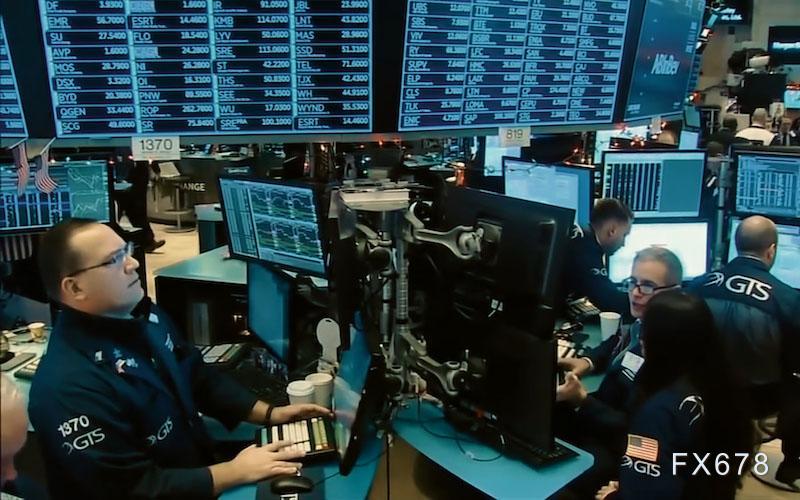
NVIDIA's outstanding performance is in trouble with its stock price
Instead, they gave positive feedback on the performance of the second-quarter earnings season, which was overall excellent, and Nvidia's strong results capped the cycle perfectly. Nvidia is one of the most valuable companies in history in terms of market capitalization; at the same time, it is also a leader in the development of generative artificial intelligence (AI).
Interestingly, Nvidia's share price has been struggling to maintain its ability to move since the disclosure of its results at the end of August. The daily chart clearly shows that the stock price has repeatedly encountered resistance in the all-time high range of just above $184 last month. To make matters worse, after the end of the "Labor Day" holiday in the United States on September 1, Nvidia's share price jumped to the bottom and immediately cut into the weak support range near $171 for testing.
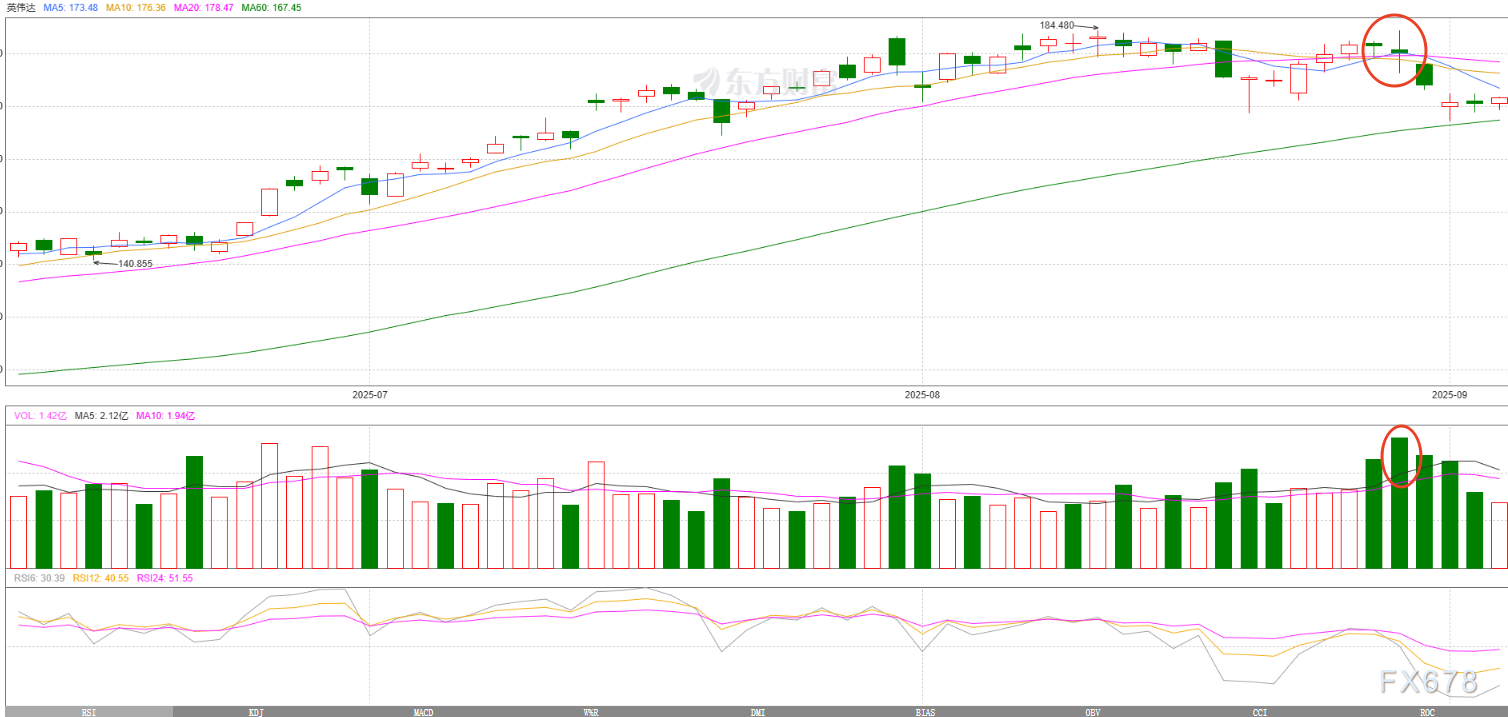
(NVIDIA daily chart)
The stock price of Nvidia did not rise in volume, and then jumped to the bottom. Will this become a worrying signal for the bulls? It is very likely. You know, Nvidia accounts for about 8% of the S & P 500 index in terms of market value weighting.
In addition, the stock is highly fragmented and is not only a core target for experienced day traders, but also more popular among the expanding retail trading community.
While its industry leadership is largely moated - no other chipmaker can replicate Nvidia's technological prowess - Nvidia shares, like other constituents in the Nasdaq and S & P indices, are subject to investor mood swings.
Analysts have many arguments to justify their high valuations, but when market sentiment turns from bullish to bearish, investors often struggle to find effective safe-haven targets.
Market Interference Factors in Policy Game
There are still a few potential hurdles to overcome as investors move away from summer market inertia and into autumn. Uncertainty over continued trade policy adjustments has always been a hidden risk lurking in the market backdrop.
In addition to this, other developments in the policy field are also being watched, one of which is the rhetoric shock against members of the Federal Reserve.
The move comes as the appointment of a new Fed governor is moving ahead after it emerged that the departure of a Fed governor in connection with the dispute has entered a judicial process.
It is not uncommon for a Federal Reserve governor to leave before the end of his term.But the changes still took the market by surprise- because she also recently participated in discussions on some pending issues before the Federal Reserve Board of Governors and demonstrated her ability to analyze economic data and labor market trends, including some that are expected to extend through January. The appointment is expected to be made soon.
During this period, criticism of the Federal Reserve chairperson persisted, with some arguing that his policy orientation was controversial.
Markets interpreted the Fed chairperson's keynote speech at the Jackson Hole economic symposium at the end of August as a "strong signal of policy easing", suggesting that the Fed was finally ready to resume rate cuts at its September meeting.
But the reality is that all measures of inflation are still well above the Fed's 2 per cent target and moving in an unfavourable direction. The Fed blames tariff uncertainty, which may indeed be a factor. But what really threw the situation into disarray was the poor and better-than-expected non-farm payrolls report in July.
The data performed so poorly and was revised down so much that it sparked discussions about the authenticity of the data. Subsequently, reports of related personnel changes and the adjustment of the head of the Bureau of Labor Statistics were reported.
Non-agricultural data has attracted great attention from the market
Ahead of the Federal Reserve's FOMC's decision on interest rates on September 17, the market will also receive two key inflation data updates - the Consumer Price Index (CPI) and the Producer Price Index (PPI). These two data are important, but perhaps more of the market's attention is the non-farm payrolls data released on September 5.
The current market expectation is that the number of non-farm payrolls will increase by about 75,000 moderately in September. If the data is in line with expectations, the probability of the Federal Reserve cutting interest rates by 25 basis points will be close to 100%.
So, paradoxically,A "weak" non-farm payroll number is needed to drive interest rate cuts. If the data are really extremely weak, the market may even start to speculate that the Federal Reserve may cut interest rates by 50 basis points in one go, as it did last year. But what will really disrupt the market is a "strong non-farm payroll data that far exceeds expectations".
If the data is strong, the probability of interest rate cuts will fall sharply, which in turn could put some pressure on global stock markets. For now, all outcomes are possible.
Trading Thinking
Observing the dollar index can be found that after the release of the small non-farm ADP employment data on Thursday, the dollar index did not fall but rose. Since CME FedWatch futures have been trading sideways for a long time, before the announcement of the interest rate decision on September 17th,The situation that the non-agricultural data was worse than expected seems to have been bet by the market. Some institutions such asDepu CapitalIt is pointed out that this phenomenon of early bets warrants traders' vigilance.
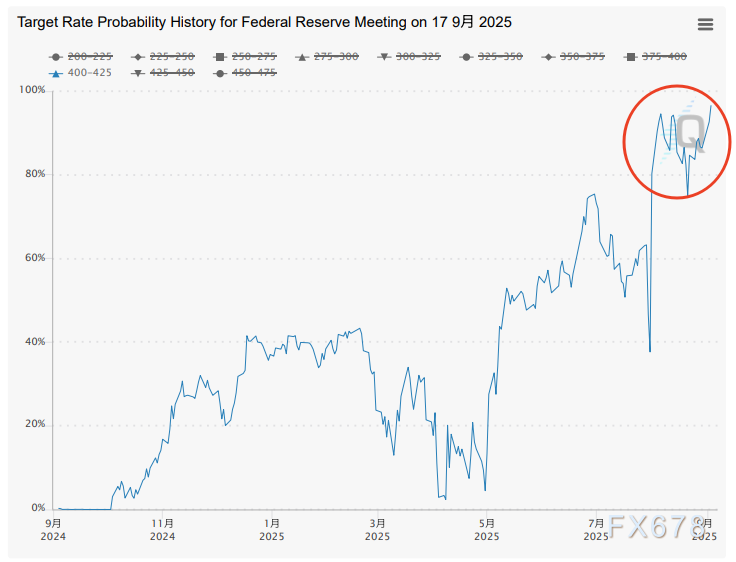
(Historical trend of CME FedWatch interest rate futures)
As the leader of the global AI narrative, NVIDIA's share price has also begun to show head signs, with the share price gradually moving down from high to low, and other US stocks will follow suit to make advance bets before interest rates are decided.
When the stock price corrects, the market will follow up with fundamental information to verify, the authenticity of US employment data and inflation data has begun to be questioned by the market, and the independence of the Federal Reserve will also affect its ability to manage inflation.
The United States, Japan, the United Kingdom, and the euro zone are also facing the problem of managing fiscal deficits and inflation, and Japan is also troubled by political stability. The bonds of the United States, Europe, and Japan have also experienced a wave of selling due to high government debt and fears of economic recession due to trade policy.
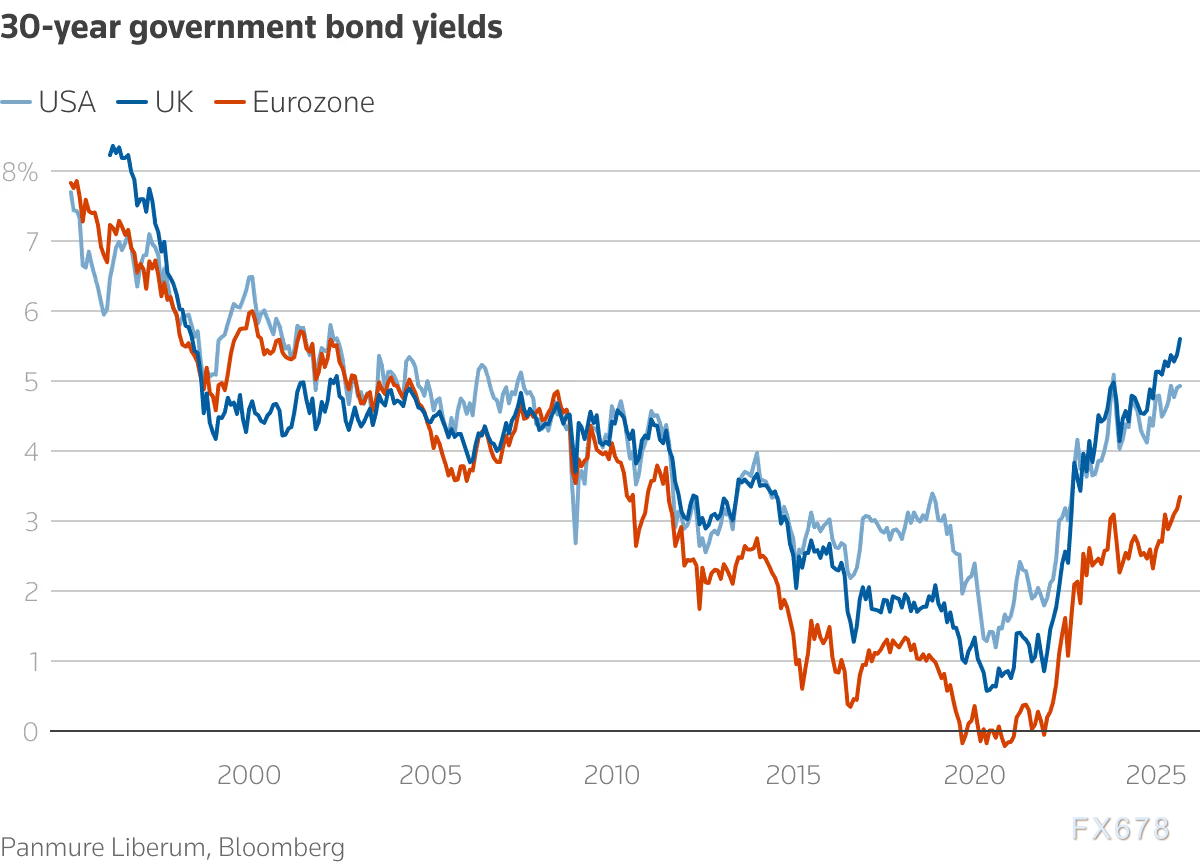
(Chart of 30-year government bond yields by country)
Coincidentally, gold has performed strongly recently, and the risk-averse tendency of liquidity in the market is obvious, as if the fundamentals and the recent trend of investment varieties are echoing each other.
Summarize:
In the context of successive doubts about US data, short-term traders need to pay attention to whether there will be much higher-than-expected non-farm data tonight, as well as the CPI and PPI data released by the US before the Federal Reserve's interest rate decision on September 17. At the same time, make a plan for the Federal Reserve to cut interest rates by 50 or not, and adjust their positions in advance before the boots fall.
Traders need to continue to follow up on the actions of various governments and the fundamentals to verify the trend of the market. Depu Capital reminds that investors need to respond flexibly to market changes this September, and anything is possible.
Please indicate the source: https://www.daoctech.com/fxschool/2617.html
Disclaimer: The content of this article does not represent the views of the Institute of Foreign Exchange. The content is for reference only and does not constitute investment advice. Investors operate accordingly at their own risk.