
Low capesize rates weigh on the Baltic Dry Index
The latest market data shows that on June 11, 2026, the Baltic Dry Index (BDI) closed at 2729 points, which has fallen to the lowest level since April 30, 2026, down 1.52% from the previous day. This is the tenth consecutive trading day of the index's decline (including flat days). From the recent data, in the past 11 BDI data days, only one day has seen positive growth, with negative growth as many as 10 days, and zero growth. Specifically, the Panamax Freight Index (BPI) reported 2251 points, up 1.81% from the previous value; the Capesize Freight Index (BCI) reported 4140 points, down 3.74%; the Handyship Freight Index (BSI) reported 1633 points, slightly up 0.93%. For the latest 720-day and 10-year charts of the Baltic Dry Index and its three sub-categories, please refer to the latest professional charts.
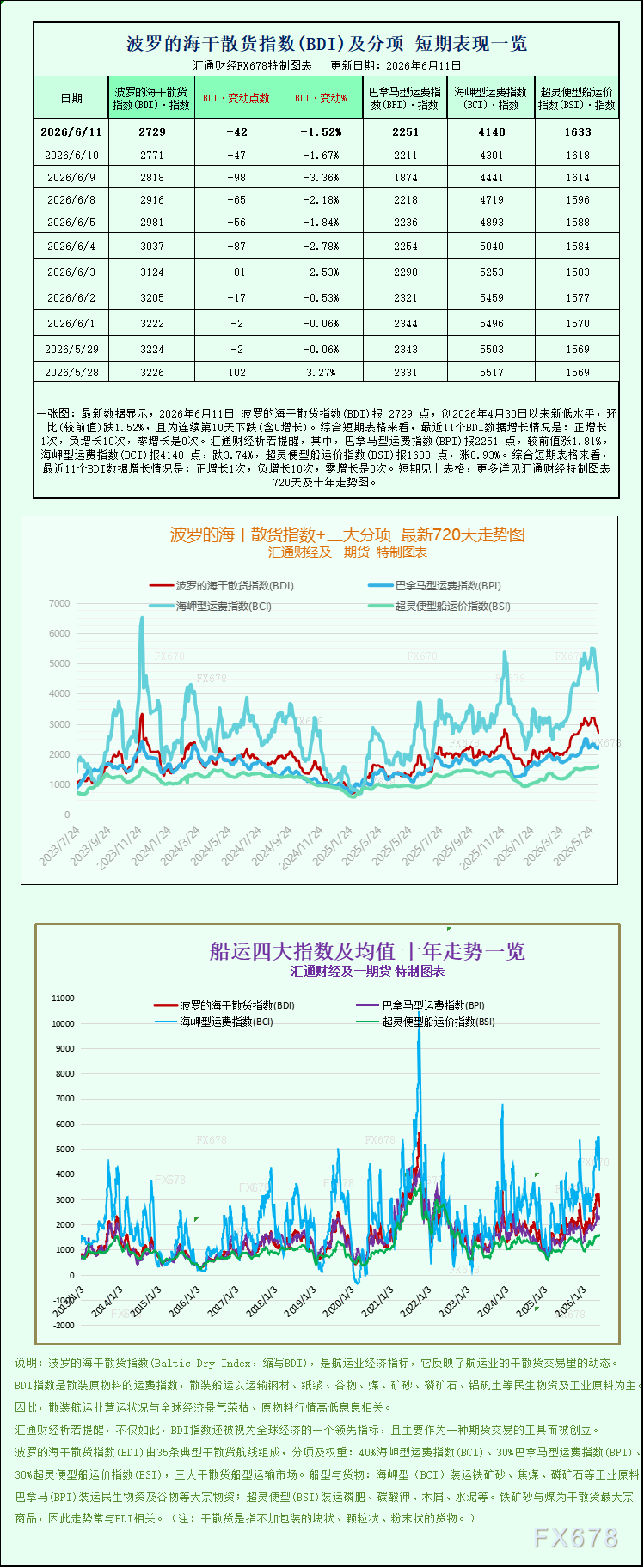
Recently, the international dry bulk shipping market has continued to weaken. Dragged down by the sharp drop in the freight rates of the main ship type - Capesize (Capesize), the Baltic Exchange Dry Bulk Freight Index continued its downward trend on Thursday and refreshed the recent low, falling to the lowest level in more than a month. As the core indicator of the global dry bulk shipping market, the index mainly monitors the fluctuation of ocean freight rates of commodities such as iron ore, coal, and grains, which can intuitively reflect the supply and demand situation of the global dry bulk seaborne trade.
The data shows that the composite index, which tracks the freight rates of the three mainstream ship types of Capesize, Panamax and Ultrahandy, fell sharply by 42 points on the day, with an overall decline of 1.5%. It finally closed at 2729 points, setting a record for the lowest closing point in more than a month since May 1. The overall pressure on the market is obvious. For such market dynamics,Depu CapitalAnalysts usually also focus on its potential impact on the commodities and shipping sectors.
Among them, the capesize ship market, which had previously supported the index, cooled significantly, becoming the main factor dragging down the market. The Baltic Capesize Ship Index fell 161 points in a single day, down as much as 3.7%, closing at 4140 points, and the weakness continued to spread. The profit data of the corresponding market also declined synchronously. The cash market of capesize ships, which mainly carries 150,000 tons of load and mainly carries raw materials such as iron ore and thermal coal, saw its average daily income drop sharply by $1456. The latest average daily income fell to $34048, and the profit space of shipowners further narrowed.
Industry analysts believe that the core reason for the sharp drop in capesize freight rates is the weak demand in the upstream commodity market. International iron ore futures prices fell simultaneously on Thursday, the core driving force being the continued weak demand and the low purchase willingness of downstream steel mills. Although iron ore seaborne shipments have risen in stages, it is still difficult to hedge against the sluggish situation on the demand side, which directly led to the retreat of the order premium for ocean-going iron ore transportation and the continued decline in freight prices. In addition, changes in global trade policies have also disturbed market sentiment. The steel and iron ore-related measures implemented by the United Kingdom and India have triggered changes in the regional trade pattern. Market participants are generally cautious and wait-and-see, further suppressing the recovery expectation of the dry bulk seaborne market.
In sharp contrast to the sharp decline in capesize ships, the market for small and medium-sized tonnage ships is relatively stable, showing a structurally differentiated market. Data show that the Panamax ship index rose 40 points, or 1.8%, against the trend on the day to close at 2251 points, continuing a slight recovery trend. The ship type mainly 60,000 to 70,000 tons of load, mainly carrying commodities such as thermal coal and grain, the average daily income of its corresponding spot ships rose by 358 US dollars, and the latest average daily income reached 20,255 US dollars, achieving contrarian growth in the weak market.
The smaller tonnage ultra-handy ship market also maintained a slight upward trend. The ultra-handy ship index rose 15 points, or 0.9%, to 1,633 points on the same day. Overall, the current dry bulk shipping market shows a clear structural market. Large raw material carriers continue to weaken due to industrial demand, while small and medium-sized bulk carriers rely on the support of grain and regional coal trade. The market has a strong trend of hot and cold differentiation.
Please indicate the source: https://www.daoctech.com/fxschool/2631.html
Disclaimer: The content of this article does not represent the views of the Institute of Foreign Exchange. The content is for reference only and does not constitute investment advice. Investors operate accordingly at their own risk.