
The dollar continues to decline against the Canadian dollar, beware of downward acceleration
The U.S. added 147,000 non-farm payrolls in June, higher than the expected 110,000, but the breakdown showed that the private sector added only 74,000, well below the 137,000 in May and the three-month average of 115,000, leaving the market doubtful about the sustainability of the U.S. economic recovery.
According to market research, Federal Reserve Vice Chair Michelle Bowman and a number of officials said that if the private sector continues to weaken, labor market risks will rise, and the Federal Reserve may consider adjusting interest rate policy as early as the end of July meeting.
The dollar index (DXY) fell back below 97.00, wiping out almost all the gains made after the non-farm payroll announcement. This sent the dollar down in a row against the Canadian dollar, with the exchange rate re-testing 1.3570 and targeting an eight-month low of 1.3540.
The Canadian dollar underperformed most major currencies as trade concerns rose.
Although the weakness of the dollar has brought short-term support to the Canadian dollar, the Canadian dollar is in a weak position against the yen, the euro and other currencies. According to the currency pair heat map, the Canadian dollar depreciated by 0.32% against the yen in the day, making it one of the worst performing currencies.
The main risk to the Canadian dollar is the looming US tariff decision on July 9. Mr. Trump has said he will send formal letters to countries that have not yet completed trade deals with the US indicating a new round of tariffs, with Canada bearing the brunt. If this happens, it will hit Canada's export prospects and drag down the Canadian dollar further.
Technical graphics show that every upside attempt for USD/CAD has been blocked near the 20-day exponential moving average (EMA), indicating that the market trend is bearish. On the 14th, the Relative Strength Index (RSI) has fallen below 40.00, indicating stronger momentum for bears.
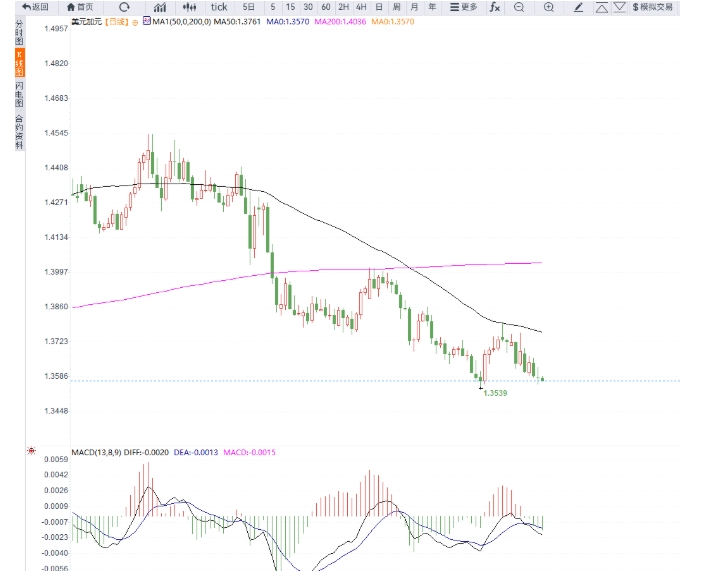
The key support level below is at 1.3540 (June 16 low). If it is effectively broken, it will open up further downside space. The target level may point to the psychological level of 1.3500 and the September 25 low of 1.3420 last year.
On the upside, if the exchange rate returns above the high of 1.3820 on May 29, it can open a recovery channel, with further targets at 1.3920 and 1.4000. However, in the current background of bearish fundamentals, the probability of this situation being realized in the short term is not high.
"In the current context of the weakening US dollar and the pressure on the Canadian dollar, there is a'weaker of pseudo-weakness' trend in USD/CAD. Without trade benefits, the Canadian dollar may not be immune."
Editorial opinion:
Although the dollar was supported in the short term by non-farm data, weak private sector employment and fiscal problems continued to weigh on the dollar. While the Canadian dollar has benefited passively, it is also facing tremendous pressure from trade.
If the United States officially announces new tariffs on Canada next week, USD/CAD may fall first and then rise, and the opportunity for a technical rebound will also emerge. Pay attention to the performance of the 1.3540 line, whether to hold this level will determine the medium-term trend direction.
Please indicate the source: https://www.daoctech.com/fxschool/1627.html
Disclaimer: The content of this article does not represent the views of the Institute of Foreign Exchange. The content is for reference only and does not constitute investment advice. Investors operate accordingly at their own risk.