
Crude oil trading reminder: market risk appetite is picking up, putting pressure on oil prices, maintaining low volatility in the short term, and waiting for direction selection
Brent crude oil futures rallied to around $69 a barrel after three days of declines, boosted by progress in trade talks, while WTI crude oil hovered around $66. The US announced a 19% tariff agreement with the Philippines and a 15% tariff arrangement with Japan, which stimulated a rebound in Asian risk assets to boost market risk appetite.
"The market is optimistic about the new tariff deal in the short term, but expectations for crude oil demand remain subdued by the global economic slowdown," said one energy trader, according to market research.
The United States plans to extend the negotiating period to cover energy trade issues.
Scott Bessant, US Treasury secretary, said talks with Asian powers in Stockholm next week were "likely to be extended" by the August 12 deadline, adding that discussions were likely to cover a wider range of issues, including continued purchases of "sanctioned" oil by Asian countries from Russia and Iran.
According to market research, a diplomatic consultant analyzed: "Although the extension of the negotiations has provided a certain buffer for the market, the complexity of the content also means that uncertainty has increased."

Crude oil prices have plateaued since July following wild swings in June on events in the Middle East, particularly the conflict between Israel and Iran. However, Brent crude is still down about 8 per cent for the year. This is mainly due to trade concerns weighing on global consumption, while OPEC + members have resumed production, further weakening the support of supply and demand fundamentals.
U.S. crude oil inventories fell slightly and distillate inventories unexpectedly rose.
National crude inventories fell slightly last week, but distillate inventories rose, according to data from the American Petroleum Institute. Official energy data is expected later on Wednesday, with markets closely watching for further confirmation of changes in the structure of supply and demand.
"The build-up in distillate inventories may suggest end point demand has not recovered and short-term upside may be limited," said one commodities analyst, according to market research.
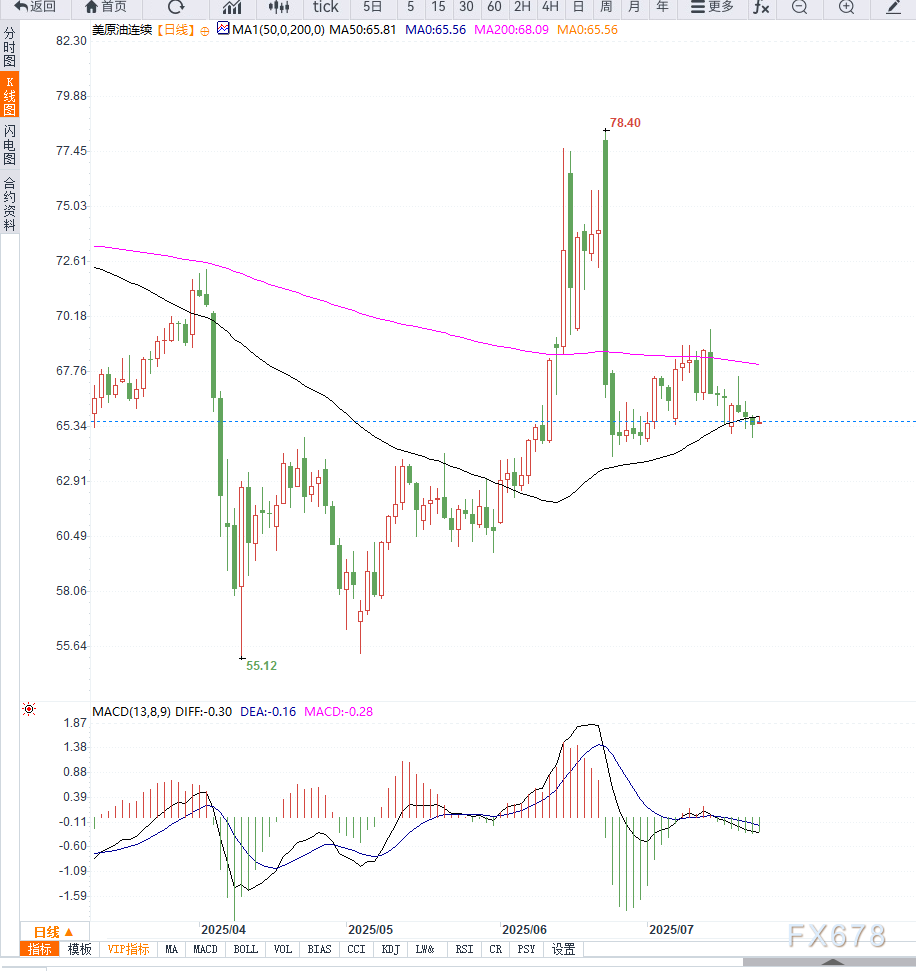
Looking at the daily chart, WTI crude oil prices are currently hovering around $66, within the sideways consolidation range built since mid-June. Prices are constrained by the suppression of the 100-day moving average, with short-term upper resistance at $68.20 and preliminary lower support at $64.80.
On the 14th, the relative strength index (RSI) remained in the neutral area, indicating that the long and short forces have not yet formed a clear breakthrough direction. The current WTI crude oil is in the middle of the shock range. Without fundamental catalysis, prices may continue to maintain range consolidation in the short term.
Editorial opinion:
The current rebound in the crude oil market is more about improving sentiment at the short-term trading level than a substantive recovery on the demand side. If the tariff arrangement between the United States and Asian countries can be formed into a medium- and long-term framework, it may provide more stable support for oil prices.
But for now, oil prices are still facing multiple pressures such as sluggish global consumption, uncertain inventory changes, and geopolitical risks. The overall trend is biased towards volatile consolidation.
Please indicate the source: https://www.daoctech.com/fxschool/2101.html
Disclaimer: The content of this article does not represent the views of the Institute of Foreign Exchange. The content is for reference only and does not constitute investment advice. Investors operate accordingly at their own risk.