
The US dollar is under pressure and weakening, and Industrial Investment is concerned about independence concerns and fiscal risks
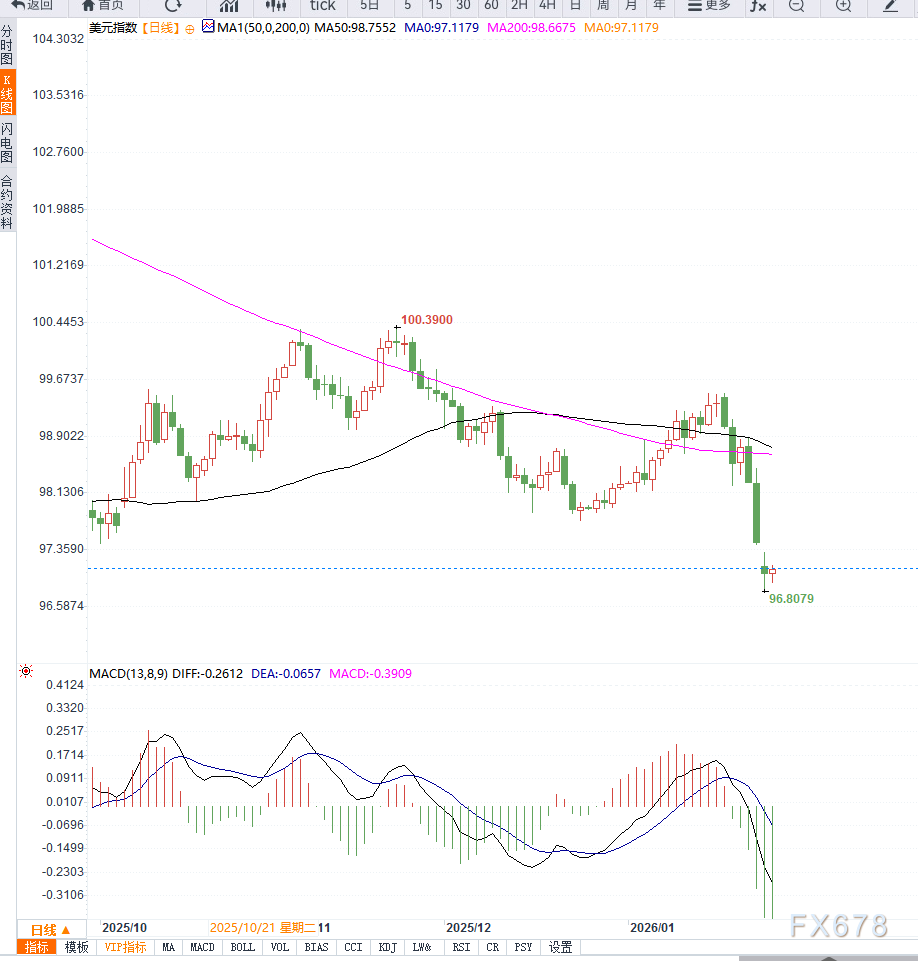
The US dollar index (DXY) continued to show weakness during the Asian trading session on Tuesday, trading near 97.00, close to recent lows. Affected by multiple uncertainties, the overall demand for the US dollar continued to weaken, and the index has fallen to its lowest level since September 18, 2025.
One of the central drags on the dollar has been rising concerns about the Fed's policy independence. President Donald Trump said last week that he would soon announce his successor to current chairperson Jerome Powell, whose term ends in May, sparking widespread speculation about the future direction of monetary policy.
Betting markets now see BlackRock executive Rick Rieder as a potential frontrunner, according to market research, as investors worry that a dovish new chairperson could push for a faster pace of rate cuts, undermining the dollar's medium-term appeal.
 Tim Duy, chief US economist at SGH Macro Advisors, said: "It is not possible to see the actions of the next Fed chairperson completely in isolation from the economic environment or its ability to influence other FOMC members."
In addition to monetary policy uncertainty, US fiscal risks are also weighing on the dollar. The US Congress is facing a January 30 funding deadline, and if it fails to agree on a new budget package, the government will face the risk of a partial shutdown.
Mr. Schumer, the Democratic leader in the Senate, has made it clear that he will oppose a package that includes funding for the Department of Homeland Security, complicating the prospects for negotiations. History shows that government shutdowns tend to erode confidence in dollar assets in the short term.
On the macro front, markets will be watching the US ADP employment change data and consumer confidence index released on Tuesday to assess the resilience of the US economy in a high interest rate environment. These data may provide some guidance for market sentiment ahead of the Federal Reserve's decision.
Focus will shift further to Wednesday's Federal Reserve policy meeting, which is widely expected to leave interest rates unchanged after three successive rate cuts.
Policy statements and press conferences will be key to judging the short-term direction of the dollar. If officials release a hawk signal, the decline of the dollar may be temporarily limited; conversely, any dovish tendency may further amplify the downward pressure on the dollar.
From the perspective of the daily structure, the dollar index is currently in a clear downward trend. The index has fallen below the lower edge of the consolidation range that has been maintained for several months, and the technical pattern shows that bears are dominant.
In terms of the moving average system, DXY has clearly operated below the 20-day, 50-day and 100-day moving averages, and the short-term moving average has accelerated downward, forming a bearish arrangement with the medium and long-term moving average. This structure usually indicates that the market is in a trend decline phase, and the rebound is more likely to be regarded as a correction rather than a reversal.
For investors,Societe Generale InvestmentIt is believed that the current trend of the dollar needs to be combined with policy and risk factors for comprehensive judgment. In terms of momentum indicators, the 14-day Relative Strength Index (RSI) has fallen to the range of 30-35, which is weak but not extremely oversold. The RSI has not shown a clear bottom divergence signal, which means that the downward momentum has not been fully released, but there is a possibility of technical rebound or lateral consolidation in the short term.
From the perspective of key price levels, the 97.00 integer mark has become an important psychological support level at present. If this position is lost, the downward space of the index may be further opened, and the 96.50 and 96.00 areas are concerned below. Once these positions are tested, the market's pessimism towards the dollar may be further magnified.
On the upside, if there is a technical repair, the initial resistance is in the range of 97.60 - 97.80, and further resistance is around 98.50. This area is also a dense area with multiple moving averages along the lower edge of the previous range, and it is expected to rebound more difficult.
Overall, the daily trend of the US dollar index shows that it is still in a trend-pressured stage, with limited room for a short-term rebound, unless there is a clear turnaround in fundamentals.
editorial opinion
:
The dollar's current move reflects a repricing of the US policy environment as disputes over the Fed's independence, uncertainty over fiscal negotiations, and ambiguity over the outlook for monetary policy reduce the dollar's risk-off and yield advantage.
From the perspective of technical structure, the dollar index has not yet shown a clear stop signal, and its performance near key support levels will determine whether to enter the shock repair stage in the short term. If the Federal Reserve releases a signal of stable expectations in policy communication, the dollar may usher in a phased stabilization; conversely, policy uncertainty continues to ferment, and the weakness of the dollar may be difficult to reverse quickly.
Please indicate the source: https://www.daoctech.com/fxschool/2309.html
Disclaimer: The content of this article does not represent the views of the Institute of Foreign Exchange. The content is for reference only and does not constitute investment advice. Investors operate accordingly at their own risk.