
The market is picking up, can the Australian dollar rebound continue?
The Australian dollar stabilised near the $0.6500 mark in North American trading on Monday after continuing a modest rally in the wake of the Jackson Hole annual meeting. Disks showed a pick-up in appetite for risk-sensitive currencies as markets digested dovish comments from Federal Reserve Chairperson Jerome Powell, with the Australian dollar maintaining a moderate advantage against the dollar.
Fundamentals:
At the annual meeting in Jackson Hole, Federal Reserve Chairperson Jerome Powell stressed that downside risks to the US labor market are increasing, opening up space for future interest rate cuts. He pointed out that the Fed can quickly cut interest rates once employment risks become apparent, and reminded again that downside risks to employment are rising, and if they occur, they usually come quickly. This statement significantly weakened previous expectations of "higher and longer" interest rates. Affected by this, the dollar experienced a wave of significant weakness last Friday, but then tried to stabilize; as of now, the dollar index (DXY) is hovering around 98.00.atfxThe analysis points out that this macro context is altering the market's perception of the path of interest rates.
Correspondingly, risk appetite in equity markets has increased, providing support for high-beta currencies. In Australia, the August monetary policy meeting notes will be released on Tuesday. Previously, the Reserve Bank of Australia cut its official cash rate by 25 basis points to 3.6%, which will be a key clue for the market to evaluate its subsequent policy bias and the trade-off between inflation and growth. Overall, the macro narrative has shifted from "wait and see" to "proactive response to employment risks", which helps to temporarily suppress the spread advantage of the US dollar, thus providing a certain buffer for the Australian dollar.
Technical aspects:
The four-hour candlestick chart shows that the Bollinger Band parameter is at 0.6449, the upper rail is 0.6507, and the lower rail is 0.6391. The exchange rate rebounded rapidly after touching 0.6414 last week, and formed a repeatedly tested pivot at the 0.6487 line. The latest price is close to the range of 0.6495 to 0.6505, approaching the double resistance of the upper rail and the integer mark. The price has re-stood on the Bollinger Band, indicating that the short-term trend has transitioned from "downward consolidation" to "upward and retracement controllable"; if it continues to hold steady at 0.6449, the middle rail will transform into dynamic support. In terms of swing indicators, the DIFF of MACD is 0.0005, the DEA is -0.0006, and the bar chart shows a positive value (0.0021) and continues to zoom in, showing bullish kinetic energy; the relative strength index RSI has passed through 60 and is close to 65, and has not yet entered the overbought area.
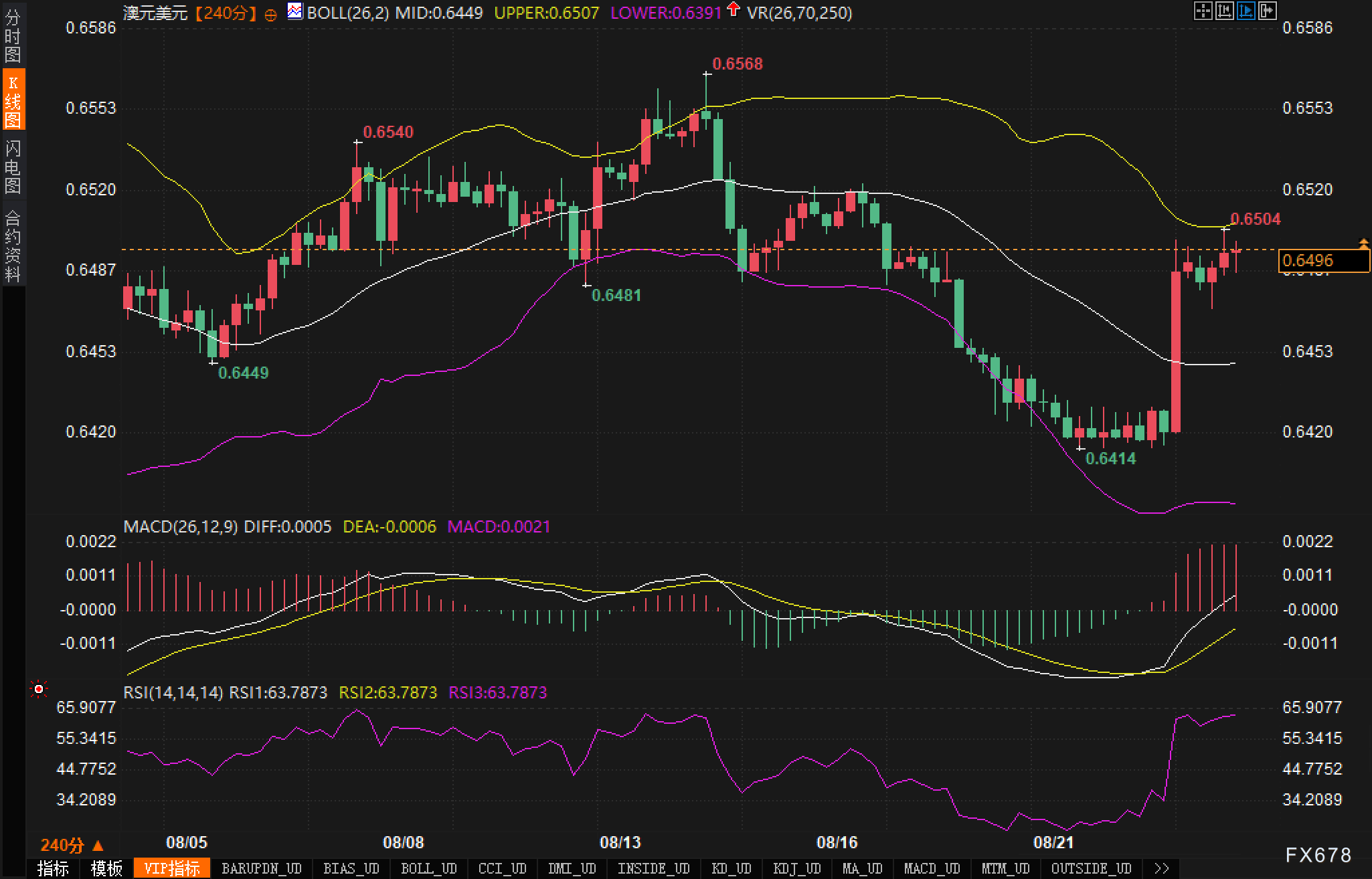
Structurally, 0.6568 is the significant front high of this round of rebound, with the upper resistance at 0.6507, 0.6540 and 0.6568 in turn; the lower support focuses on 0.6487, 0.6449 and 0.6414. If it falls, the lower rail 0.6391 will be a more critical trend line of defense. ATFX technical research believes that the current volume and price pattern is in line with the classic trading rhythm of "Bollinger Band Regression, Upper Rail Temptation, Middle Rail Backtest". If the bandwidth expands in the short term and is accompanied by the positive line physical amplification, it may confirm the upward continuation of a breakthrough in volume energy; conversely, if there is a false breakthrough and falls back below 0.6487, you need to be vigilant against the mean reversion of the retracement middle rail.
Market sentiment observation:
Powell's dovish signal changed the previous market consensus of "strong dollar, weak risk", the implied path of interest rate swaps was repriced, and the market's imagination of the rhythm of interest rate cuts this year has heated up. On the foreign exchange disk, carry and momentum funds tend to cover the previous long positions in the US dollar, forming a marginal positive for high beta currencies. In terms of options, around the psychological threshold of 0.6500, the call and put positions squaring of short-term options are relatively balanced, indicating that market sentiment has shifted from extreme unilateral to neutral and optimistic.
Although the US dollar index has rebounded 0.2% from a four-week low, it remains in a weak range. Any unexpected data on employment or inflation can quickly trigger directional fluctuations. In this context, the risk premium of the Australian dollar depends more on changes in global risk appetite and the resonance of local policy signals in Australia than on a single data point.
Please indicate the source: https://www.daoctech.com/fxschool/2491.html
Disclaimer: The content of this article does not represent the views of the Institute of Foreign Exchange. The content is for reference only and does not constitute investment advice. Investors operate accordingly at their own risk.