
The situation in the Middle East has affected the oil market, causing global crude oil inventories to rapidly deplete
As the foreign oil tankers in the Persian Gulf have arrived at the end one after another, many countries have begun to release strategic crude oil reserves to fill the supply gap in the Middle East and stabilize oil prices. However, this emergency regulation method is difficult to maintain for a long time. The geopolitical situation in the Middle East continues to ferment, and global crude oil inventories are depleted at the fastest rate in history. Superimposed on the traditional peak demand season in the northern hemisphere, the cash market supply is tight, the inventory is low, the demand is weak and the geopolitical stalemate is intertwined with multiple factors, and the global crude oil supply and demand pattern is falling into
Emergency oil storage is difficult to last, and inventory consumption hits a record high
At present, the last batch of foreign oil tankers in the Persian Gulf have arrived at their destinations one after another, and countries rely on the release of strategic crude oil reserves to temporarily make up for the crude oil supply gap in the Middle East and suppress the rise in oil prices.
Industry analysts and energy executives generally agree that the longer the situation in the Middle East continues, the more severe the global crude oil supply situation will be. Recent industry monitoring data show that global crude oil inventories are falling at the fastest pace in history, and market analysts point out that the inventory buffer space is ultimately limited and cannot offset the impact of continuous supply adjustment in the long run.
This market change coincides with the regular replenishment window of refineries in the northern hemisphere. Originally, summer was the traditional peak demand for car travel, agricultural production and air travel. Affected by the situation in the Middle East pushing up oil prices, the demand for crude oil in this peak season may weaken significantly, and the impact of supply shortages will gradually spread from Asia to the world. Although future market fluctuations are relatively flat, the shortage of physical crude oil market has emerged, and the tension is expected to last at least a few months.DBG ForexMarket analysis points out that the current supply and demand imbalance has a profound impact on the global energy trade pattern.
Patrick Pouyanne, CEO of Total Energy, said that even if the situation in the Middle East can be stabilized in May, global crude oil inventories are already at extremely low levels. According to its estimates, the daily consumption of crude oil inventories in the world has reached 10 million to 13 million barrels, and the global reserves have been depleted 500 million barrels since the geopolitical fluctuation. Resta Energy is more conservative, with global supply losses of about 600 million barrels since the beginning of March. Even if Persian Gulf shipping returns to normal at the end of this month, the overall supply gap is still very large.
Global inventories are already low and continue to decline under multiple scenarios
The current hidden dangers of crude oil inventories are even more prominent, and the overall inventory base is far lower than the level of five years ago.
In 2021, global crude oil inventories can meet consumption demand for more than 90 days, falling back to less than 80 days in 2022, and then continued to decline under the monitoring of many authoritative institutions. The agency deduces three development paths of the Middle East situation. No matter what the situation is, global crude oil inventories will continue to decline before 2027; if the shipping disturbance continues beyond the end of June, inventories may fall to a critical position that can only meet 70 days of demand.
The spontaneous adjustment effect of the market has already appeared, and high oil prices have begun to suppress consumer demand. Relevant data show that Asia's crude oil imports in April fell by 30% year-on-year, setting a new low in the same period of the decade. Scarcity of supply and high prices jointly inhibit the willingness to purchase. Europe has experienced a shortage of aviation kerosene, and airlines have been forced to cut flights; Asia's naphtha supply shortage has dragged down the production of the chemical industry chain; US crude oil and refined oil inventories have been reduced simultaneously, and the energy security buffer capacity has continued to weaken. US gasoline inventories have fallen to a low level in the same period in many years, significantly lower than the five-year average.
The geopolitical situation continues, and the oil market is expected to adjust
The situation in the Middle East is difficult to achieve substantive easing in the short term. Although the United States and Iran have expressed their views on easing, there are still differences between the two sides. Even if they continue to release peaceful intentions, they have not reached an effective consensus. Under the stalemate, the probability of an optimistic ending continues to decline, and the possibility of negative scenarios continues to increase. The loose pattern of global crude oil supply will be further tightened, and the subsequent balance of oil prices and supply and demand will continue to be under pressure.
summary
Overall, relying on strategic reserves can only support the oil market in the short term, and cannot resolve the fundamental contradiction between supply and demand. The situation in the Middle East prolongs the inventory consumption cycle, superimposed on the already low global inventory base, pressure on demand during peak seasons, and the spread of regional oil shortages. Coupled with the stalemate in the geopolitical situation, the global crude oil market has entered a high volatility cycle, and subsequent low inventories and tight supply may become the norm.
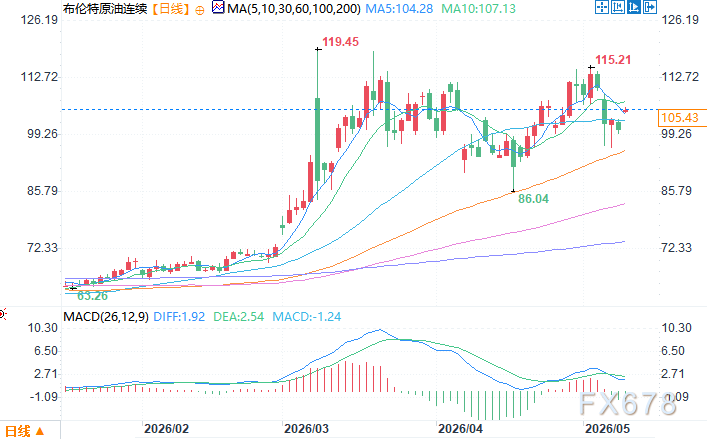
Brent crude oil continuous daily chart, source: Internet
At 11:13 on May 11, Beijing time, Brent crude oil continued to trade at $105.51/barrel
Please indicate the source: https://www.daoctech.com/fxschool/2502.html
Disclaimer: The content of this article does not represent the views of the Institute of Foreign Exchange. The content is for reference only and does not constitute investment advice. Investors operate accordingly at their own risk.