
Global chaos pushes up the Swiss franc, how long can the central bank maintain 0% interest rates?
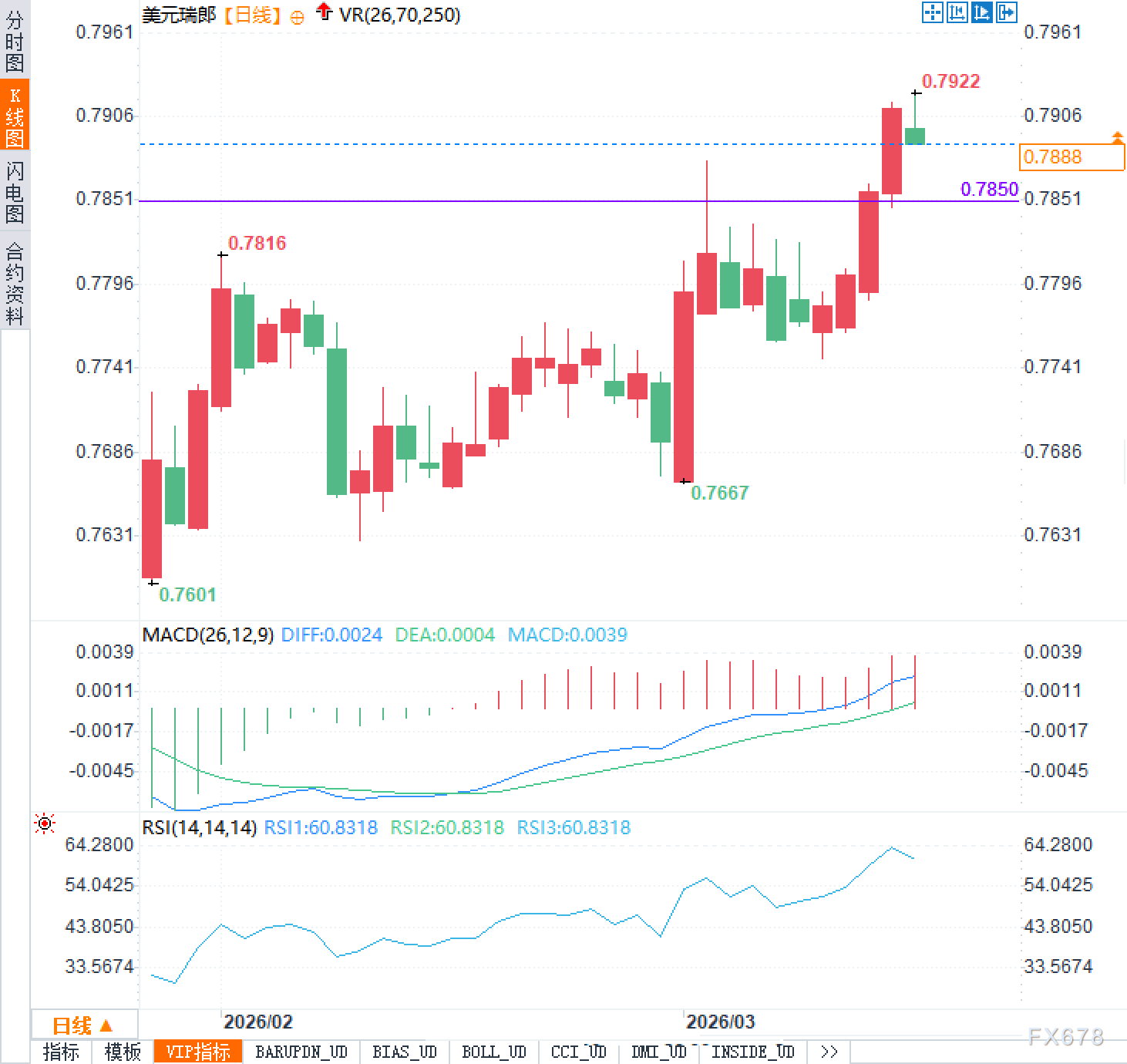
In the current market environment, the Swiss franc has shown a certain risk-off attribute. On Monday, March 16, the exchange rate of the US dollar against the Swiss franc was trading around 0.7885, and the euro against the Swiss franc was at the level of 0.9030. The policy interest rate of the Swiss National Bank has been maintained at 0.00% since June 2025; global uncertainties have driven capital inflows into the Swiss franc, resulting in increased appreciation pressure. In Switzerland, the annual rate of CPI in February was only 0.1%, and the monthly rate rose by 0.6% slightly more than expected, but the overall inflation is still close to the lower limit of the target range. Martin Schlegel of the Swiss National Bank has said many times recently that the threshold for negative interest rates is high, and the short-term negative inflation reading is not an immediate alarm. The central bank prefers to respond to the excessive appreciation of the Swiss franc through foreign exchange intervention, rather than easily
The Swiss National Bank's March meeting is expected
Institutional analysts believe that the SNB is likely to maintain the policy interest rate unchanged at 0.00% at the March 19 meeting. This judgment is based on the continuation of the current low inflation environment, the resilience of GDP growth, and the potential upside risks posed by global energy price fluctuations. Inflation has been hovering around 0.1% for several consecutive months, in line with the SNB's neutral expectations, but the appreciation of the Swiss franc poses the main downward pressure. Schlegel stressed in his recent remarks that the threshold for restarting negative interest rates is very high, and even a short-term negative inflation reading will not trigger an immediate response. The central bank is more prepared to passforeign exchange marketIn contrast to cutting interest rates, intervention in foreign exchange has become a more direct tool, especially in the context of heightened international volatility.
The appreciation of the Swiss franc and inflation trends
As a traditional safe-haven currency, the Swiss franc has become more attractive in times of frequent global risk events, resulting in a sustained rise in the nominal effective exchange rate. This directly depresses import prices and amplifies downside risks to inflation. The Swiss National Bank has previously made it clear that it has been "increasingly prepared" to intervene in the foreign exchange market since the international tensions. Data show that the US dollar is at 0.7885 against the Swiss franc and the euro is at 0.9030, indicating that the appreciation momentum has not reversed significantly. On the inflation front, the annual rate of CPI held steady at 0.1% in February, and the core pressure was limited. The Swiss National Bank forecasts that if interest rates remain at 0.00%, inflation will average 0.3% in 2026 and 0.6% in 2027, implying medium-term moderate recovery expectations, but the short-term Swiss franc factor remains the dominant variable.
The following is a comparison of key indicators: The latest value of the indicator Previous value/Near-term SNB target/expectation, SNB policy rate 0.00% 0.00% (from June 2025) - Swiss CPI Annual rate (February) 0.1% 0.1% 0-2% Swiss CPI Monthly rate (February) 0.6% -0.1% - USD/CHF around 0.7885 Recent volatility range 0.78-0 80 - EUR/CHF 0.9030 Near recent highs -
Foreign exchange intervention takes precedence over negative interest rates
Market logic suggests that the SNB is cautious about negative interest rates. Schlegel has repeatedly reiterated that the threshold for negative interest rates is much higher than the normal adjustment, and the central bank would rather tolerate mild deflation than easily turn into negative territory. On the contrary, foreign exchange intervention has become the preferred response, especially when the appreciation of the Swiss franc directly threatens the inflation target. Recent statements by the deputy governor have also reinforced this tendency, and the willingness to intervene has increased significantly under the influence of geopolitical events. Historical experience shows that the SNB prefers direct access to the market rather than interest rate instruments in similar environments, in order to avoid excessive shocks to the banking system and depositors. The current 0.00% interest rate, combined with a charge of -0.25% depending on the excess deposit, has constituted some negative incentives, but has not yet triggered more aggressive measures.
Frequently Asked Questions
Question 1: Why does the SNB currently prefer foreign exchange intervention rather than cutting interest rates into negative territory?
Answer: The appreciation of the Swiss franc directly restrains import prices and overall inflation. Foreign exchange intervention can specifically reduce this pressure, and negative interest rates have greater side effects on the real economy and the financial system. Schlegel made it clear that the threshold for negative interest rates is high, and even short-term negative inflation will not be triggered immediately. The central bank gives priority to monitoring the exchange rate and preparing to enter the market to maintain the medium-term realization of the price stability target range of 0-2%.
Question 2: In the current low inflation environment, what specific impact will the appreciation of the Swiss franc have on the Swiss economy?GTCforeign exchange
A. Appreciation helps control inflation by lowering the cost of imports, but at the same time weakens export competitiveness, especially in pillar industries such as pharmaceuticals and precision manufacturing. GDP growth is resilient, but if it continues to appreciate, it may amplify the impact of weak external demand. The SNB intervenes to balance this contradiction, to avoid the exchange rate from being too divorced from fundamentals, and to observe whether global energy prices lead to a recovery in inflation.
Question 3: What is the future path of inflation and will it force the SNB to adjust its policy?
Answer: The SNB forecasts 0.3% inflation in 2026 and 0.6% in 2027, assuming interest rates remain at 0.00%. Negative readings are possible in the short term, but a moderate recovery in the medium term is more likely. If upward pressure on the Swiss franc persists, intervention remains the main tool; if inflation accelerates unexpectedly, there is room for stabilization or fine-tuning, but the resumption of negative interest rates requires significantly worsening conditions, which is currently low probability.
Please indicate the source: https://www.daoctech.com/fxschool/2686.html
Disclaimer: The content of this article does not represent the views of the Institute of Foreign Exchange. The content is for reference only and does not constitute investment advice. Investors operate accordingly at their own risk.