
US domestic demand resilience + global risk aversion, the dollar strengthened in the short term
On Thursday (May 14), the US dollar index remained strong during Trump's visit to China. With the release of data, it rose slightly, and then suddenly fluctuated sharply. It is currently trading around 98.63. Traders can pay attention to whether there is any important news in the follow-up of the US dollar index.
In April 2026, the US economy presented a complex picture of "strong consumption support and weak employment". The differentiation of core data not only highlights the resilience of domestic demand, but also exposes the hidden concerns of growth momentum. The intertwining of geographical and market factors adds uncertainty to the follow-up policy and asset trends.

Data performance: overall compliance, but poor quality
U.S. retail sales rose 0.5% month-on-month in April, in line with market expectations; core retail sales (excluding automobiles,CBCXforeign exchangeGasoline and other volatile items) performed even more prominently, recording a growth of 0.7% month-on-month, slightly exceeding expectations by 0.1 percentage points, and standing firmly in the historical average monthly growth range of 0.3% -0.5%, highlighting the role of consumption in the economy.
From a long-term perspective, the 4.9% year-on-year growth rate continued the core boost of consumption to GDP, but the details of the data are hidden: retail sales in March were revised down from 1.7% to 1.6%, suggesting that growth momentum at the end of the first quarter was slightly weaker than initially expected.
This consumption growth is not a purely endogenous recovery, but the result of the resonance of multiple external factors: under the global energy crisis, the American people stockpiled energy-related goods in advance, directly driving up sales;
The continued strength of US stocks in April stimulated consumption willingness through the wealth effect. Data showed that for every $1 increase in stock wealth, personal consumption increased by an average of nearly 5 cents, further amplifying the strength of retail sales data.
Job market: cracks appear, non-agricultural differentiation confirms weakness
Labor Department data show that as of the week of May 9, the number of initial jobless claims jumped from 199,000 to 211,000, higher than market expectations and a new high; the number of continuing jobless claims rose to 1.782 million,It means that it will be more difficult for the unemployed to re-employ, and the "friction" of the job market will increase.
The four-week moving average, which eliminates weekly volatility, rose to 203,750, further confirming that the employment slowdown is not a short-term surprise, but an emerging trend change.
This weakness is confirmed in the non-farm payrolls data: although the US non-farm payrolls increased by 115,000 in April, the industry differentiation is obvious - the health care, transportation and warehousing industries continue to recruit heat, but the federal government, information industry employment continues to decline, and the retail trade shows the coexistence of general merchandise store layoffs and bulk commodity retailers. Behind it is the cautious attitude of enterprises towards the economic outlook.
The dollar index under the data game: torn in the strong oscillation
The current strengthening of the US dollar index, in addition to being boosted by the US visit to China, the US dollar index stabilized above 98.50 after the data was released, and then strengthened significantly.
On the one hand, core retail sales exceeded expectations, confirming the resilience of domestic demand, easing fears of economic recession, weakening the need for short-term interest rate cuts by the Federal Reserve, and providing fundamental support for the dollar.
On the other hand, global geopolitical uncertainties are exacerbated by high energy prices, driving risk aversion back into US dollar assets and strengthening their risk-off properties.
The weakness of the labor market has constrained the growth of the dollar: if the number of initial jobless claims continues to rise and the growth rate of non-farm employment further slows, it may trigger the market to reprice the economic outlook, thereby suppressing the upward space of the dollar.
It is expected that in the short term, the US dollar index will maintain a "torn" strong fluctuation, which is deeply tied to the sustainability of retail consumption and the deterioration of the labor market, while energy price fluctuations and geopolitical changes will become key disturbance variables.
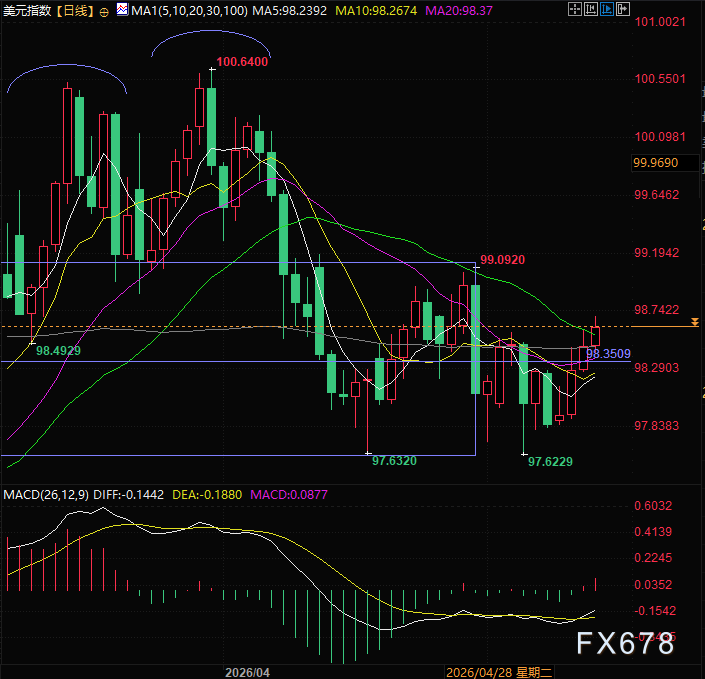
(Dollar index daily chart, source: Internet)
At 21:54 Beijing time, the dollar index was trading at 98.63.
Please indicate the source: https://www.daoctech.com/fxschool/2699.html
Disclaimer: The content of this article does not represent the views of the Institute of Foreign Exchange. The content is for reference only and does not constitute investment advice. Investors operate accordingly at their own risk.