
Mainstream techniques for position sizing management
Previous courses have suggested that if you follow a mathematician's model, there is only one best way to set your position size. But in reality, traders also use many other methods to set positions. The first is the 2% rule, invented by the managers of the Turtle Trader experiment, which seeks to prove that anyone can learn to trade and trade successfully if they are given enough tools (including the 2% capital limit) for any trade. Mathematically, it can be easily demonstrated that assigning a maximum of 2% risk to each trade allows you to take a series of initial and ongoing losses, and that these losses will be recovered if the winning ratio of the trading system is higher than 1:1.
The problem with the 2 per cent rule is that, as with many forex traders, if your initial principal is very low, you can trade only a few mini or micro lots, but it takes a very long time to build a large capital base. Alexander Elder has developed another 6 per cent rule that also fits this argument. The problem with breaking the 2 per cent rule is that you will become impatient, greedy and likely to lose all your principal and have to save again to start over.
The first step in managing a position size is always to determine the amount of money you can afford to lose, whether that money is a dollar amount or a percentage of the total principal. Logically, this means that you have to find stops that will not be touched and measure the entry level available at the time or the ideal entry level that will bring the most gains. For example, you are studying the following chart. EUR/USD has broken through a minor support level. You want to sell short at the current position, and your stop will be set at the support-to-resistance level (red line) 1.0830 or 73 pips away from the current ask price of 1.0757. You are willing to take a loss of 500 dollars for this trade, so this can be easily calculated as, you can trade about 0.68 lots (500 dollars divided by stop loss distance and then divided by pip value). Please note that we do not consider profit potential this time either. Profit may only be 45 pips (reaching 1.0712)greenWhen the support line is reached), but if the previous low is reached at 1.0521 or 236, the profit could be even higher.
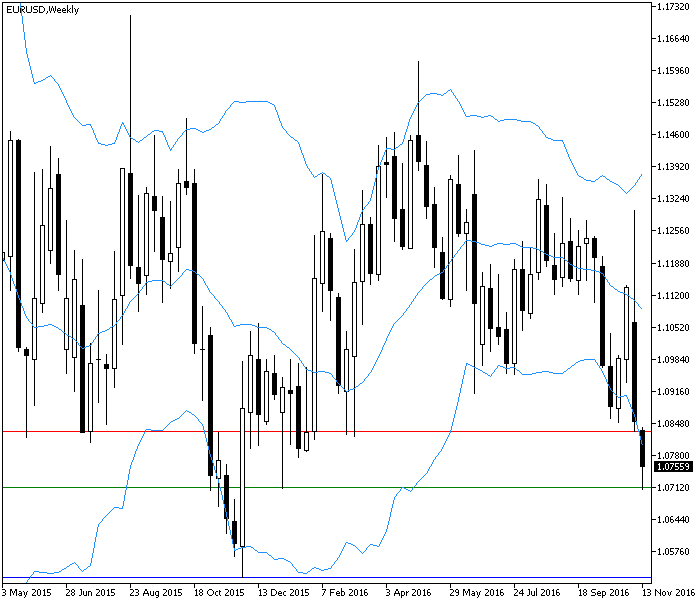 EUR/USD falls below the support line (red), and has the potential to reach the nearest support level (green) or a long-term low (bluePlease do not consider moving the support down to unreachable levels in order to get more contracts. The important thing about stop loss levels is their safety. You want them untouched, just as you have fire insurance, but you don't want your house to catch fire. Modifying the "allowed" stop loss level instead of using the calculated value to trade one or two complete contracts is itself an act of self-deception. You can choose the bottom of the Bollinger Bands as the stop loss level, which is only 43 points and can trade more contracts (1.16 lots). But 43 points is easily touched by noisy activity during the week, so it is not a good stop loss. It is true that you will be trading 1 full lot, so if the price does not break through the bottom of the B line and does not fall to the previous low, you will have a decent gain - but this is still the wrong thing to do. Set stops and position sizes based on the worst possible scenario.
For example, this trade (0.68 lots) did result in a loss. Now what? The turtle still works: when your account loses 10%, risk losing 20% of your total capital. If you have more than $5,000 in EUR trading in your account and the maximum you can afford to lose is $500, or 10% of your principal, you have about $4,500 left, and the next stop loss should be reduced accordingly, or set to 80% x $500 = $400.
Another more sophisticated way to manage position size is through volatility. This approach is very reasonable and appropriate, although foreign exchange volatility changes rapidly, making it necessary to constantly update the data. Given the proportion of initial principal and venture capital in the trade (i.e. the pips/dollar amount in the stop loss level), the core principle is to manage position size according to currency volatility. You can predict volatility at will, but the standard algorithm is to convert the average true volatility range (ATR) to dollars:
Position size = (% of principal x risk capital)/ATR
This can be simplified to:
Position Size = USD Stop Loss/ATR
Fortunately, we can easily obtain ATRs from most data providers and platforms. In the Euro case, the current ATR on W1 (weekly chart) is 186 pips. Therefore:
Position size = 730 dollars/1 dollar,Industrial foreign exchange860 = 0.39
As you can see, the volatility-adjusted position size is as low as almost half of the funds chosen by any 2% risk rule. In some cases the opposite can happen - volatility will exceed the original 2% rule. If you use a reasonable measure of volatility and the volatility is relatively stable, then you can abandon the rule, but it should be noted that you may overtrade on risky funds.
Please indicate the source: https://www.daoctech.com/fxschool/2697.html
Disclaimer: The content of this article does not represent the views of the Institute of Foreign Exchange. The content is for reference only and does not constitute investment advice. Investors operate accordingly at their own risk.