
The expectation of yen intervention is superimposed on geopolitical risks, and the dollar remains high against the yen
The dollar rose slightly against the yen to around 161.80 during the Asian trading session on Monday, continuing the recent high and volatile strong trend. The current rise in the exchange rate is mainly supported by the safe-haven demand for the dollar, especially in the context of the uncertainty of the negotiations between the United States and Iran over the situation in Hormuz.
The United States and Iran have agreed to temporarily suspend military confrontation in the Gulf region and plan to hold a new round of negotiations in Qatar. Although the short-term conflict has cooled down, the market is still cautious about the effect of the implementation of the agreement, resulting in the safe-haven attribute of the US dollar still having some support, so that the USD/JPY maintains a strong structure. However, the policy risk on the Japanese side is rising significantly, becoming one of the key factors to limit the further rise of the exchange rate. Japanese officials have recently emphasized that they will take appropriate intervention measures against excessive foreign exchange fluctuations, which has made the market highly vigilant against the rapid depreciation of the yen. Once the exchange rate further approaches the key psychological level, the actual intervention risk may quickly increase, thus forming a clear suppression of the USD/JPY.
At the same time, the Bank of Japan's policy expectations are also changing marginally. Naoki Tamura, a governor of the Bank of Japan, recently said that the central bank should gradually raise interest rates and accelerate the pace of tightening if necessary to deal with the risk of inflation from external shocks.DepuThis statement strengthened market expectations for the normalization of Japan's monetary policy, strengthening the medium-term support for the yen.
From the overall structure, USD/JPY is currently in a two-way game of "dollar risk aversion support + yen policy intervention risk". Although the short-term remains strong, the upward space is obviously constrained by policy. The market's follow-up focus will shift to the US non-farm payrolls data released on Thursday, which will affect the short-term direction of the dollar. Meanwhile, the Bank of Japan's July 30-31 meeting will also be a key event, and the market will focus on its inflation forecast and interest rate hike path signals.
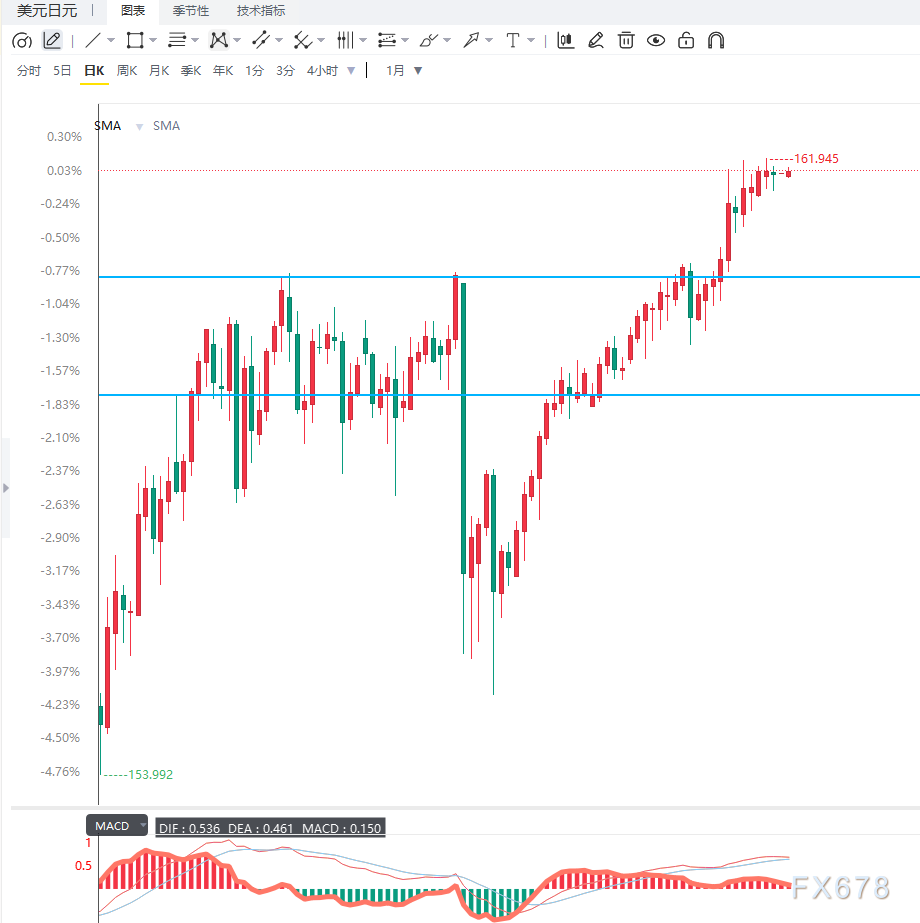
From the perspective of the daily structure, USD/JPY maintained a high and volatile upward pattern, and the price continued to operate atHigh range above 160The overall trend is still strong, but the above is close to the historical high pressure area, and volatility risk has increased significantly. The current key resistance above is located at162.50-163.50The region could trigger an expected strengthening of policy interventions, limiting further upside.
In terms of support below, first pay attention toNear 160.80This position is a short-term long-short demarcation area; if it falls below, it may be backtested159.50-158.80Range, this area is the support zone for many recent steps back. Overall, the daily trend is still too much, but the risk-reward ratio is gradually declining.
From the perspective of the 4-hour level, the exchange rate has entered a high-level consolidation structure after continuous upward movement. The moving average system maintains a long arrangement but the slope slows down, indicating that the margin of rising kinetic energy has weakened. The kinetic energy indicator is in a high-level oscillation state, and the market has obvious profit-taking and chasing differences. If the exchange rate cannot effectively break through the 162 mark, it may enter a high-level consolidation; if it falls below 160.80, the short-term may turn to adjust the structure.
edit summary
Overall, the current rise in USD/JPY is mainly driven by the safe-haven demand of the US dollar, but the expectation of Japanese policy intervention and the normalization of monetary policy are forming a clear check and balance. The market is facing dual pressure of policy and sentiment in the 161-163 range, which constrains the upward space of the exchange rate.
In the medium term, the trend of the yen will depend more on the policy path of the Bank of Japan and the rhythm of foreign exchange intervention, rather than purely driven by the dollar. Before the US non-agricultural data and the Bank of Japan's July meeting, the USD/JPY is likely to maintain a high volatility pattern, and a trend breakthrough still requires new macro catalysts.
Please indicate the source: https://www.daoctech.com/fxschool/2748.html
Disclaimer: The content of this article does not represent the views of the Institute of Foreign Exchange. The content is for reference only and does not constitute investment advice. Investors operate accordingly at their own risk.