
Crude oil trading reminder: the United States and Iran reached a peace agreement, the risk premium fell sharply, and oil prices may start a short mode?
International oil prices suffered a marked sell-off at the start of the week, with US West Texas Intermediate crude falling to near $80 a barrel in Asian trading, its lowest level in nearly two months. The signs of a major de-escalation in the months-long military conflict in the Middle East and the rapid cooling of market concerns about the blockage of global energy transportation prompted the risk premium that had accumulated to be quickly reversed.

Pakistani Prime Minister Shahbaz Sharif said that the United States and Iran have reached a peace agreement, and the two sides announced an immediate and permanent cessation of all military operations, including in Lebanon. Later, US President Donald Trump also confirmed that the agreement has been completed and announced that normal shipping in the Strait of Hormuz will be allowed to resume, while lifting the previous maritime blockade against Iran.
Previously, the Strait of Hormuz was seriously affected after the US and Israel launched air strikes on Iran in late February. As one of the most important energy transportation channels in the world, the Strait of Hormuz is responsible for about 20% of the world's seaborne crude oil transportation. The risk of closure of the Strait of Hormuz has pushed international oil prices to remain high for several months. Now as the expectation of a recovery in shipping has strengthened, the market has begun to reassess the risk of global crude oil supply, and safe-haven funds have gradually withdrawn from the energy market.
However, market concerns about the situation in the Middle East have not completely disappeared. Trump stressed that if Iran fails to reach a final nuclear agreement with the United States in the future, the United States may still resume military action. This means that the current peace agreement is more of a phased de-escalation, and geopolitical risks may still re-enter the market pricing range in the future. Once the Middle East supply disruptions again, crude oil risk premiums may rebound, supporting WTI prices.
In addition to geopolitical factors, investors will also be watching the latest weekly crude oil inventory data released by the American Petroleum Institute (API) this week. If the data shows that the decline in US commercial crude oil inventories exceeds market expectations, it may mean that refinery demand improves or consumption increases, providing a rebound in oil prices. Conversely, if inventories unexpectedly increase, it may strengthen the market's concerns about loose supply and slowing demand, further limiting the upside of WTI crude oil.
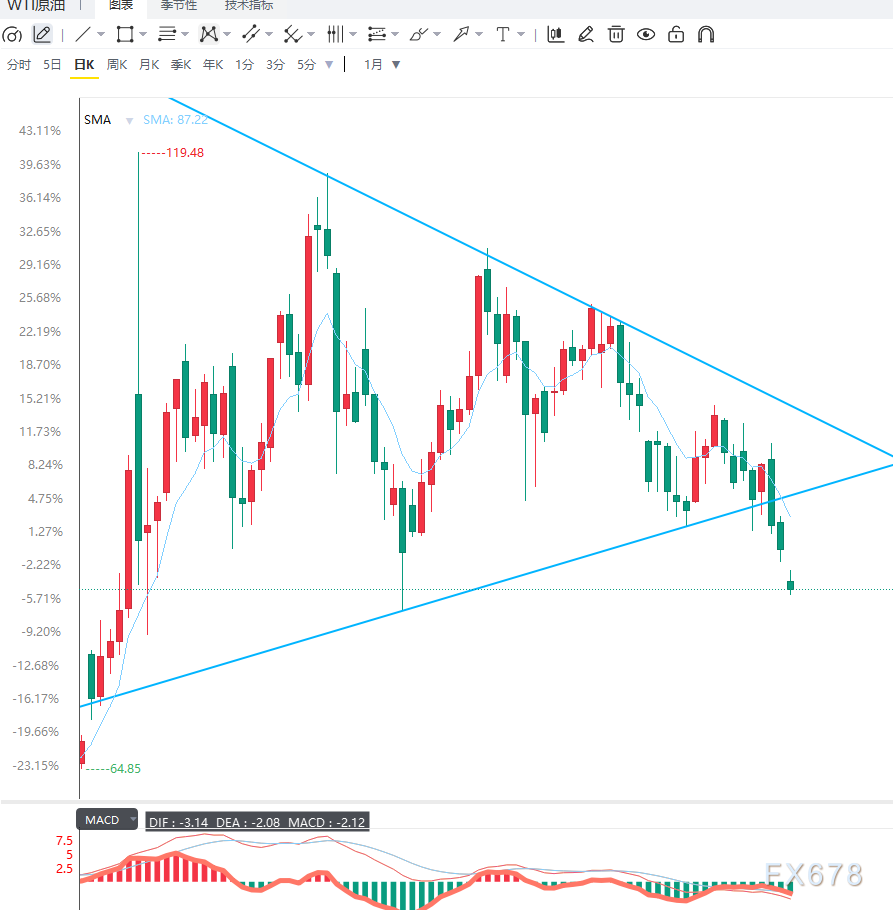
Judging from the daily trend,PepperstoneThe previous upward trend of WTI crude oil driven by the situation in the Middle East has reversed significantly. The price quickly fell below several key moving average areas, indicating that the market sentiment is dominated by supply concerns and shifts to a renewed focus on fundamental supply and demand. The current near $80 has become an important short-term psychological support area. If it falls below this level, oil prices may further test the $77.00 and $75 areas. From the above, the vicinity of $82 and $84 will become an important resistance area for the short-term rebound. Only by regaining a foothold in these positions can it be expected to ease the current bear pressure.
From the observation of the 4-hour cycle, WTI is still in a significant downward channel, with the short-term moving average remaining short. The kinetic indicators show that although selling pressure has been released, there has not been a clear trend reversal signal. If oil prices stabilize near $80, a technical correction rebound cannot be ruled out, but if the rebound cannot break through the $82 area, the overall trend will still be dominated by weak shocks or continue to decline.
edit summary
The emergence of the US-Iran peace agreement has significantly eased the market's concerns about the interruption of crude oil supply in the Middle East, pushing WTI oil prices to quickly give up the previous geopolitical risk premium and fall to a two-month low. In the short term, the resumption of navigation in the Strait of Hormuz and the improvement of supply expectations will still limit the room for oil prices to rise, but the situation in the Middle East is still possible to be repeated as the final nuclear agreement is not yet fully determined. At the same time, US API inventories and subsequent EIA inventory data will become important indicators to measure actual demand. If inventories continue to decline, or provide phased support for oil prices, the future WTI trend is expected to find a new balance between the easing of geopolitical risks and changes in global supply and demand.
Please indicate the source: https://www.daoctech.com/fxschool/2746.html
Disclaimer: The content of this article does not represent the views of the Institute of Foreign Exchange. The content is for reference only and does not constitute investment advice. Investors operate accordingly at their own risk.