
The Australian dollar has stabilized at a low level against the US dollar, and market attention has turned to the Federal Reserve
Sept. 19 - The Australian dollar remained in a tight band against the dollar last week as traders reacted to important economic data from the United States, China and Australia. The most important data came on Wednesday, when the United States released its latest consumer inflation data.
The Aussie dollar pair remained in a narrow range last week as traders reacted to important economic data from the US, China and Australia. The most important data came on Wednesday, when the US released its latest consumer inflation data.
The data showed that headline consumer prices rose to 3.7 per cent in August from 3.2 per cent in July. Core inflation, on the other hand, fell to 4.3 per cent. Analysts believe inflation will continue to rise now that crude oil prices have jumped to their highest since November.
Another important macro event came on Thursday, when the US reported strong retail sales figures that suggested the US consumer remained strong despite rising interest rates.
Therefore, analysts believe that the Federal Reserve will pause at its meeting on Wednesday. This is where the bank left interest rates unchanged and hinted at further rate hikes later this year. The Fed's decision will be the most important catalyst for the pair this week.
The AUD/USD currency pair also reacted moderately to the latest economic data from Australia and China. The unemployment rate held steady at 3.7% in August, with the economy adding more than 64.9,000 jobs, according to Statistics Australia. Participation rose to 67%.
Meanwhile, China's National Bureau of Statistics (NBS), Australia's largest trading partner, said retail sales, industrial production, and fixed-asset investment all rose in August.
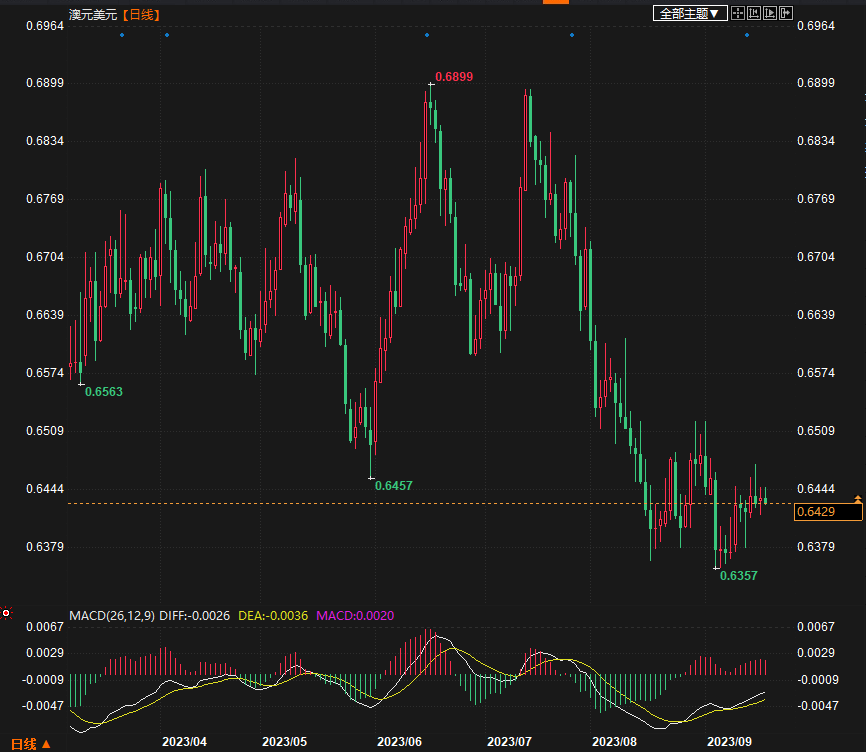
Technical analysis of the AUD/USD currency pair trading
Despite the jump of the Dollar Index (DXY) to its highest level in months, the AUD/USD pair tried to rebound last week. It rose to a high of 0.6472, its highest level since September 1. In the process, the pair formed a red channel in an uptrend and is currently below. It is also oscillating at the 50-day exponential moving average (EMA).
The MACD indicator and the signal line form a cross pattern in the downtrend. Therefore, the future trend of the pair is biased downwards, and the next support is at the psychological level of 0.6400.
At 14:30 Beijing time, the Australian dollar was trading at 0.6431/33 against the US dollar.
Please indicate the source: https://www.daoctech.com/fxschool/791.html
Disclaimer: The content of this article does not represent the views of the Institute of Foreign Exchange. The content is for reference only and does not constitute investment advice. Investors operate accordingly at their own risk.