
FX today's news, this week's Federal Reserve resolution is not expected to raise interest rates, what are the key points to pay attention to?
Sept. 20 - The Federal Reserve is all but unlikely to raise interest rates after a two-day meeting that will release quarterly updates on its forecasts for a range of key measures, including interest rates, GDP, inflation and unemployment. The central bank is widely expected to ensure that markets know that it should not make assumptions about what comes next.
As usual, this week's Federal Reserve meeting will focus more on policymakers' expectations for the future than on what they are doing now.
At present, it is almost impossible for the Federal Reserve to choose to raise its benchmark borrowing rate. According to data from the Chicago Mercantile Exchange (CME), the market expects only a 1% chance of the Federal Reserve raising interest rates for the 12th time since March 2022.
But in the early hours of Thursday, Beijing time, the focus will be on the Fed's latest quarterly forecasts for a range of key indicators - interest rates, GDP, inflation and unemployment. That's where the suspense lies.
1. Interest rate
The Federal Reserve will not adjust its key funds rate, which determines the overnight lending rate between banks but also affects many forms of consumer debt.Historically, especially under Chairperson Jerome Powell, the Fed does not like to move against the market, especially when market expectations move strongly in one direction. The funds rate is locked in the current target range of 5.25% -5.5%, the highest level since the early 2000s.
However, it is widely believed that the Federal Reserve will ensure that the market knows that it should not make assumptions about what comes next.
Roger Ferguson, former vice-chairperson of the Federal Reserve, said this week: "There may be a pause here, but obviously, as they say, the November meeting is likely to be a live meeting. I don't think they're ready to say, 'We're done raising rates now.'"
He added: "This is a time for the Fed to be very careful. They should never say we are completely over raising rates because I don't think they really understand that yet and I think they want the flexibility to do it again if they need to."
2. Dot map
One way the Federal Reserve communicates its intentions is through its dot plot, an anonymous grid that lists individual members' expectations for future interest rates.
The market will look for subtle changes in the dots to understand how officials perceive developments.
Gus Faucher, chief economist at PNC Financial Services, said: "I think they will maintain their bias towards rate hikes and suggest they are willing to raise rates further if the data start to show that inflation is not slowing as they expect, or if the labour market remains too tight."
One key factor that market participants will be watching: the "longer-term" median point, in Wednesday's case, will be the forecast beyond 2026. The median forecast at the June meeting was 2.5%.
Joseph Brusuelas, chief economist at RSM, said that if it rose by even 25 basis points, it could be a "default" signal that the Fed would be content to keep inflation above its 2 per cent target, which could roil markets.
"We are laying the groundwork to prepare our clients for inflation targets that we believe will rise," he said.
3. Summary of Federal Reserve Economic Projections (SEP)
The Federal Reserve updates its summary of economic forecasts each quarter - outlooks for interest rates, inflation, GDP, and unemployment. Think of the SEP as a policy clue left by the Fed that, unfortunately, often leaves something to be desired.
In particular, over the past few years, as Federal Reserve officials have misread inflation and economic growth, forecasts have consistently been demonstrably wrong, leading to some major policy adjustments that have unbalanced markets.
In this week's iteration, the Federal Reserve is widely expected to significantly raise its June forecast for GDP growth this year, while downgrading its forecasts for inflation and unemployment.
"The Fed will have to almost double its growth forecast," Ellen Zentner, chief US economist at Morgan Stanley, said on Tuesday.
4. Statement
While the SEP and bitmap will attract the most attention, potential adjustments in the post-meeting statement could also be in the spotlight.
Zentner said the Fed could change some of its policy descriptions, as well as its view of the economy. One potential adjustment to the July statement could go something like this: "In determining the extent of further policy tightening (which may be appropriate to bring inflation back to the 2 percent level over time), the Committee will consider the cumulative degree of tightening of monetary policy, the lagged effects of monetary policy on economic activity and inflation, and economic and financial developments."
She said removing the word "further" would send a signal that FOMC members were at least considering the need for no more rate hikes.
The second potentially powerful change is that if the Fed removes the word "highly" from the phrase "the committee remains highly concerned about inflation risks", it could indicate that the Fed is less concerned about inflation.
"These are small adjustments that should not be taken lightly, and they will be a small step in stopping the rate hike cycle," said Mr. Zentner.
5. Press conference
After the statement, the dot plot, and the SEP, Powell will take the stage to answer questions from reporters, an event that typically lasts about 45 minutes.
Mr. Powell used the meeting to amplify what the FOMC had already done, and sometimes his statements differed somewhat from those in official documents, making things unpredictable and potentially market-moving.
Markets are betting that the Federal Reserve has ended the current rate hike cycle, with only a 30% chance of a rate hike in November. It would make sense if the Fed chairperson could do something to calm market sentiment.
However, Zentner expects the Fed to align with market thinking. "We do think the Fed is over, they just don't know it yet," she said.
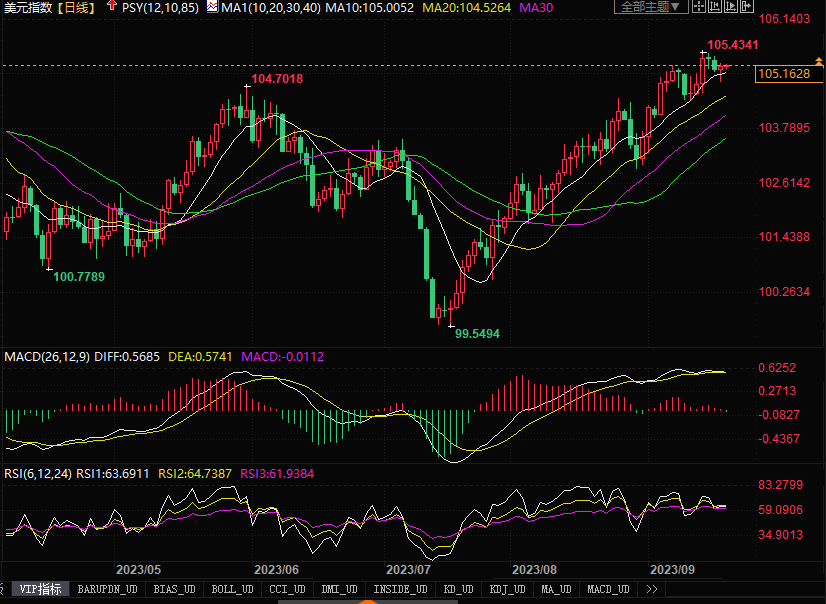
Dollar index daily chart
At 12:33 on September 20, Beijing time, the US dollar index reported 105.17.
Please indicate the source: https://www.daoctech.com/fxschool/797.html
Disclaimer: The content of this article does not represent the views of the Institute of Foreign Exchange. The content is for reference only and does not constitute investment advice. Investors operate accordingly at their own risk.