
FXTM in-depth analysis: After the Federal Reserve raises interest rates to 5.50%, a financial crisis is inevitable! Leverage and high interest rates are endless
Michael Lebowitz recently wrote that the Federal Reserve's "prolonged higher" interest rate actions could trigger a financial crisis.
Michael Lebowitz specializes in macroeconomic research, valuation, asset allocation, and risk management.
As you can see below, every time federal funds suddenly rise, there is a crisis, says Mr. Lebowitz. Look closely and you will see that most of this happens after a rate hike and is quickly addressed by the Fed by slashing the federal funds rate. After the federal funds rate of 5.50 per cent and a similar increase in yields on all bonds, financial crises are virtually inevitable, and there is "financial history" to learn from.
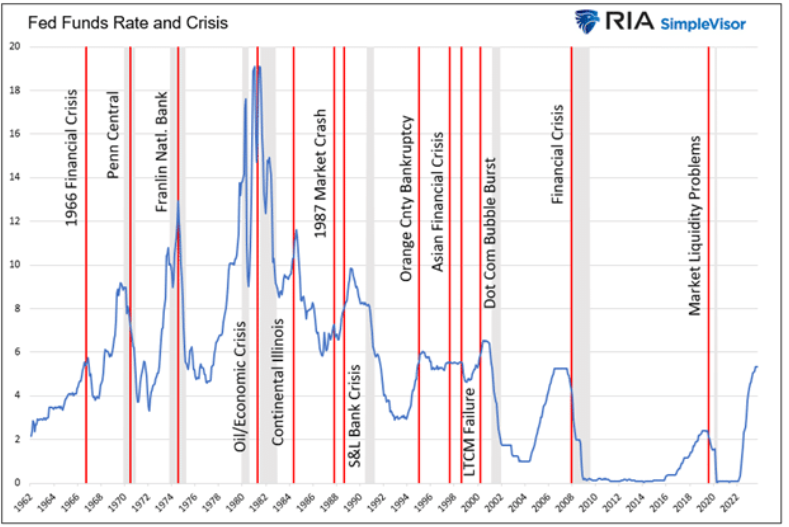
Leverage and high interest rates should not be confused
Warren Buffett used to say: "The high tide floats all boats, and it's only when the tide goes out that you find out who's swimming naked."
Strong economic growth and low interest rates mask financial imbalances, which are exposed only when growth slows and interest rates rise.
As the chart above shows, every rise in interest rates leads to a crisis. Crises sometimes involve a single bank, company, or even a county or country. There are also crises that are systemic, spreading through industries, economic sectors, or financial marekts.
What makes these phenomena so precise is leverage.
Assume the following:
ABC Hedge Fund bought $100 million of XYZ stock with a $90 million loan and paid the rest in cash. In financial terms, ABC is 10 times leveraged. If XYZ shares fall by 5%, ABC's trading equity will be cut in half. Therefore, they lost 50%.
To make matters more troublesome, the lender, bank or other Financial Institution Group will ask the ABC for additional collateral or cash to restore the leverage to 10x. If they are unable to generate funds, the Financial Institution Group will force a sale of shares to make the hedge fund aware of the loss. Do the math and if the loss is 20%, you will realize that it doesn't take much time and the Financial Institution Group is also at risk.
This example is simple, but it shows how leverage can significantly increase the likelihood of borrowers and potential lenders defaulting.
The tide is starting to ebb. When the lag effect catches up with the economy and falling asset prices, today's high interest rates will allow us to see who is swimming naked.
The regional banking crisis was averted
In March, we were reminded of how higher interest rates could trigger a crisis.
The spike in interest rates caught many banks off guard. As a result, banks were forced to sell assets as deposits fled banks in search of higher yields elsewhere. Most bank assets, whether loans or securities, traded below their purchase prices. As a result, banks sold some assets to keep leverage at a regulatory minimum. The result was significant losses that further exacerbated bank runs.
First Republic Bank, Silicon Valley Bank and Signature Bank are the second, third and fourth largest failed banks in US history, respectively. Combined, the assets of these three banks are almost twice that of Washington Mutual, the largest bank to fail.
With large banks in similar trouble, the Fed bailed out and stopped the contagion. To contain the crisis, it quickly instituted the Bank Term Funding Program (BTFP), which allows banks to use government bonds traded at a discount as collateral for loans based on the face value of the collateral.
Six months into the program, the BTFP balance continues to grow, albeit slowly. The program ended in March. So between now and then, they can extend the program and roll over existing loans or terminate it. The program is a form of quantitative easing, so the Federal Reserve may view the rollover of existing loans as triggering inflation. However, closing lenders would reignite the crisis.

Who is swimming naked?
The level of US debt, and its ratio to GDP, is significantly higher than it was four decades ago, when Paul Volcker, chairperson of the Federal Reserve, tamed inflation with double-digit interest rates. Total debt is twice as high as it was in 2008, when the crisis nearly bankrupted the entire banking system.

In short, we have a lot of naked swimmers in our financial system.
Consider that about one fifth of public companies are zombie businesses, as shown in the chart below, courtesy of Kailash Capital Research. As they describe, zombie companies have debt payments that exceed their profits. Not all zombies will die out as interest rates rise. Some are growing their revenues and profits fast enough to meet their debt expenditures. Others may have cash on hand to meet creditors' demands. However, most of one fifth of U.S. companies can only survive by issuing more debt. So could the impending crisis be a zombie apocalypse?

The chart below warns that such a crisis may be underway.

As has been typical in the past, banks, hedge funds, and other institutional investors all use leverage and are prime candidates for crisis.
The risks for zombie companies are rising interest rates and weak revenues. For institutional investors, they are exposed if interest rates remain high and asset prices fall. If credit markets freeze, the risks for companies and investors multiply.
Leverage and high interest rates can lead to a crisis. While such warnings may sound frightening, they can also be relatively mild, like the banking crisis in March.
As expected in the past, the Fed may be able to cut interest rates to zero and reintroduce quantitative easing fast enough to prevent bankruptcy. Unfortunately, for those who rely on the Fed, they do not always have the best pulse of the financial system or the economy. Despite the ominous signs, they raised their GDP forecast range for the rest of the year from 0.3-1% to 1.0-1%.
Please indicate the source: https://www.daoctech.com/fxschool/858.html
Disclaimer: The content of this article does not represent the views of the Institute of Foreign Exchange. The content is for reference only and does not constitute investment advice. Investors operate accordingly at their own risk.